
Livraison le jour même ou le lendemain

Qualité garantie

Débloquez vos offres de bienvenue: Livraison GRATUITE | Jusqu'à -80 % | 30 jours d'essai gratuits à JoyPlus
Téléchargez l'application
Choosing adjustable inline skates for children is about more than simply selecting a colour or size. For a beginner, foot support, adjustment precision and ease of braking matter far more than promises of speed. A poorly fitted pair can quickly become uncomfortable, lack stability or become too small within a few months.
Here are the criteria to consider before buying, along with a selection of models suited to different needs.
The word ‘adjustable’ alone does not guarantee a perfect fit. Check the extension system, the adjustment range and how securely the foot is held in place. A push-button combined with a safety buckle and a hook-and-loop strap will generally allow more precise shell adjustment.
The models featured here offer four extension positions, identified by the letters A, B, C and D on the mechanism. It is still essential to measure your child’s foot, then compare this measurement with the length specified by the manufacturer.
ABEC-5 bearings indicate a manufacturing precision class, but this rating alone is not enough to assess how smoothly the skates will roll. The condition of the wheels, the cleanliness of the bearings, the child’s weight and the type of surface also play a part.
For recreational use, ABEC-5 carbon-steel bearings are a sensible specification. After skating in damp conditions, dry them thoroughly and maintain them in line with the manufacturer’s recommendations.
Skates with a brake make it easier to learn how to slow down. Make sure the brake pad is included, does not constantly rub against the ground and can be replaced once worn. A helmet, wrist guards, elbow pads and knee pads are not just accessories: they complete the essential equipment, especially for those first outings.
Helmets and protective gear should be replaced after a significant impact, even if no damage is visible. For beginners, choose a smooth, dry and clear surface away from traffic, and make sure the child practises under adult supervision.
Growing-with-you skates can accommodate growth, provided the stated range genuinely matches your child’s foot. As a guide, the selected models cover the following sizes:
Measure both feet at the end of the day, wearing the socks your child will use for skating. Use the measurement of the longer foot as your guide. However, avoid choosing a pair that is far too large in the hope of using it for longer: excessive space reduces support and control.
An aluminium chassis generally provides a rigid base and firm support. A plastic model often feels lighter while remaining more affordable. The right choice depends on how often the skates will be used, your child’s build and the surfaces they will skate on.
Also check for a reinforced shell, a soft liner, an ankle support strap and a lockable buckle. These features do not replace a careful fitting, but they help distribute fastening pressure more evenly.
Models fitted with 82A PU wheels have a hardness rating of 82A, a common compromise for recreational outings on even surfaces. This rating does not mean that the wheels are suitable for every surface: gravel, cracks and wet ground accelerate wear and reduce grip.
Some models instead use PVC wheels with 608Z bearings. These can be suitable for occasional recreational use. In all cases, regularly check wheel wear, chassis tightness and the condition of the brake pad.
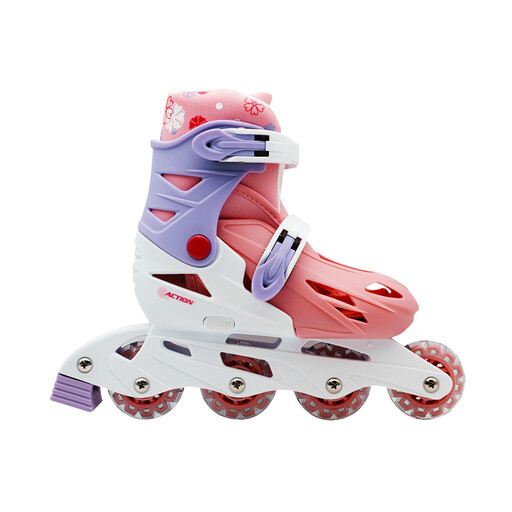
Why this choice suits this profile: With its 27-30 range and soft liner, this model is well suited to a first pair for discovering inline skating.
The four-position adjustment avoids moving too quickly to a fixed size that would soon be outgrown. The brake is included.
Plastic chassis, PVC wheels, 608Z bearings, safety buckle and hook-and-loop straps.
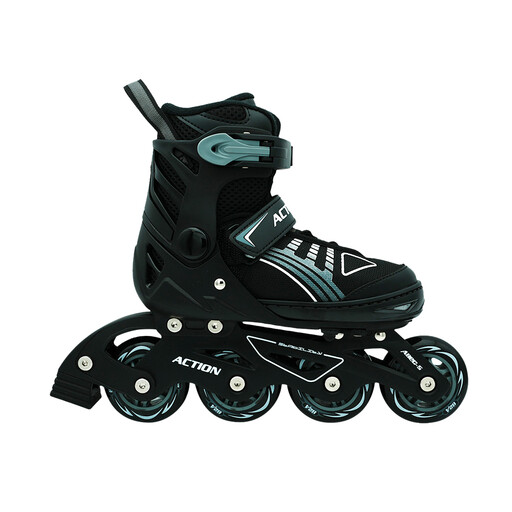
Why this choice suits this profile: Designed for children wearing sizes 31 to 34, it provides more structured support for regular outings on smooth tarmac.
The aluminium chassis and ankle straps reduce the risk of equipment that is too flexible or does not provide enough support.
8 PU 82A wheels, ABEC-5 carbon-steel bearings, safety buckle and wear-resistant brake.
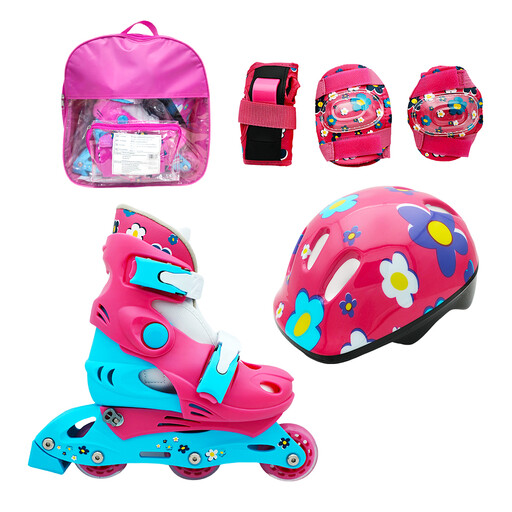
Why this choice suits this profile: This kit, including skates, a helmet and protective gear, is ideal for families who want to buy all the necessary equipment in one go.
The helmet, knee pads, elbow pads and wrist guards are included, so you cannot forget an essential item when buying a gift.
Adjustable skates from 26 to 29, brake included, safety buckle, hook-and-loop straps and carry bag.
We have put together a complete, real-time updated selection of products that meet these demanding criteria and European safety standards.
After every outing, wipe the wheels, bearings and chassis. If you skate in the rain or on a wet surface, dry everything immediately to help prevent oxidation. The liners and protective gear should also be aired before being stored away.
Regularly check the chassis fixings, the condition of the straps and brake wear. Service life depends on how often the skates are used, the child’s weight, the surfaces they skate on and how well the skates are maintained. The adjustment range accommodates foot growth, but it cannot extend the service life of the wheels and bearings indefinitely.
Start by loosening the buckle and, if the model has one, the hook-and-loop strap. Then press the adjustment button and slide the front of the skate to the desired position. Check that both skates are set to the same length before tightening the fastenings without compressing the foot.
No. The number of positions does not remove the need to check the actual foot length. Always compare the measurement in millimetres with the range stated for the model. Your child should be able to move their toes slightly without their heel lifting inside the liner.
At a minimum, provide a helmet, wrist guards, knee pads and elbow pads, along with skates fitted with a brake. Suitable protective gear does not replace adult supervision or the need to choose a clear space away from vehicles.