
Livraison le jour même ou le lendemain

Qualité garantie

Débloquez vos offres de bienvenue: Livraison GRATUITE | Jusqu'à -80 % | 30 jours d'essai gratuits à JoyPlus
Téléchargez l'application
A new baby changes everything, starting with your home's layout. Among the essentials, the changing table plays a key role. Yet, choosing the right model can quickly become a headache. The wrong choice can lead to chronic back pain for parents and a piece of furniture that's as bulky as it is useless.
My role, as a product expert at Joybuy, is to help you navigate the options. Let's forget the marketing jargon and focus on the practical features that will make a real difference in your daily life. Together, let's break down the key points for choosing a changing table that will genuinely simplify your life.
Many parents regret their purchase after just a few weeks. The reason? Design flaws that go unnoticed in the store but become a daily ordeal.
You don't need to get bogged down in details to make the right choice. Focus on these few key points that guarantee comfort, safety, and practicality.
An ergonomic changing table is, above all, a table that adapts to you, not the other way around. Adjustable height is THE solution to end back pain.
A good baby changing station is a true command centre where everything should be centralised.
Your child's safety is non-negotiable. Ensure the table has raised edges (on at least three sides) to prevent any risk of falls. The frame must be stable, with sturdy materials (like steel tubes) and a reliable locking system. For maintenance, choose a mattress with a waterproof surface and a fabric (like Oxford cloth) that is easy to wipe clean or is machine-washable.
Rather than an endless list, we've chosen to highlight one product that perfectly meets the challenges of today's parents.
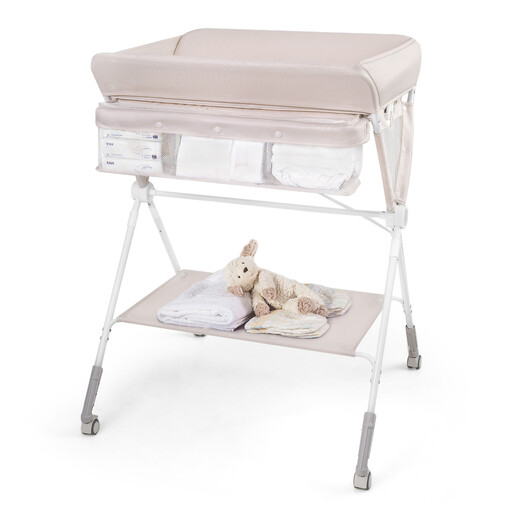
Why it checks all the boxes: It's mobile, adjusts to each parent's height, and includes ample storage to keep everything within reach. Its folding feature makes it the perfect ally for apartments and small spaces.
Its 3 adjustable heights (83, 86, and 89 cm) protect your back. Its wheels with brakes and integrated storage solve the static unit problem. Finally, its folding design frees up precious space when you're done.
Stable metal frame with reinforcements, waterproof and washable Oxford fabric, and impressive versatility (can be used as a drying rack or storage shelf).
We've compiled a complete, up-to-date list of products that meet these strict selection criteria and safety standards.
The perfect height is one that allows you to keep your back straight, with your arms bent at about a 90° angle. Generally, the tabletop should be at your hip level. That's the whole point of an adjustable changing table: it adapts to each parent's height for optimal comfort.
Absolutely, as long as you choose a quality model. Check for a sturdy frame (steel tubes are a sign of durability) and reliable locking mechanisms (for both the folding function and the wheel brakes). Once unfolded and locked, a good folding table is just as stable as a fixed unit.
Generally, a changing table is used from birth up to about 12 months, or until your baby reaches the maximum weight specified by the manufacturer (often around 11?kg or 24 lbs). It is crucial to respect this weight limit for safety reasons. The advantage of convertible models? They easily convert into a utility shelf or drying rack, extending their lifespan well beyond your baby's first few months.