
Livraison le jour même ou le lendemain

Qualité garantie

Débloquez vos offres de bienvenue: Livraison GRATUITE | Jusqu'à -80 % | 30 jours d'essai gratuits à JoyPlus
Téléchargez l'application
Moving a wardrobe, sofa or heavy table can quickly leave marks on parquet, laminate flooring or tiles. Adhesive furniture sliders solve this problem without drilling, but not every model is suitable for every piece of furniture.
Before buying your furniture sliders, check three points: the total load, the size of the foot and the type of flooring. A poor combination can cause the slider to come loose, create uneven movement or provide insufficient protection.
A large-diameter slider is not necessarily suitable for a heavy piece of furniture. The stated capacity generally applies to a set of four sliders, not to each individual slider. You must therefore consider the furniture’s weight, how the load is distributed and the actual number of support points.
For example, a model rated for 150 kg with four sliders should not be installed under a safe or piano weighing more than this limit without first checking its suitability.
An adhesive slider must be applied to a clean, dry and sufficiently flat surface. If the foot is too small, uneven or dusty, the adhesive may not hold properly. Measure its diameter—or its length and width—before choosing your adhesive furniture foot sliders.
Manufacturers may advertise compatibility with different floor coverings, but the result also depends on the condition of the floor, the presence of joints, dust and how the furniture is moved. Scratch-resistant sliders reduce direct contact between the furniture and the floor; they do not eliminate the need to move slowly and carefully.
On an uneven floor, articulated all-terrain sliders are better suited than simple fixed pads.
Start by estimating the furniture’s weight, then compare it with the load stated on the product page. For particularly heavy furniture, plan for four support points—or more if the design allows it. Never exceed the load specified by the manufacturer.
The models in this selection list capacities of 100 kg, 150 kg, 300 kg, 400 kg, 500 kg or 600 kg per set of four, depending on the reference. These figures should be treated with caution: they are not a recommendation for lifting or moving furniture quickly.
Available formats range from small square dimensions, such as 24 × 24 mm, to large diameters of 80 mm. A slider that is too small will not adequately cover the foot; a model that is too large may extend beyond it and catch on an obstacle.
For standard furniture, measure the base of the foot with a ruler. For heavier loads, also check that the foot can support a permanent attachment without deforming.
Honeycomb sliders feature a structured surface designed to reduce friction. According to the specifications for the relevant Scotch models, this structure provides up to 50% more glide compared with an unequipped piece of furniture. This is a manufacturer-stated feature, not a guarantee of identical results in every home.
On parquet, laminate flooring or tiles, remove grit and dust before moving the furniture. For piano or billiard-table casters, sliders designed for wheeled feet may be more suitable than a conventional adhesive model.
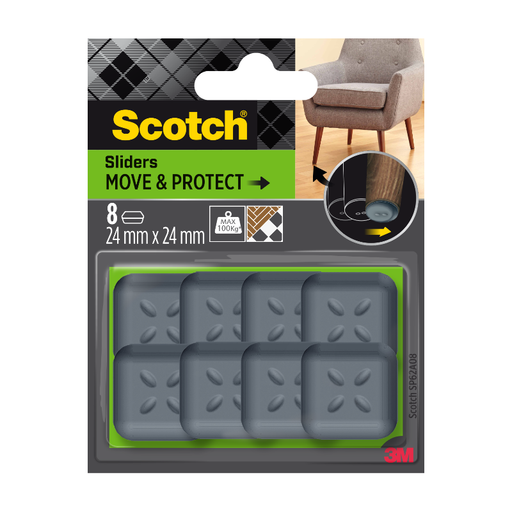
Why it suits this profile: A compact format, well suited to small pieces of furniture, chairs and narrow feet—particularly in an apartment or rental property.
Its dimensions reduce the risk of choosing a pad that is disproportionate to the foot. The stated capacity reaches 100 kg for four sliders.
A pack of eight pieces, a honeycomb structure and an adhesive attachment designed for permanent use, according to the product specifications.
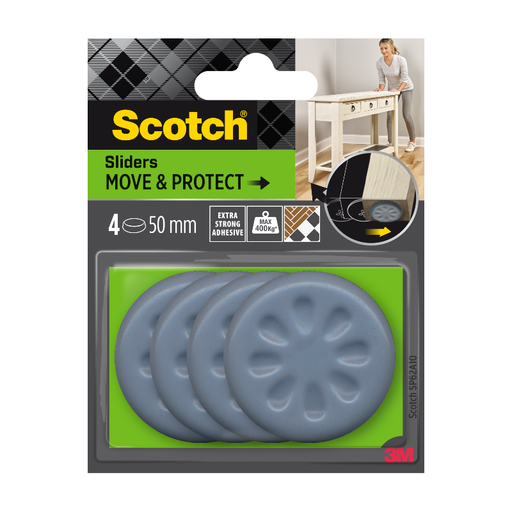
Why it suits this profile: An intermediate diameter for larger pieces of furniture, where foot coverage and stability are the priorities.
The 50 mm format avoids pairing a small pad with a wide foot. The stated capacity reaches 400 kg with four sliders.
A honeycomb surface, four pieces and stated suitability for various types of flooring.
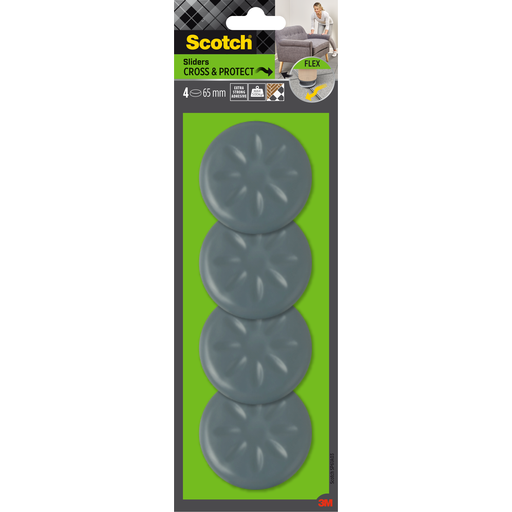
Why it suits this profile: For a heavy wardrobe, piano or professional equipment being moved across a floor with minor irregularities.
The articulated design and compensating foam are engineered to accommodate minor irregularities, unlike a fixed pad.
A set of four sliders rated for up to 500 kg, with a honeycomb structure and adhesive attachment.
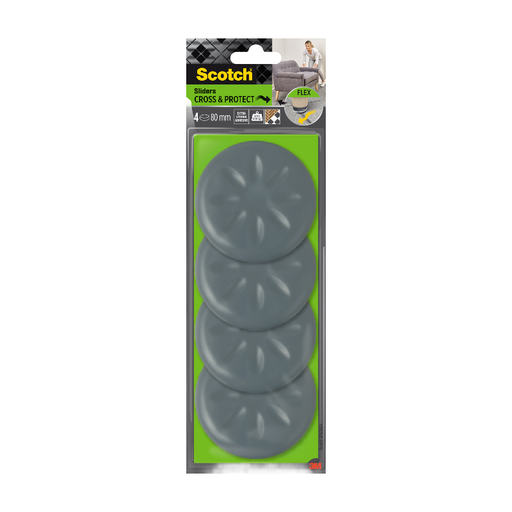
Why it suits this profile: A solution designed for substantial loads, such as a grand piano, safe or industrial equipment.
Its 80 mm diameter and articulated mechanism overcome the limitations of small sliders on bulky furniture.
The stated capacity reaches 600 kg per set of four, with compensating foam and a honeycomb structure.
Do not apply the sliders to a damp, greasy or crumbly surface. For heavy loads, check regularly that each slider remains securely in place. Keep small parts out of the reach of children and pets.
Explore an updated selection of products that meet these criteria for protecting and moving heavy furniture in France.
Yes. The specifications for several Scotch models indicate use on different types of flooring, including wood, laminate and tile. However, clean the floor before moving the furniture and check that no abrasive grit is trapped beneath the slider. On an older or delicate floor, testing in an inconspicuous area may be advisable.
Generally, wait 24 hours before moving the furniture when this instruction appears on the product page. The surface must be completely dry and clean when the slider is applied. Moving heavy furniture immediately may shift the slider or compromise its adhesion.
Compare the total weight, the surface area of the feet and the evenness of the floor. The 65 mm and 80 mm All-Terrain models list stated capacities of 500 kg and 600 kg per set of four sliders, respectively. For an exceptional load or professional moving operation, also check the handling requirements and never exceed the limits specified by the manufacturer.