
Livraison le jour même ou le lendemain

Qualité garantie

Débloquez vos offres de bienvenue: Livraison GRATUITE | Jusqu'à -80 % | 30 jours d'essai gratuits à JoyPlus
Téléchargez l'application
Renovating a kitchen, bathroom or interior wall without mortar or major building work is possible with adhesive wall tiles. These coverings can usually be cut with a craft knife and applied directly to a prepared surface. They’re particularly suited to DIY beginners, renters and anyone who enjoys decorating their walls.
A quick installation doesn’t necessarily guarantee a long-lasting result, though. Here are the main pitfalls to avoid before buying peel-and-stick kitchen tiles, an adhesive splashback or self-adhesive wall tiles.
Self-adhesive PVC tiles or vinyl coverings can mimic the look of ceramic wall tiles, stone or mosaic. However, they don’t necessarily offer the same features as traditional ceramic tiles. The texture, thickness and finish all affect how realistic the relief looks and how well the surface resists scratches.
So check the material listed, the thickness of the decorative layer and the care instructions. A textured finish can make the tiles look more realistic, while a smooth surface is easier to clean.
Adhesive works properly on a clean, dry, smooth, grease-free and dust-free surface. A rough, porous or damp wall, or one with peeling paint, can affect how well the tiles stick. This can lead to lifting edges, bubbles or tiles coming away from the wall.
Before fitting, remove any grease, fill holes and sand down uneven areas. In a bathroom, make sure the surface is completely dry before applying adhesive tiles.
One 30 × 30 cm tile covers around 0.09 m². Ten tiles therefore cover nearly 0.9 m², before cutting. Allow an extra 10 to 15 % for corners, electrical sockets, pattern matching and any cutting mistakes.
Also check how many tiles are in each pack. A small pack may be enough for a splashback, but nowhere near enough to cover an entire wall.
A self-adhesive backing means you don’t need to buy glue or mortar, but you still need to prepare the surface properly. Check whether the manufacturer recommends using the product only on smooth, untextured walls. If you’re renting, test it on a small, inconspicuous area first. Depending on the paint, removing the tiles could pull off the finish or leave residue.
In a kitchen, check the product’s heat-resistance information. Don’t place an adhesive covering directly next to a flame or intense heat source. A splashback fitted behind a hob must comply with safety clearances and the appliance manufacturer’s recommendations.
In a bathroom, good moisture resistance doesn’t mean the edges or joints can be left submerged. Avoid areas directly exposed to a continuous stream of water, unless the manufacturer clearly states that the product is suitable for this use.
For straightforward cuts, a craft knife with a new blade, a metal ruler and a pencil are usually all you need. Measure twice before cutting, especially around sockets and pipes. For a convincing finish, line up the patterns and plan how they’ll meet before removing the backing film.
For cleaning, use a soft sponge and a non-abrasive product. Scouring pads, harsh solvents and repeated scrubbing can damage the decorative layer.
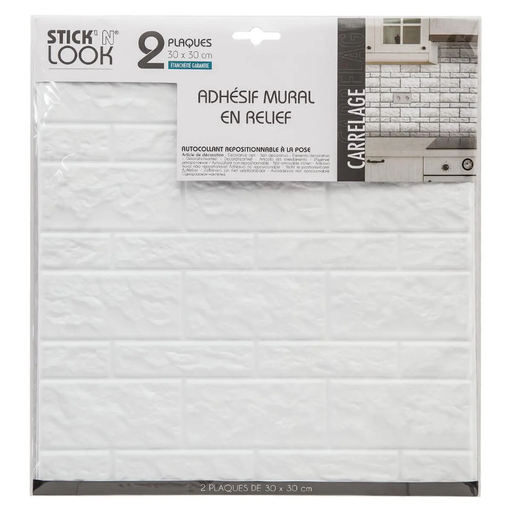
Why it suits this type of project : This pack of two 30 × 30 cm tiles is ideal for a small splashback, a return wall or a modest decorating project. They’re easy to handle, making them a reassuring choice for a first installation.
The small pack size helps you avoid buying too much for a limited area. Still, allow some extra if you’ll need to make cuts.
PVC backing, 30 × 30 cm size, stated weight of 0.21 kg and a white, stone-effect surface.
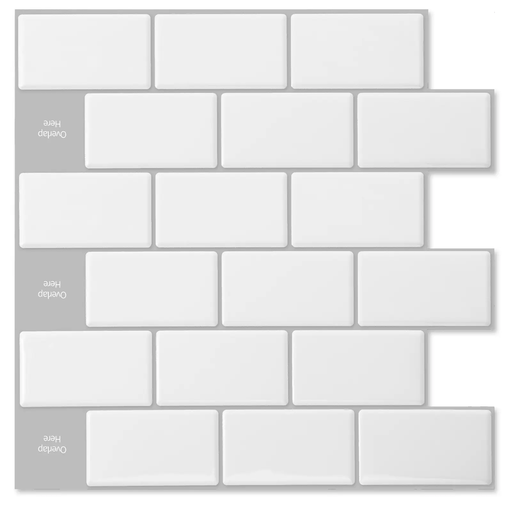
Why it suits this type of project : The 3D relief and white finish with grey grout lines make this a good choice if you’re looking for a more polished finish in a kitchen or on a feature wall.
Its stated thickness and texture set it apart from a simple flat film. The surface needs to be perfectly smooth to show off the relief properly.
Pack of 10 30 × 30 cm tiles, covering around 0.9 m², which the product listing says can be cut with a craft knife.
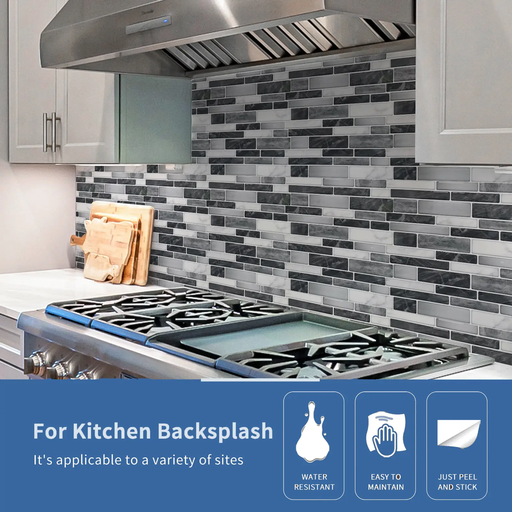
Why it suits this type of project : These self-adhesive PVC tiles are suited to kitchen, bathroom or feature-wall projects where you need to cover a larger area.
The product listing mentions a non-porous surface and a gel top layer. These features should make the tiles easier to care for, provided they’re fitted to a suitable surface.
10 tiles measuring 30 × 30 cm, a textured finish, a surface stated to be moisture-resistant, and no need for mortar or extra glue.
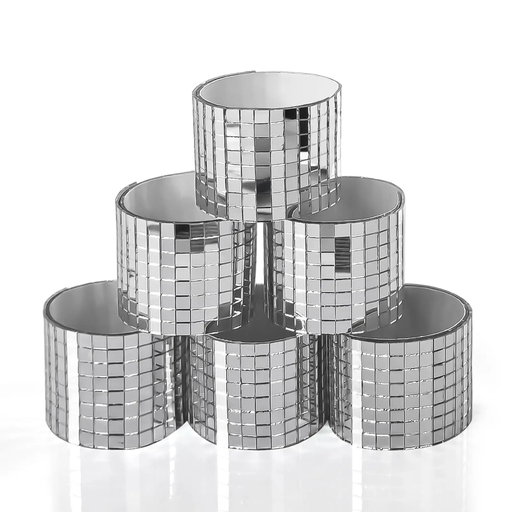
Why it suits this type of project : These small mirror tiles are ideal for frames, collages, decorative balls, feature walls and other creative projects that call for flexible sizing.
These aren’t traditional splashback tiles. Their small squares are better suited to decorative surfaces and creative designs than to areas exposed to splashes every day.
Mirror glass mosaic with smoothed edges, self-adhesive backing, six rolls and a stated 2 364 pieces.
We’ve put together a complete list, updated in real time, of products that meet these exacting selection criteria and European safety requirements.
They can work on a smooth, dry wall that isn’t often exposed to splashes. Prepare the surface carefully and check the manufacturer’s guidance on moisture. For a shower or an area that’s constantly wet, choose a covering specifically designed for that environment.
Their lifespan depends on the material, the quality of the adhesive, how well the wall was prepared, the temperature and the level of humidity. There’s no one lifespan that applies to every model. Gentle cleaning and fitting the tiles to a perfectly clean surface can help keep them looking good.
It depends on the paint, the surface and the adhesive used. Warm the tiles slightly with a hairdryer, then peel them away gradually without pulling too hard. If you’re renting, ask your landlord’s permission and always test the product on an inconspicuous area first.