
Livraison le jour même ou le lendemain

Qualité garantie

Débloquez vos offres de bienvenue: Livraison GRATUITE | Jusqu'à -80 % | 30 jours d'essai gratuits à JoyPlus
Téléchargez l'application
Whether you're a renter dreading the final inspection, a homeowner keen on preserving your walls, or simply a fan of easy decorating, adhesive wall mounting is an excellent solution. However, the market is flooded with products making tempting promises, and it's easy to fall into traps that all too often result in broken frames and damaged walls. To help you avoid these disappointments, let's review the mistakes you should never make.
Marketing promises can be seductive, but they often hide weaknesses that only reveal themselves once the product is in use. Here are the three most common pitfalls:
To confidently navigate the adhesive jungle, it's crucial to focus on a few objective technical characteristics. Ignoring these points means risking a useless purchase.
This is the non-negotiable criterion. First and foremost, weigh the object you want to hang. Then, choose an adhesive solution whose stated maximum load capacity is at least 20-30% higher than your object's weight. This safety margin is essential to compensate for surface imperfections and temperature variations. For a no-hole picture hanger, check if the advertised weight applies to a single strip or the entire pack.
An adhesive does not bond the same way to all surfaces. Manufacturers always specify compatible surfaces. The most common are:
On the other hand, most powerful adhesives should be avoided on wallpaper, textured surfaces, brick, or freshly painted walls (wait at least a week). An ill-suited adhesive strip won't last long.
The conditions of use determine the adhesive's composition.
Rather than creating a generic list, we've matched specific products to well-defined user profiles to help you find THE perfect solution for your needs.
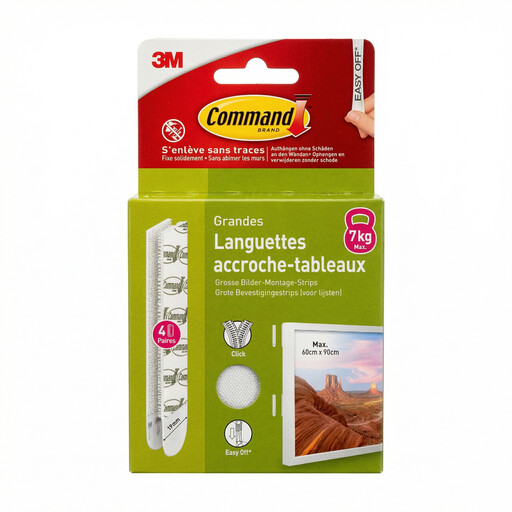
Why it's the right choice: Ideal for those who love to change their decor regularly or for renters. These strips allow you to hang frames and objects up to 7.2 kg without any tools, and most importantly, without leaving a single trace upon removal.
This product directly tackles the "trace-free" myth. Its patented 3M technology was specifically designed for clean removal by stretching the strip, thereby preserving the paint and the wall.
Clear load capacity: 7.2 kg. Damage-free removal: Designed to leave no holes, marks, or sticky residue.
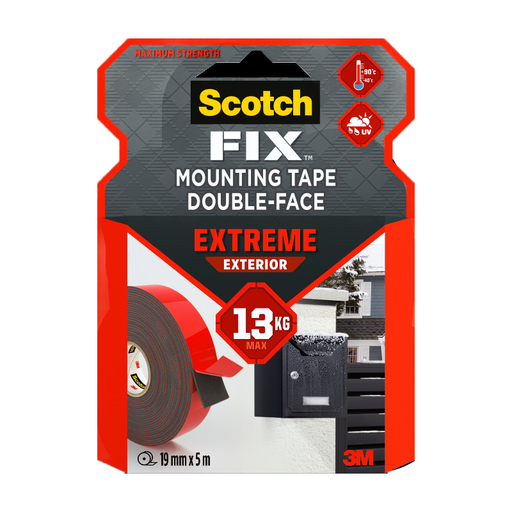
Why it's the right choice: For outdoor DIY projects that demand a permanent and robust bond. Ideal for mounting signs, lightweight mailboxes, or decorations on surfaces like metal, PVC, or treated wood.
This tape avoids the "one-size-fits-all" trap by being explicitly designed for the outdoors. It's formulated to resist weather and UV rays, where an indoor adhesive would stand no chance.
High strength: Holds up to 13 kg. Outdoor durability: Permanent adhesive resistant to weather, rain, sun, and UV rays.
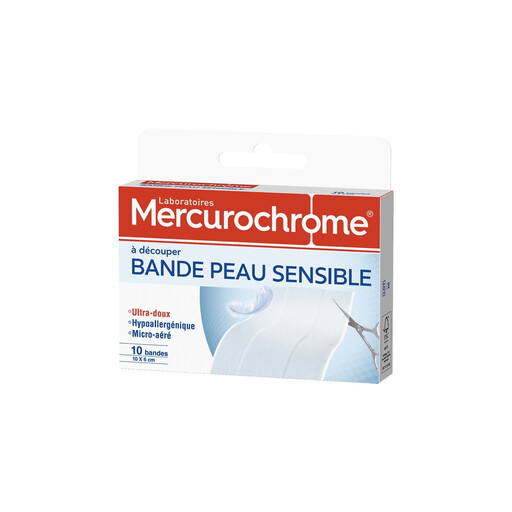
Why it's the right choice: An essential for the family first-aid kit. This bandage is designed to protect small wounds while being gentle on the most delicate skin, especially children's.
This product is the antithesis of the "one-size-fits-all" trap. It is a specialised medical adhesive. Its hypoallergenic and micro-aerated formula is designed for skin, an application where a DIY tape would be not only unsuitable but also potentially irritating.
Suitable for sensitive skin: Ultra-soft, hypoallergenic non-woven fabric. Practical: The cut-to-size format allows you to adjust the bandage to the size of the wound.
We have curated a complete range of products that meet our selection criteria and current standards.
For removable strips, follow the manufacturer's instructions to the letter: this usually involves pulling the tab downwards, slowly and parallel to the wall. For permanent adhesives or stubborn residue, gently heating the area with a hairdryer can help soften the glue. Then, use a plastic scraper (never a metal one) to carefully remove the residue.
No, that's a very bad idea. Most strong adhesives will tear the top layer of the wallpaper upon removal. There are products specifically designed for delicate surfaces, but it's crucial to read the manufacturer's recommendations and, if possible, test it on an inconspicuous area first.
Durability depends on the product's quality and its exposure to the elements. A high-quality extra-strong outdoor adhesive is designed to last for several years. However, its lifespan can be reduced by extreme sun exposure, frequent freeze/thaw cycles, or constant humidity. An annual visual inspection is recommended.