
Livraison le jour même ou le lendemain

Qualité garantie

Débloquez vos offres de bienvenue: Livraison GRATUITE | Jusqu'à -80 % | 30 jours d'essai gratuits à JoyPlus
Téléchargez l'application
An adhesive wall hook without drilling can make a real difference when organising an entryway, bathroom or student accommodation. No drill, wall plugs or unsightly holes required. However, not every model is suitable for every wall or load.
To help you avoid unpleasant surprises, the Joybuy Product Recommendation Officer focused on the criteria that matter most: surface compatibility, maximum load, moisture resistance and removal method. Here’s how to distinguish a genuinely suitable no-hole wall hook from an accessory that is merely marketed as “heavy-duty”.
A stated capacity of 1.3 kg does not mean you can hang a heavy bag filled with books from it. The object’s weight, repeated movement and the way it is hung all directly affect how securely it holds.
An adhesive hook designed for keys or a tea towel is not intended for the same use as a wall hook for a bathrobe, coat or bag. It is best to leave a margin below the maximum load and distribute items across several hooks.
Adhesive strips generally hold on smooth, clean and dry surfaces such as tile, glass, mirrors, metal or firmly bonded paint. Adhesion may be significantly weaker on wallpaper, textured walls, brick, porous plaster or freshly painted surfaces.
The claim “no nails or screws” does not eliminate the need to check the substrate. This precaution is particularly useful in rented accommodation, where it can help minimise the risk of detachment or marks.
A removable wall hook must be taken down using a specific method. Depending on the model, you may need to pull the tab slowly and parallel to the wall, rather than pulling the hook towards you. Incorrect handling, a delicate surface or excessive weight can still cause damage.
The manufacturer’s instructions should take precedence over general packaging claims. If you expect to move the hook, remember to keep compatible replacement strips on hand.
For small accessories, a capacity of 450 g to 1.3 kg may be more than sufficient. For towels, a bathrobe or a small bag, look for a higher load rating while accounting for movement and humidity.
Double hooks allow you to separate two items, but they do not automatically double the permitted load. Check the capacity specified for the complete model, not just for a single adhesive strip.
A hook designed for a painted wall is not necessarily suitable for wallpaper or unfinished concrete. The product listing should clearly specify compatible surfaces, such as smooth paint, varnished wood, tile, glass or mirrors.
Before installation, degrease the area according to the manufacturer’s recommendations, then dry it completely. Also avoid grout lines, corners and surfaces directly exposed to a heat source.
For a bathroom hook, choose a moisture-resistant tab and a material that will not rust easily, such as a suitable plastic or a metal finish designed for this environment. Even a model marketed as water-resistant should not be installed on a wet or dusty surface.
Also observe the waiting period before hanging anything from it. Some models require pressure to be applied for around 30 seconds, followed by a one-hour wait before first use.
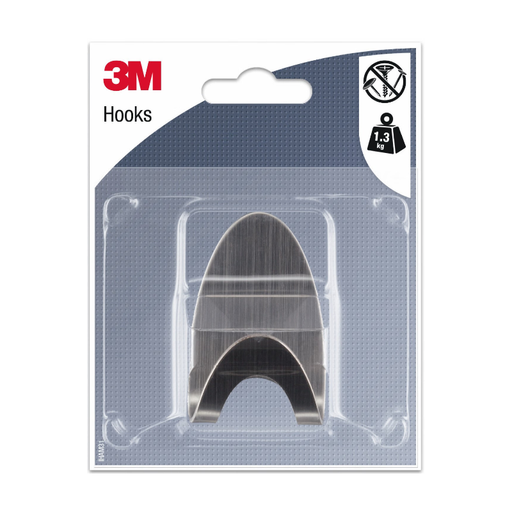
Why this model fits the brief: its compact design fits easily in an entryway, office or small kitchen for keys and lightweight accessories. Its stated capacity is up to 1.3 kg.
The product details specify compatible surfaces and advise against wallpaper, porous substrates and heat sources. It is therefore not the right choice for an uneven wall.
A silver metal hook, tool-free installation and stated compatibility with painted walls and tile.
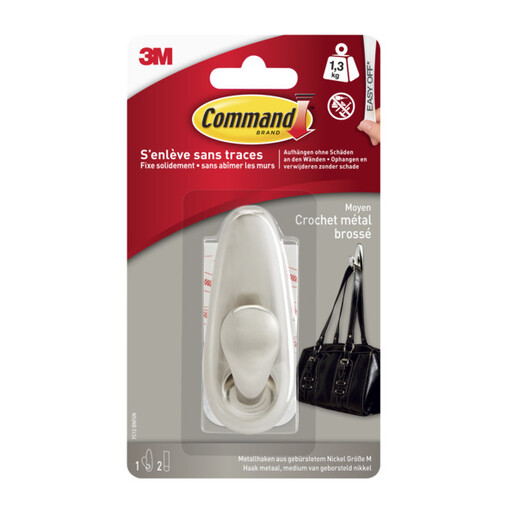
Why this model fits the brief: its brushed nickel finish works effortlessly in an entryway, bedroom or bathroom when aesthetics matter just as much as organisation.
The stated maximum load is 1.3 kg, and the instructions specifically exclude wallpaper and textured surfaces. The choice therefore depends on having a suitable substrate.
Tool-free installation, tab-based removal and the option to use compatible replacement adhesive strips.
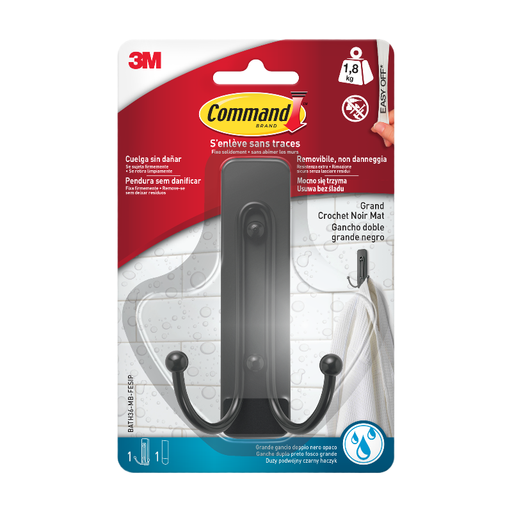
Why this model fits the brief: it is designed for humid environments and provides two hanging points for towels, bathrobes or shower accessories.
Its product details state that it is water-resistant and supports up to 1.8 kg. The surface must nevertheless be smooth, clean and sufficiently dry when installed.
ABS construction, a matte black finish and stated compatibility with glass, mirrors, tile and certain painted surfaces.
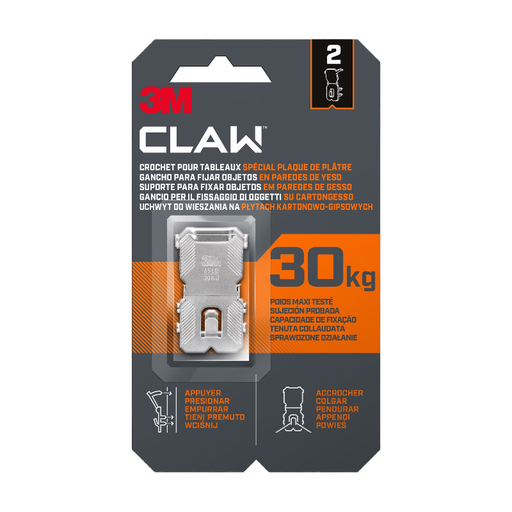
Why this model fits the brief: it is designed for hanging frames, mirrors and heavy decorations on drywall, with a stated capacity of up to 30 kg.
This is not an adhesive hook: its steel claws penetrate the drywall. Installation requires no tools, but it does leave small perforations. Bear this in mind before buying.
Thumb-pressure installation, with no wall plug or reinforcement required, and a stated capacity of 30 kg on drywall.
When installing a fragile or valuable item without tools, always check the load rating, substrate type and manufacturer’s recommendations. No adhesive system can replace a fixing designed for the wall structure when the load is substantial.
It depends on the suspended weight, temperature, humidity, surface quality and frequency of use. A strip applied to clean bathroom tile can perform very differently from one installed on porous paint. Inspect the hook regularly and replace the strip as soon as it begins to lift or deform.
This is generally not recommended unless the product details clearly confirm that it is suitable. During removal, the adhesive may tear the decorative layer or bond unevenly. On a delicate wall, choose a solution designed for that type of surface or seek advice before installation.
Yes, provided you choose a model whose capacity and moisture resistance match the intended use. In a bathroom, a double hook rated at 1.8 kg may be suitable for everyday textile items. Do not exceed the stated load, and do not install it on a wet surface.