
Livraison le jour même ou le lendemain

Qualité garantie

Débloquez vos offres de bienvenue: Livraison GRATUITE | Jusqu'à -80 % | 30 jours d'essai gratuits à JoyPlus
Téléchargez l'application
So, your new floor is installed. The result is flawless—or almost. But one detail is off?: that unsightly transition between two rooms, or the small gap under the front door. The adhesive threshold strip seems like the perfect solution?: quick to install, cost-effective, and no need to get out the drill.
But be careful—the wrong choice can quickly turn this easy fix into a real headache. As a product expert at Joybuy, I see countless models come and go. Let me guide you through the most common pitfalls so you can find the threshold strip that will truly elevate your interior.
This seemingly simple product can hold some unpleasant surprises. Here are the key points to watch out for?:
To avoid these pitfalls, here are the technical specifications you absolutely must check.
The material is the crucial element?: it determines both durability and ease of installation. A flexible PVC threshold strip has a clear advantage here. Unlike rigid metal or hard plastic profiles, it conforms to the slight imperfections of the floor. This maximises surface contact, ensuring a much stronger bond. Plus, it's easily cut with scissors or a utility knife, making a no-drill door threshold adjustment an absolute breeze.
Even the world's best adhesive won't hold on a dusty, greasy, or damp surface. Don't forget?: a successful installation is 50% product and 50% surface preparation. Before applying your floor transition strip, the surface must be impeccably clean, dry, and degreased. A quick wipe with rubbing alcohol can make all the difference.
While length might seem obvious, width is just as crucial. Measure the gap to ensure the floor joint cover is wide enough to completely hide the transition, especially for a parquet-to-tile transition where the gap is often uneven. A width of 4 to 5 cm is a safe bet that works for most situations.
Instead of an endless list, here are concrete solutions for specific needs. Find the product that's right for you.
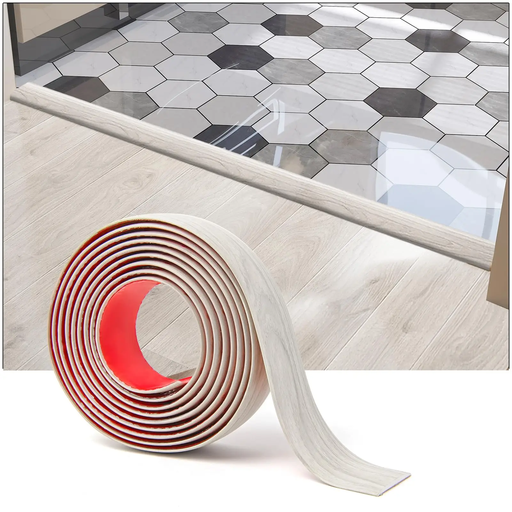
Why we chose it : Perfect for tackling several doors at once. The 3-metre roll format allows for multiple cuts, helping you optimise every centimetre and minimise waste. It's the ultimate practical solution for a quick renovation.
Its powerful adhesive, provided it's applied to a well-prepared surface, ensures excellent long-term hold. Say goodbye to the risk of premature peeling !
One roll for the whole house (or almost). Cuts with a simple pair of scissors for a millimetre-perfect fit.
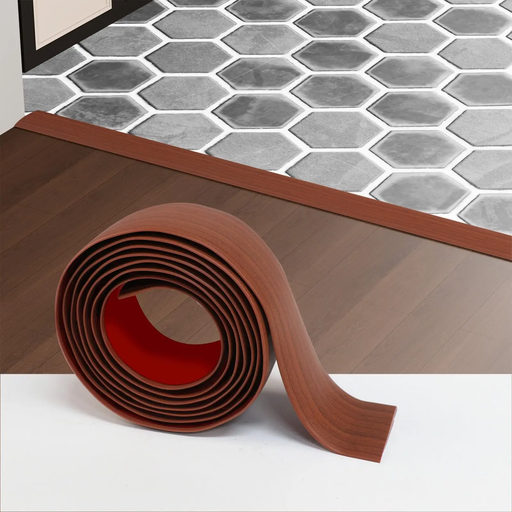
Why we chose it : For those who won't compromise on visual harmony. Its cherry wood grain finish is designed to blend seamlessly with warm-toned parquet or laminate floors, creating a laminate floor finish that is as discreet as it is elegant.
Its realistic texture and pattern avoid the trap of a cheap, "plasticky" finish. The illusion is perfect, and the result looks high-quality.
A stunningly realistic wood-effect finish for a nearly invisible transition.
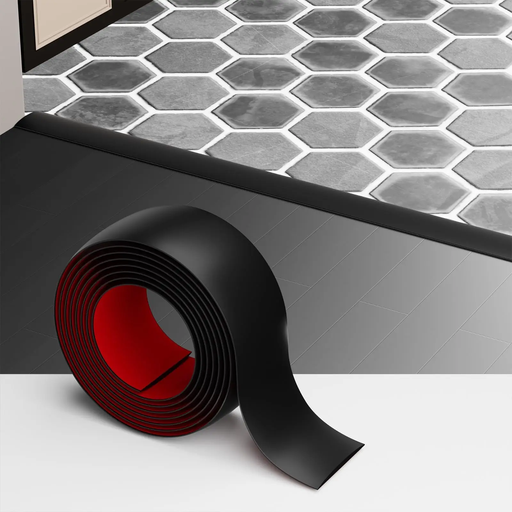
Why we chose it : A must-have for contemporary interiors that use black to structure the space. This adhesive door threshold creates a graphic, designer contrast, perfect for transitioning between an anthracite tile and a whitewashed parquet floor, for example.
Its flexible PVC design allows it to conform to the micro-imperfections of the floor. It lies perfectly flat, with no risk of lifting or cracking like a rigid profile.
Its flexibility ensures a perfectly flat and secure transition, even on a floor that isn't perfectly level.
Explore our full range of adhesive profiles, all selected for their quality and ease of installation.
To wrap up, let's answer the most frequently asked questions.
This is strongly discouraged. The adhesive needs a smooth, hard, non-porous surface (like tile, vinyl, parquet, or laminate) for an optimal bond. Carpet fibres prevent any reliable, long-lasting adhesion. For a transition involving carpet, a screw-down profile or a gripper-style strip is the only truly durable solution.
Its longevity depends on a trio of factors?: the quality of the adhesive, the care taken in preparing the surface, and the amount of foot traffic. A good product, installed correctly on a clean floor in a moderate-traffic area, will easily last for several years. In a busy entryway, an annual check is recommended.
To remove a flexible PVC strip, the trick is to gently heat it with a hairdryer. The heat will soften the adhesive, allowing you to peel it off smoothly. Pull gently and keep the strip as flat as possible. If any adhesive residue remains, it can be easily removed with an adhesive remover or rubbing alcohol (be sure to test it on an inconspicuous area first!).