
Livraison le jour même ou le lendemain

Qualité garantie

Débloquez vos offres de bienvenue: Livraison GRATUITE | Jusqu'à -80 % | 30 jours d'essai gratuits à JoyPlus
Téléchargez l'application
A junction between laminate flooring and tile, a gap between two rooms or an uneven finish around carpet can quickly become noticeable. An adhesive floor threshold strip provides a neat way to conceal these joins without drilling or adding glue.
However, choosing the right model is essential. An unsuitable width, a dusty surface or an adhesive that does not cope well with moisture can lead to premature lifting. Here are the key points to check before buying, along with a selection of Art3d strips available from Joybuy.
A 1 m or 1.22 m strip may appear sufficient, but the decisive measurement is the width of the area to be covered. A 4 cm width suits many junctions between flooring materials, but it may be too narrow for an uneven gap or a significant change in floor height.
Measure the area to be covered at several points. Allow a small margin for trimming, without choosing a strip that is far wider than necessary: its edges could overlap both adjoining floors.
An adhesive threshold strip will only bond properly to a clean, dry, degreased and sufficiently smooth surface. Dust, wax residue, crumbling grout and pronounced irregularities can significantly reduce adhesion.
The phrase “easy installation” generally means that no screws or additional glue are required. It does not eliminate the need to clean the substrate thoroughly or press firmly along the entire length.
PVC is easy to clean and withstands everyday use. The adhesive, however, does not cope well with standing water or moisture seeping beneath the strip. In a bathroom, install it only on a completely dry floor. It should not be used to conceal a leak, damaged grout or an area that remains wet.
For a more comprehensive project in this room, also explore our selection of adhesive bathroom flooring.
An adhesive PVC transition strip is typically lightweight, flexible and easy to cut. This flexibility allows it to follow a slightly uneven junction more effectively, while its surface can be wiped clean with a damp cloth.
The Art3d models featured here are described as PVC, with a wood-effect finish and resistance to scratches, stains and abrasion, according to the information provided on their product pages. These details describe the manufacturer’s stated material characteristics, but do not guarantee identical performance in every environment.
The selected products mainly offer:
This format is particularly suitable for a junction between wood flooring and tile, a transition between laminate flooring and carpet or a floor joint cover between two rooms. Where there is a significant difference in height, however, check that the strip covers the step properly without creating a raised edge.
Before you begin:
If the strip is slightly curved after transport, the product page recommends briefly warming it with a hairdryer to restore its flatness. Use moderate heat and keep the appliance moving.
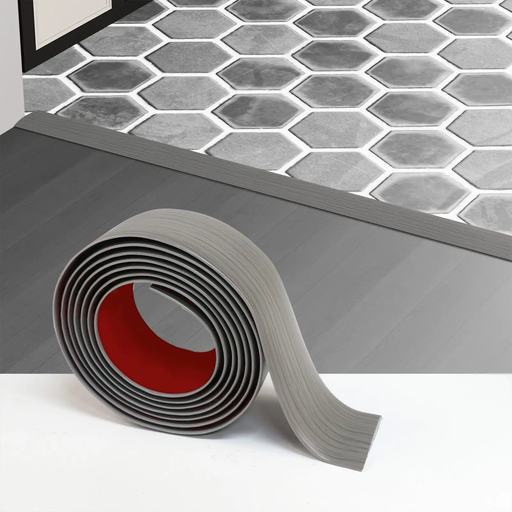
Why this profile is a good match: its one-metre format is ideal for a small junction between two floors in a bedroom, hallway or living room.
The stated length and width are clearly specified, making it easy to check the dimensions before ordering.
Flexible PVC, peel-and-stick installation, scissor cutting and damp-cloth cleaning according to the product page.
Why this profile is a good match: its grey finish pairs easily with light laminate flooring, mineral tones or contemporary interiors.
The wood-effect finish is a considered aesthetic choice: compare its shade with your existing flooring before fixing it in place.
The peel-and-stick system requires neither nails nor additional glue and can be easily cut with scissors.
Why this profile is a good match: its design suits joins between laminate flooring, tile and carpet in living areas.
The recommended uses are detailed by flooring type rather than presented as a solution for just one application.
The surface can be cleaned with a damp cloth, and the strip can be cut to the desired length.
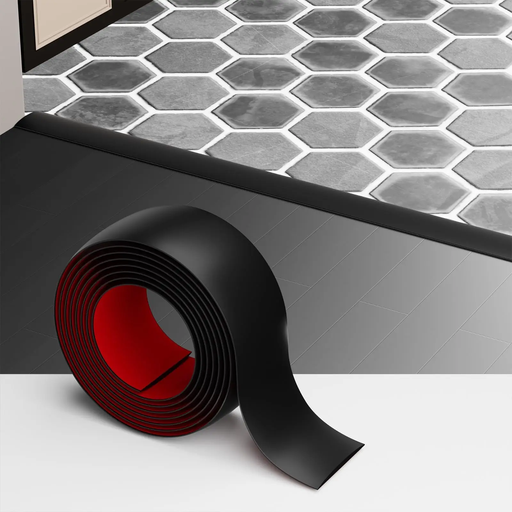
Why this profile is a good match: its 122 cm length can cover a longer junction in a kitchen, living room or bedroom.
The dimensions are specified precisely, reducing the risk of ordering a strip that is too short.
PVC described as resistant to scratches, stains and abrasion, with integrated adhesive for installation.
The service life of an adhesive threshold strip depends primarily on foot traffic, the condition of the substrate and exposure to moisture. In a low-traffic area installed on a properly prepared surface, regular cleaning is generally enough to preserve its appearance. Avoid abrasive products, and do not pull on the ends when washing the floor.
Inspect the edges of the strip regularly. If any section begins to lift, do not simply allow dust to accumulate over it: clean and dry the area, and check that the substrate is not crumbling. In a damp room, a strip that is coming loose should be replaced rather than kept in place on a wet floor.
Explore an updated selection of solutions suited to these dimensional, installation and usage requirements for your flooring projects in France.
Yes, provided the tile is clean, dry, degreased and relatively smooth. Very deep grout lines or heavily textured tiles may reduce the contact area. Test-fit the strip first and check that both edges sit flat, without tension.
The models featured are described as suitable for cutting with scissors. For a straight cut, mark the required length with a pencil and use a ruler as a guide. A clean cut helps prevent a corner from lifting after installation.
It may be suitable for a dry, stable junction, but it is not a substitute for proper waterproofing. Do not install it over a leak, in an area where water collects or on a damp substrate. Dry the floor thoroughly and check regularly that the edges are still adhering properly.