
Livraison le jour même ou le lendemain

Qualité garantie

Débloquez vos offres de bienvenue: Livraison GRATUITE | Jusqu'à -80 % | 30 jours d'essai gratuits à JoyPlus
Téléchargez l'application
As a product expert at Joybuy, I see countless storage solutions come and go. The adhesive hook remains one of the most ingenious, especially for renters or anyone who dreads pulling out the drill. But be warned: choosing the right model to prevent a picture frame from crashing to the floor or paint from peeling off during removal can quickly become a headache.
To ensure this great idea doesn't turn into a costly mistake, here are the pitfalls you must avoid.
To make the right choice, forget the marketing promises for a moment and focus on these few, far more reliable technical criteria.
The world of no-drill wall hooks is vast, but it all becomes simpler when you know what to look for. Here are the three checkpoints you should never overlook.
The golden rule is simple: never push the limit. For a 1?kg object, don't choose a hook rated for 1?kg. Always aim for double. For an adhesive coat hook, which will endure repeated stress, a heavy-duty model (over 3?kg) isn't a luxury—it's a necessity for peace of mind.
The type of wall is the deciding factor. Smooth, non-porous surfaces like tile, glass, metal, or varnished wood are ideal. Painted walls, especially with a matte or powdery finish, are trickier.
Not all adhesive strips are created equal—far from it. The most reliable technology for clean removal remains the stretch-release type (popularised by the Command hook). Simply pull the tab downwards, parallel to the wall, and the adhesive will stretch and release without leaving a trace or damaging the paint. With other systems, removal is often a gamble. A clear hook might be appealing for its discretion, but its removal technology must be scrutinised just as rigorously.
Here are a few options that meet specific needs, based on the criteria we've just covered.
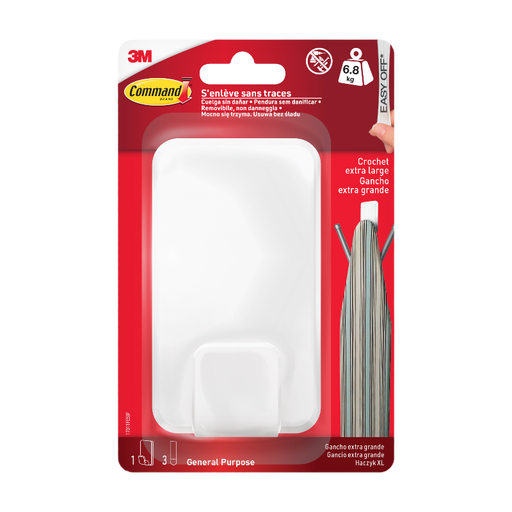
Why we chose it: The perfect drill-free mounting solution for heavy everyday items: a backpack, a bulky winter coat, or even an ironing board. A very serious alternative to a classic adhesive coat rack.
It avoids the "fantasy maximum load" trap by providing a real, tested capacity of 5.8 kg, designed for intensive daily use.
Its high payload, combined with 3M's clean removal technology, makes it a solution that is both robust and reversible.
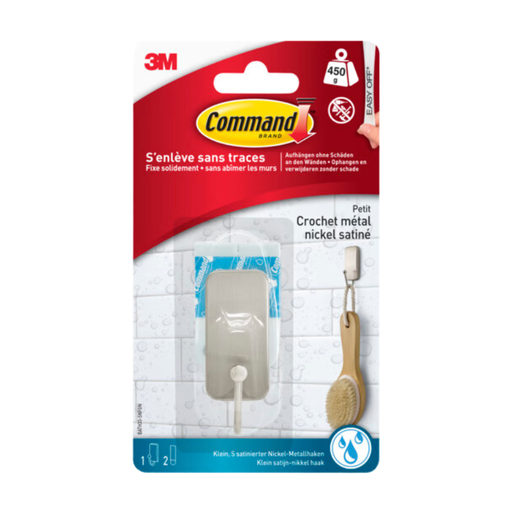
Why we chose it: Perfect for hanging a towel, bathrobe, or shower loofah on tile—even inside the shower stall, where a standard adhesive would give up in a matter of days.
It tackles the "universal" adhesive problem with strips specifically formulated to resist water and humidity.
Its moisture resistance is its standout feature, complemented by an elegant satin nickel finish that fits perfectly in modern bathrooms.
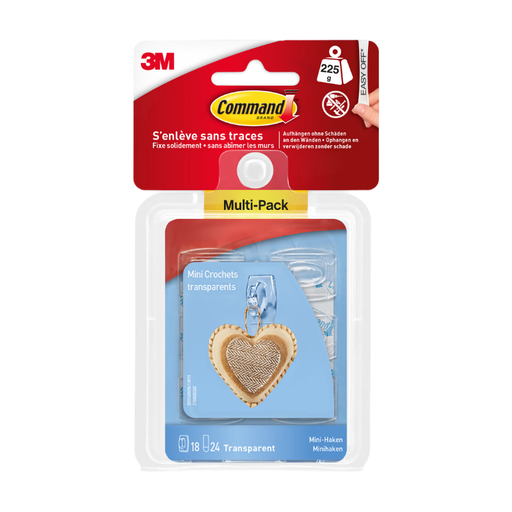
Why we chose it: Perfect for seasonal decorations, string lights, small cables, or a set of keys. This clear hook blends into the background, letting your suspended item take centre stage.
Its transparency means you don't have to compromise on aesthetics. Its low load capacity (225 g) is clearly stated, preventing unpleasant surprises.
Its value pack size (18-pack) and near-invisibility make it the go-to solution for a thousand and one small daily needs.
Whether for picture frames, coats, or even hanging your plants without drilling, discover our full selection of products that meet our quality criteria.
For models with a stretch-release tab (like Command), the secret is to never pull the hook towards you. Grab the tab and stretch it very slowly downwards, keeping it parallel to the wall, until the hook releases on its own. For others, try warming the base with a hairdryer to soften the glue, then slide dental floss behind it to gently "saw" through the adhesive.
Absolutely not. This is a very bad idea. The weight of the object will pull on the paper and likely tear it. Even worse, upon removal, you will definitely rip the wallpaper, causing irreversible damage. Stick to the smooth, non-porous surfaces recommended by the manufacturer.
When properly applied to a suitable surface and used within its load limit, a quality hook can last for several years. Its lifespan will depend on its environment (humidity and temperature changes reduce it) and its use (a key holder is under less stress than a coat hook). Remember to check its hold from time to time, especially if it's supporting a valuable object.