
Livraison le jour même ou le lendemain

Qualité garantie

Débloquez vos offres de bienvenue: Livraison GRATUITE | Jusqu'à -80 % | 30 jours d'essai gratuits à JoyPlus
Téléchargez l'application
Whether you're a renter worried about your security deposit or a homeowner who values pristine walls, the adhesive hook is the quintessential smart storage solution. No more drills, dust, or holes to patch! The only problem is that the market is flooded with products making wildly different claims, and a poor choice can quickly lead to disappointment.
As a product expert at Joybuy, my mission is to help you see things more clearly. Let's cut through the marketing jargon and get to the facts. Here's a breakdown of the pitfalls to avoid and the essential criteria for choosing a drill-free hook that will actually live up to its promises.
The promise of a simple, damage-free installation can sometimes make us forget what's most important. Here are the three most common issues:
To make the right choice, keep an eye on these three parameters. The performance and durability of your wall hook depend on them.
The first question to ask is simple: what do I want to hang, and where? The load capacity, expressed in kilograms (kg), is the number one criterion.
Also, remember to check for compatibility with your wall. Adhesives generally work very well on smooth tile, glass, metal, and painted (non-textured) walls. However, on wallpaper or delicate surfaces, caution is advised.
Not all adhesive strips are created equal. Some are designed for general use, while others are specifically formulated for demanding environments.
For a bathroom hook or kitchen hook, choose models that specify water or moisture resistance. Their adhesives are designed to maintain their adhesive power despite steam and splashes, preventing your towel from ending up on the floor. The suction cup hook can be an alternative on very smooth surfaces like tile or glass, but its reliability is often hit-or-miss and depends on the quality of the suction cup and the cleanliness of the surface.
The choice of material has a direct impact on durability and aesthetics.
Design isn't just a matter of taste. An adhesive coat rack with multiple hooks will optimise space in an entryway, while a simple door hook will add discreet storage behind a bedroom or closet door.
To help you make an informed choice, here are a few products that stand out by perfectly addressing the pitfalls we've just discussed.
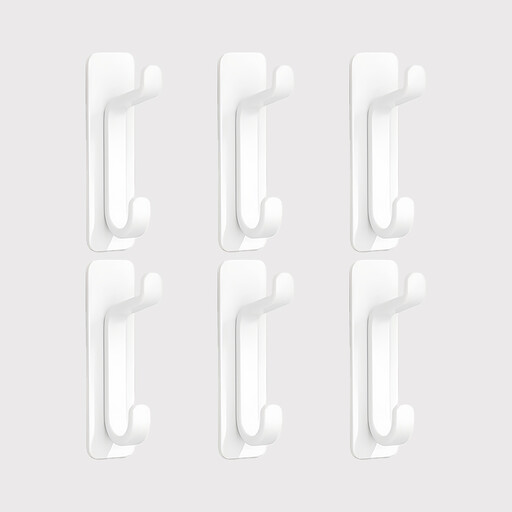
Why we chose it: Ideal for those looking for a simple, cost-effective solution to organise numerous small items (keys, towels, light accessories) throughout the house.
This pack allows you to distribute the load across multiple anchor points instead of relying on just one, which limits the risk of overloading.
The 6-pack format offers excellent value for basic organisation. Its design, combining stainless steel and plastic, makes it highly versatile.
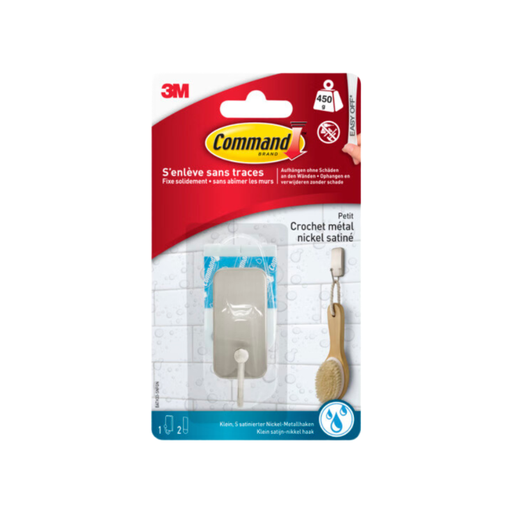
Why we chose it: Perfect for the bathroom or kitchen, where humidity is a constant. It combines a sleek aesthetic with functionality designed for these demanding environments.
It uses specially water-resistant adhesive strips, and its satin nickel finish prevents rust. It thus sidesteps the classic pitfall of deterioration in a humid environment.
The Command adhesive technology guarantees clean, damage-free removal, preserving the integrity of your tile or wall. Its double hook is very practical for hanging both a towel and a bathrobe.
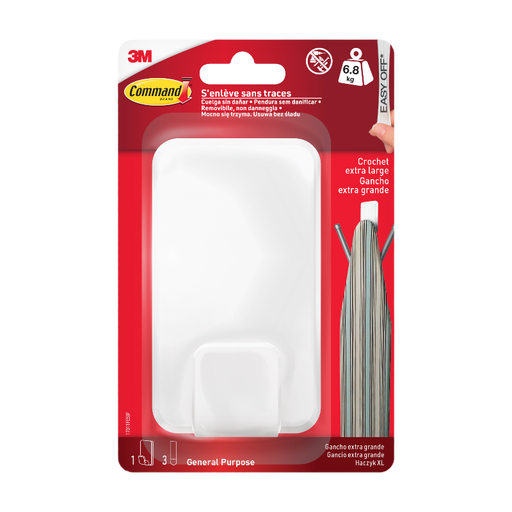
Why we chose it: THE solution for those who want to hang heavy items (winter coats, loaded backpacks, even a step stool) without taking out the drill.
It avoids the trap of unrealistic "heavy-duty" promises by stating a real-world capacity of 5.8 kg. This is one of the highest on the market for an adhesive hook, all based on proven technology.
Its high and reliable load capacity makes it a true alternative to drilling for significant storage needs in an entryway, garage, or laundry room.
We have compiled a complete selection of products that meet these selection criteria and our quality standards.
1. How do I remove an adhesive hook without damaging my wall? Most quality hooks, like those in the Command range, have a tab that you simply pull slowly downwards, parallel to the wall. The adhesive stretches and releases without leaving a trace. For other models, you can gently heat the adhesive with a hairdryer (on low heat) to soften it before carefully peeling it off.
2. How long should I wait before hanging something? This is a crucial yet often overlooked step. It is generally recommended to wait at least one hour after applying the hook before hanging anything on it. This delay allows the adhesive to bond with the surface and reach its maximum load capacity. In all cases, always follow the manufacturer's instructions.
3. Can I reuse an adhesive hook? The hook itself is almost always reusable. The adhesive strip, however, is single-use. To reuse the hook, you will simply need to purchase compatible refill strips, making sure to choose the correct size and type (standard, water-resistant, etc.).