
Livraison le jour même ou le lendemain

Qualité garantie

Débloquez vos offres de bienvenue: Livraison GRATUITE | Jusqu'à -80 % | 30 jours d'essai gratuits à JoyPlus
Téléchargez l'application
Moving a wardrobe, sofa or household appliance can leave marks on a wooden floor, laminate or tiles. Adhesive furniture sliders reduce friction and make it easier to move or reposition items, provided you choose a model suited to the weight of the furniture, the shape of its legs and the type of flooring.
Yet certain mistakes are all too common. A slider that is too small may peel off under the load. Conversely, a model designed for static use won't necessarily be suitable for repeated movements. Also check the stated capacity: it sometimes refers to a set of four sliders, not a single one.
A honeycomb structure can reduce resistance when moving, but it won't work miracles on a dusty, damp or uneven floor. Honeycomb sliders must be placed on a clean, dry surface. Dirt trapped underneath the slider can scratch the floor or prevent the adhesive from holding properly.
A product page may state a maximum load of 100, 300 or 600 kg for four sliders. You therefore need to consider the actual weight distribution. If one leg bears more weight than the others, allow a safety margin. Never exceed the capacity stated by the manufacturer and avoid sudden movements.
Scotch adhesive sliders, like other self-adhesive models, won't hold for long on a greasy, unevenly varnished or dusty surface. Clean the underside of the leg, dry it, centre the slider, then press firmly. For some models, the product page recommends waiting 24 hours before moving the furniture.
Measure the underside of the leg before ordering. Square formats, such as 24 × 24 mm, 40 × 40 mm or 50 × 50 mm, suit flat surfaces. Round versions from 19 to 80 mm are suitable for circular legs, castors or heavy furniture.
The slider should cover a sufficient area of the support without protruding awkwardly. For an elongated leg, a rectangular format such as 70 × 19 mm will often be more appropriate than a disc.
Compare the maximum load with the weight of the furniture and its contents. As a guide, the selection available includes models stated at 100 kg, 150 kg, 300 kg, 400 kg, 500 kg or 600 kg per set of four, depending on the reference.
These figures do not replace correct installation. An uneven floor, an unbalanced piece of furniture or lateral movement can increase the stress placed on the sliders.
On wooden floors, tiles, vinyl or laminate, always check the product page instructions. No slider should be used on a damaged or unstable floor.
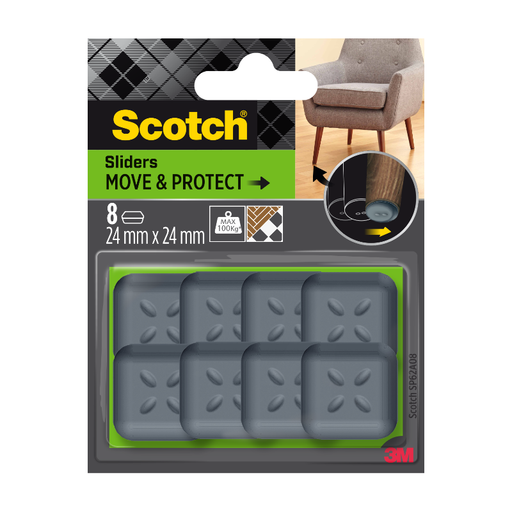
Why this choice suits this profile: Its compact size and adhesive back make it ideal for small tables, chairs, bedside tables and everyday furniture. The pack of eight pieces allows you to fit several legs, depending on the setup.
The product page states a maximum load of 100 kg for four sliders: this clarity prevents using them with furniture that is too heavy.
Honeycomb structure, tool-free fitting, adhesive back and 24 × 24 mm size.
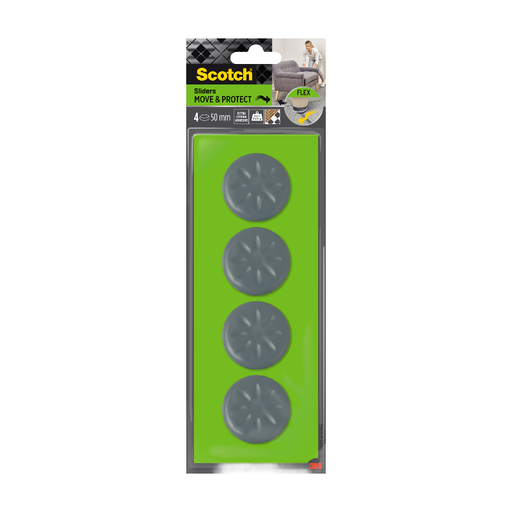
Why this choice suits this profile: This model combines a honeycomb structure, an articulation and a compensating layer. It is aimed at those looking for an adhesive solution for a sofa, sideboard or fridge.
Its articulation reduces the issues caused by a rigid slider on a slightly uneven floor. Fitting still requires 30 seconds of pressure, followed by a 24-hour setting time.
50 mm diameter, stated load up to 400 kg for four pieces and articulated mechanism.
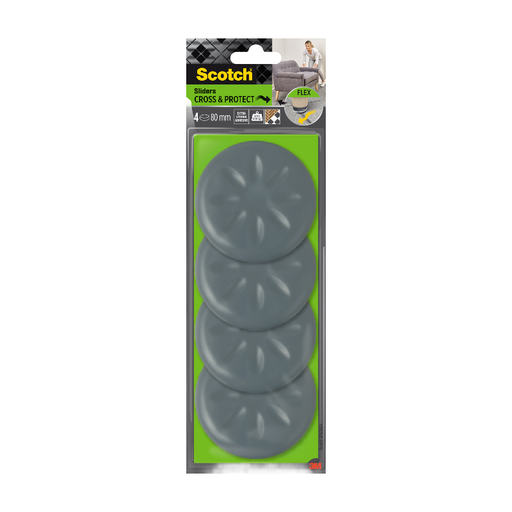
Why this choice suits this profile: Its large diameter is intended for particularly heavy furniture, professional equipment and occasional moves that require a wide contact surface.
The stated load of 600 kg for four sliders reduces the risk of choosing a size too small for a heavy piece of furniture. The product page recommends leaving the furniture stationary for 24 hours after fitting.
80 mm diameter, articulation, compensating foam and stated compatibility with various surfaces.
For a permanent fixing on a wooden leg, nail-on models can be a good option. Adhesive sliders remain easier to install and require no tools, but their hold depends largely on how well the surface is prepared.
Generally allow one slider per leg or per contact point. For very heavy furniture, distribute the load with the number of pieces recommended by the manufacturer and check that each slider sits flat.
The product pages for several references state compatibility with different floorings, including wooden floors, tiles, laminate and vinyl. This indication does not replace testing on an inconspicuous area: a dusty, damp or already damaged floor can affect the result.
Their lifespan depends on the weight supported, how often they are moved, humidity and the quality of the surface. To make them last longer, remove any accumulated debris, avoid pulling the furniture at an angle and replace any slider that has come loose, cracked or become deformed.