
Livraison le jour même ou le lendemain

Qualité garantie

Débloquez vos offres de bienvenue: Livraison GRATUITE | Jusqu'à -80 % | 30 jours d'essai gratuits à JoyPlus
Téléchargez l'application
Moving a table, sofa or household appliance without scratching the floor can quickly become a real headache. Adhesive furniture glider pads offer a simple, tool-free solution, provided you choose the right model. Not every pad is suitable for every leg, load or floor covering. An unsuitable product may come loose, destabilise the furniture or leave the floor exposed to friction.
Here are the points to check before you buy, along with a selection of Scotch glider pads suited to different indoor uses.
A pad that is too small concentrates the weight over a limited area. It may wear out prematurely or fail to cover the furniture leg completely. Conversely, a model that is too large may protrude, catch on an obstacle or compromise the stability of the furniture.
Measure the base of each leg, especially if it is oval, rectangular or irregular. For a small chair, self-adhesive pads for furniture legs measuring 19 to 25 mm may be sufficient. For a wardrobe, sofa or heavy appliance, a diameter of 40 to 90 mm provides a larger contact area and distributes the load more effectively.
The stated load usually applies to a set of four pads, rather than to a single piece. It also assumes that the weight is distributed relatively evenly. Furniture loaded asymmetrically can place considerably more pressure on one of its legs.
Never exceed the load stated on the product page. Take into account the weight of the furniture, its contents and the forces exerted while moving it. Heavy-duty furniture pads are not a substitute for proper moving equipment when the furniture is unstable or particularly bulky.
Product pages may state that a pad is compatible with wood, tiles, laminate or vinyl. This does not mean you can skip removing grit, dust and residue from the floor or underneath the furniture. A hard particle trapped beneath a floor protection pad can leave a mark, even if the pad is designed to minimise scratching.
On delicate flooring, test the pad first in an inconspicuous area and move the furniture slowly, without jerking.
The shape of the pad should match the shape of the leg:
The Scotch honeycomb pads in this selection claim to improve gliding by more than 50% compared with furniture without pads. This figure comes from the product information; actual results will depend in particular on the weight of the furniture, the type of flooring, how clean the surfaces are and the speed at which the furniture is moved.
Adhesive models can be fitted quickly, without drilling. However, how securely they stay in place depends largely on preparation. The surface underneath the leg must be clean, dry and free from grease. Press the pad firmly for around 30 seconds. For products designed for heavier loads, allow the adhesive to set for 24 hours before moving the furniture.
Nail-on models are generally intended for wooden furniture when a permanent fixing is required. They are not suitable for every type of leg, particularly metal or very thin structures.
A standard pad is suitable for slow movement across a reasonably even surface. To cross tile joints, small irregularities or a slightly uneven floor, all-surface models with an articulated ball joint and cushioning foam may follow the movement more effectively.
Also check that the pads are designed for indoor use and slow movement. For a piano, chest or very heavy appliance, arrange for several people to help and check the stability of the furniture before starting any manoeuvre.
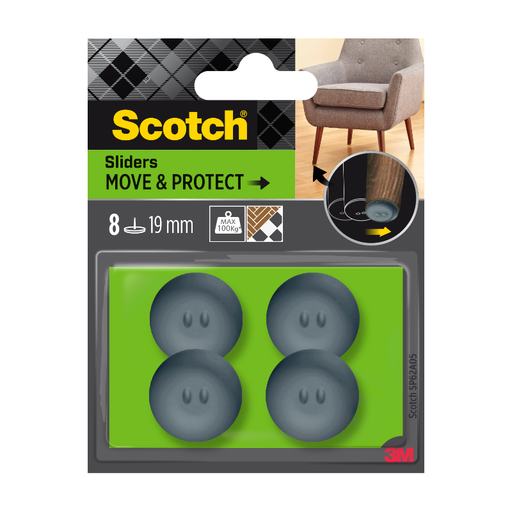
Why this product suits this profile : With its 19 mm diameter and pack of eight, this model is suitable for small chair legs, occasional tables and lightweight furniture.
The diameter is clearly stated and the maximum advertised load is 100 kg for four pads, reducing the risk of choosing the wrong size.
A honeycomb structure, adhesive backing and stated permanent use on indoor floors.
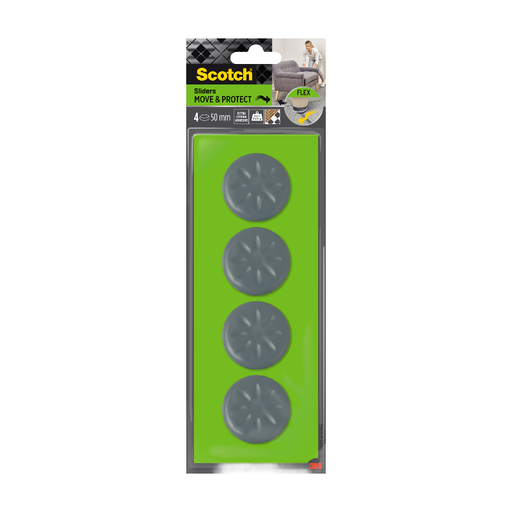
Why this product suits this profile : This model combines a 50 mm diameter with an articulated ball joint and cushioning foam. It is therefore suitable for heavy furniture moved across floors with small joints or gaps.
Its design does more than simply provide a large diameter: the articulated components are designed to follow uneven areas of the floor.
An advertised load of 400 kg for four pads, a honeycomb structure and permanent adhesive.
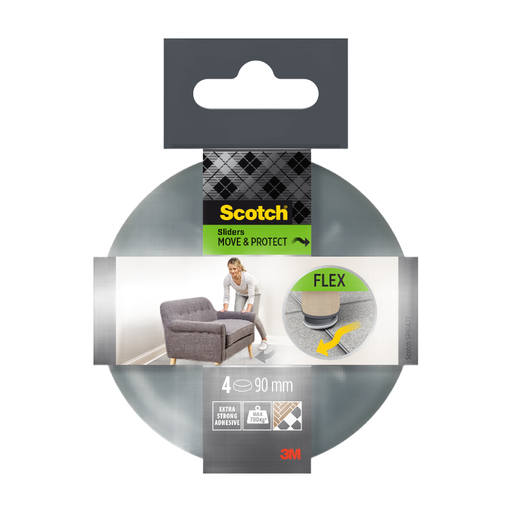
Why this product suits this profile : Its large diameter and flexible design are intended for furniture and appliances weighing up to 700 kg, according to the product page.
The load, diameter and usage limitations are clearly detailed. It remains essential to observe the stated limit and check the stability of the furniture before moving it.
A 90 mm diameter, an articulated joint, cushioning foam and an advertised load of 700 kg for four pieces.
To move furniture without scratching the floor, proceed slowly and avoid jerking movements. If the furniture starts to tip, a pad comes loose or the floor has a significant uneven area, stop immediately.
We have put together a complete, real-time updated selection of products that meet these demanding selection criteria and European safety regulations.
For models designed for heavier loads, some product pages recommend waiting 24 hours. Always follow the instructions for the specific product you have chosen. A surface that has not been cleaned properly or is still damp may also reduce adhesion.
The products featured are advertised as being compatible with various indoor floor coverings, including wood, tiles, vinyl and laminate. Even so, test the pad in an inconspicuous area, carefully remove any dust and avoid moving heavily loaded furniture quickly.
Scotch adhesive pads can be fitted without tools and are suitable for legs with a clean, sufficiently large bonding surface. Nail-on models may be considered for wooden furniture when a permanent fixing is preferred. The choice therefore depends on the material of the leg, the load it must support and how often the furniture is moved.