
Livraison le jour même ou le lendemain

Qualité garantie

Débloquez vos offres de bienvenue: Livraison GRATUITE | Jusqu'à -80 % | 30 jours d'essai gratuits à JoyPlus
Téléchargez l'application
Want to give your kitchen or bathroom a makeover without starting an endless construction project? The promise is tempting. The adhesive backsplash has established itself as the go-to solution for modernising a space cost-effectively and in record time. But be warned: the market is flooded with products of wildly inconsistent quality, and it's easy to fall into a trap that will turn your easy kitchen renovation project into a real disappointment. To save you from a nasty surprise, let's review the mistakes you should never make.
The two main pitfalls to watch out for concern resistance and durability. The first is the mirage of "heat resistance": many cheap products warp or turn yellow within weeks if placed too close to a hob, even a gas or induction one. The second is false waterproofing. A self-adhesive backsplash that is merely "water-resistant" will not withstand the constant splashing near a sink or the ambient humidity of a bathroom. Peeling is almost guaranteed, with the added risk of mould growth.
To avoid regretting your purchase, two technical criteria must be scrutinised: the material and the quality of the adhesive. These will determine not only the final look but, more importantly, the lifespan of your new backsplash.
The choice of material is decisive: it determines the backsplash's resistance to daily wear and tear (heat, humidity, cleaning products).
Before you check out, always verify the manufacturer's technical sheet on two crucial points:
Finally, never forget: 50% of your project's success depends on preparing the surface. The surface must be perfectly smooth, clean, dry, and degreased. Even the strongest adhesive will never stick properly to a textured, dusty, or damp wall.
To help you make an informed decision, here are a few products that exemplify these criteria, suited for different needs and budgets.
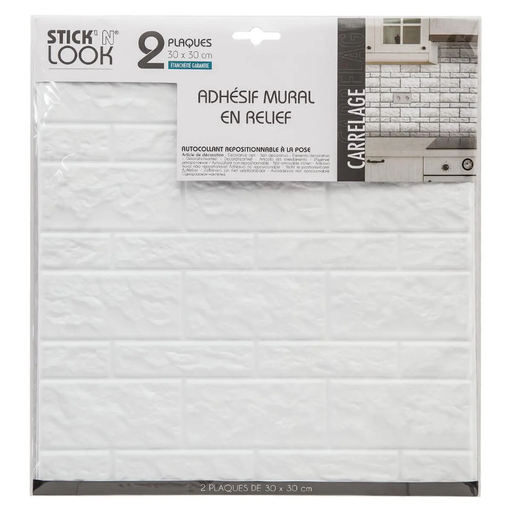
Why we chose it: Ideal for renters or for a quick, economical refresh. This PVC set allows you to cover a small area or test out a decorative effect without breaking the bank. Its simple installation makes it accessible even for DIY novices.
This product is designed for low-stress areas. By using it away from a hob or a shower, you are using it for what it truly is: a simple and effective decorative solution. This way, you avoid the disappointment of durability that is unsuited for intensive use.
Its format as a set of two 30x30 cm tiles is very practical for small surfaces: a stair riser, the back of a shelf, or a small section of wall. The PVC can be cleaned with a simple wipe of a sponge.
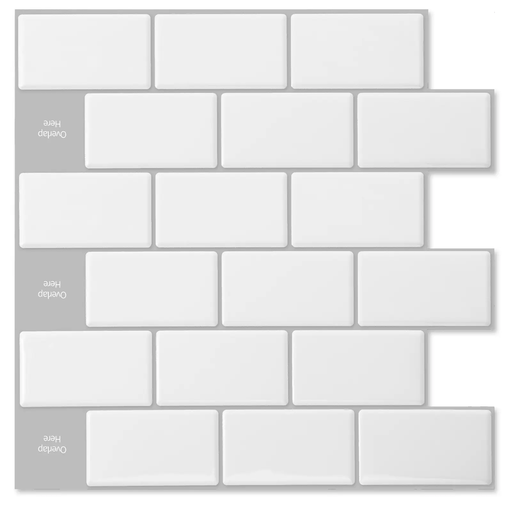
Why we chose it: For those who want a result that looks like real tile, without the construction work. This model is built for demanding areas like the kitchen, combining a polished look with good resistance.
It sidesteps the two classic pitfalls: heat and durability. The technical sheet mentions heat resistance and an industrial-grade adhesive, ensuring better longevity. Its thick gel layer protects it from yellowing and splashes.
Its 3D effect is very well-executed and offers stunning realism, perfectly imitating subway tile. The tile format (30x30 cm) allows for quick coverage of large areas with minimal seams.
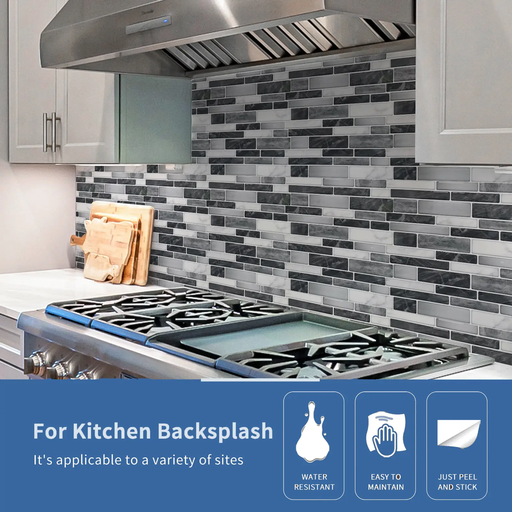
Why we chose it: An excellent option for renovating bathroom walls (outside the shower enclosure). Its design is specifically engineered to hold up in rooms where humidity is a major concern.
It tackles the false waterproofing trap head-on. The technical sheet highlights an upgraded, powerful adhesive for reliable attachment in damp environments, as well as a protective gel layer against splashes, which also simplifies cleaning.
Its non-porous surface and moisture resistance make it a very low-maintenance covering. Ideal for bathroom walls, around the sink, or for dressing up a bathtub surround.
Discover our complete and up-to-date selection of products that meet our quality criteria and current standards.
Yes, but with one absolute condition: you must choose a model specifically designed for this purpose. Opt for aluminium composite backsplashes or PVC/vinyl models with 3D gel whose manufacturer explicitly guarantees heat resistance. It is imperative to respect the recommended safety distance (usually 15 to 20 cm), especially with gas hobs.
The lifespan of a kitchen adhesive tile can range from a few months to over five years. It all depends on three factors: the quality of the product (material, glue), the quality of the installation (flawless surface), and the environment (exposure to heat, water, cleaning products). A quality model, installed according to best practices, can remain in perfect condition for many years.
Absolutely, it's one of the most common scenarios. For an optimal result, the surface of the old tile must be impeccably cleaned and degreased. If the grout lines of your old tile are very deep, it is highly recommended to fill them with a smoothing compound. This will give you a perfectly flat surface, which is essential for the new tiles to adhere perfectly.