
Livraison le jour même ou le lendemain

Qualité garantie

Débloquez vos offres de bienvenue: Livraison GRATUITE | Jusqu'à -80 % | 30 jours d'essai gratuits à JoyPlus
Téléchargez l'application
Bloating, gas, digestive discomfort... These issues can quickly disrupt your daily life. To combat them, activated vegetable charcoal has emerged as a popular natural remedy. The problem? The dietary supplement aisle is a jungle where it's easy to be misled. Behind slick marketing, many products hide ineffective dosages or highly questionable ingredients.
My role, as a product expert at Joybuy, is to guide you through this jungle. Together, let's break down the pitfalls to avoid so you can make a truly informed choice—one based on efficacy and transparency, not on empty promises.
Venturing into the gut wellness aisle requires a bit of vigilance. Two common pitfalls could leave you regretting your purchase.
To ensure you don't make a mistake, rely on objective criteria. These are the true guarantors of a quality digestive supplement.
Your first instinct should be to check the activated charcoal dosage per capsule, not per serving. This is the only way to objectively compare products and tailor the dose to your needs. The source of the charcoal is also a quality indicator: charcoals derived from high-quality woods (like eucalyptus) or coconut shells are renowned for their high adsorption capacity—a major asset against bloating.
A minimalist formula is often a sign of quality. The ideal? The shortest possible ingredient list: activated vegetable charcoal and the capsule shell, period. Opt for a plant-based shell (often hypromellose) that is compatible with vegan and vegetarian diets. The absence of GMOs, gluten, and additives is, of course, a welcome bonus.
For an activated charcoal regimen or regular use, the bottle size becomes a decisive economic factor. A large-format bottle of 180 capsules (or more) will almost always be more cost-effective than a small 60-count bottle, while also generating less waste. It's a simple calculation to make.
Based on these criteria, one product particularly caught our eye for its transparency and formulation.
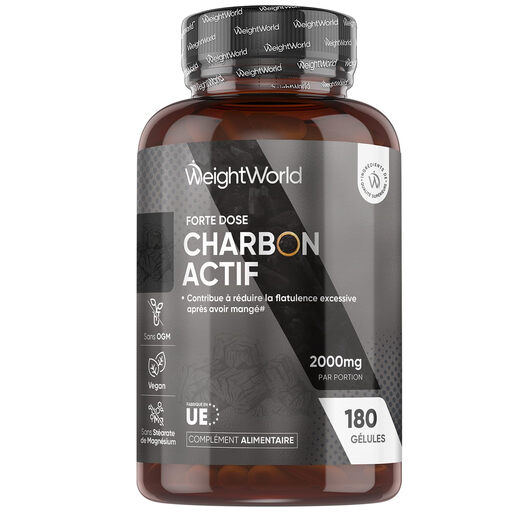
Why it stands out: Perfect for long-term use. Its 180-capsule format ensures excellent value for money, ideal for regular use or an extended regimen aimed at maintaining digestive comfort.
The brand is transparent: the 2000 mg dosage is clearly specified for a 6-capsule serving, which prevents any unpleasant surprises. The formula is minimalist: just activated charcoal and a vegetable capsule, with no magnesium stearate or GMOs.
Its vegan formula, economical bulk size, and quality charcoal source (eucalyptus and acacia) make it a reliable and transparent choice for managing your intestinal comfort.
Explore our full selection of charcoal-based products, available in various formats and all rigorously selected for their compliance and quality.
The entire difference lies in the "activation" process. Activated vegetable charcoal is superheated in the presence of water vapour, a treatment that creates a network of microscopic pores on its surface. It's this ultra-porous structure that gives it its renowned adsorption capacity, allowing it to trap substances (like gases) in the digestive tract. Barbecue charcoal, on the other hand, does not undergo this treatment and should under no circumstances be consumed.
The golden rule: always take it away from meals (at least 1 to 2 hours before or after) and, most importantly, far from any medications or other supplements. Its powerful adsorbent properties could reduce their effectiveness. Each dose should be taken with a large glass of water. In all cases, strictly follow the instructions on your product's packaging.
Activated charcoal is primarily used on an occasional basis to soothe temporary discomfort, or as a short course (typically 7 to 15 days). Prolonged use is not recommended without the advice of a healthcare professional. Indeed, taking it over a very long term could interfere with the absorption of certain essential nutrients.