
Livraison le jour même ou le lendemain

Qualité garantie

Débloquez vos offres de bienvenue: Livraison GRATUITE | Jusqu'à -80 % | 30 jours d'essai gratuits à JoyPlus
Téléchargez l'application
Whether you're racing down mountain bike trails, exploring the ocean depths, or vlogging your travels, the action camera is your best companion for capturing the moment. But faced with a jungle of models, each with a spec sheet more tempting than the last, it's tough to navigate. To avoid marketing traps and the disappointment of a purchase you'll regret, you need to learn to read between the lines.
Our mission is to guide you through this jungle. Let's break down the mistakes to avoid and the criteria that truly matter to find that hidden gem: the camera perfectly suited to your adventures.
Marketing promises are beautiful, but the reality is often disappointing. Too many users end up disappointed with a device that, on paper, seemed perfect. Here are the three most common traps to avoid:
To make the right choice, forget the marketing jargon and focus on the few technical specs that don't lie. They are the true arbiters of an action cam's performance.
A sports camera with stabilization isn't a luxury; it's an absolute necessity for getting usable footage. Without it, the slightest vibration (on a bike, skis, or even just walking) will turn your shots into a shaky, almost unwatchable mess. Today, Electronic Image Stabilization (EIS), often paired with a 6-axis gyroscope, has established itself as a remarkably effective solution. It analyzes movements and compensates for shakes by cropping the image in real-time. This is a crucial point, whether you're looking for a motorcycle helmet cam or vlogging on the move.
A true4K sports camera must be able to record at a native resolution of 3840 x 2160 pixels. The other key figure is the frame rate (fps, or frames per second):
Demand native 4K at a minimum of 30?fps. Anything less is just smoke and mirrors.
Your use case will determine the level of waterproofing required.
The advantage of going 'caseless'? Ease of use and much better audio capture. The case, however, remains the best life insurance for your camera against impacts and deep water, even if it is bulkier.
Rather than an endless list of models, here is our curated selection based on user profiles. The goal: to help you find the perfect fit.
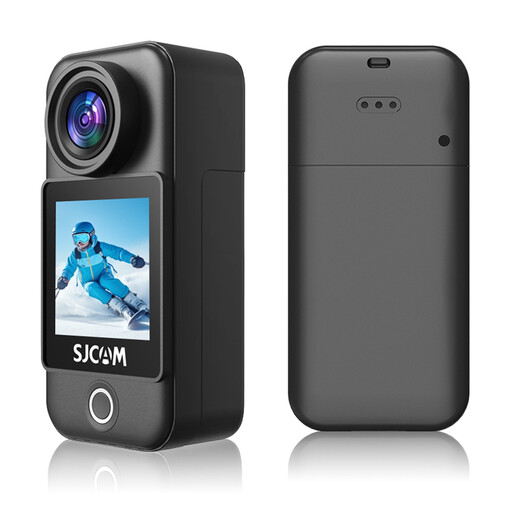
The smart choice for this profile: Perfect for anyone looking for an effective mini action camera without breaking the bank. Its pocket-sized form factor and feather-light weight (just 55g) make it the king of portability. On the technical side, its specs (true 4K/30fps, 6-axis stabilization) are more than solid for getting started.
It offers true 4K at 30 fps and gyroscopic stabilization that holds up, a far cry from the empty promises of entry-level models with inflated spec sheets.
6-Axis Stabilization (EIS): Stable videos, even when things get shaky. Ultra-compact: Fits in your pocket, ready at a moment's notice.
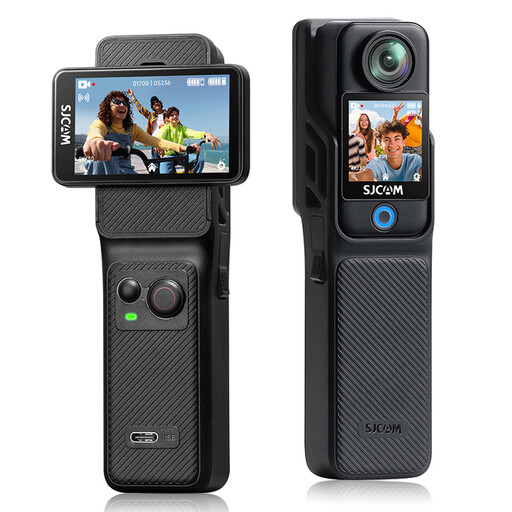
The smart choice for this profile: The perfect tool for vlogging, thanks in particular to its dual touchscreens that simplify framing in selfie mode. Its main advantage is the battery grip that massively extends the battery life: a decisive advantage for long shooting days.
It tackles the trap of unrealistic battery life claims head-on by providing a hardware solution (the battery grip) that guarantees hours of 4K recording.
Dual Touchscreens: Ideal for framing yourself. XXL Battery Life: Up to 437 minutes in 4K/30fps with the battery grip. Plenty of power to spare.
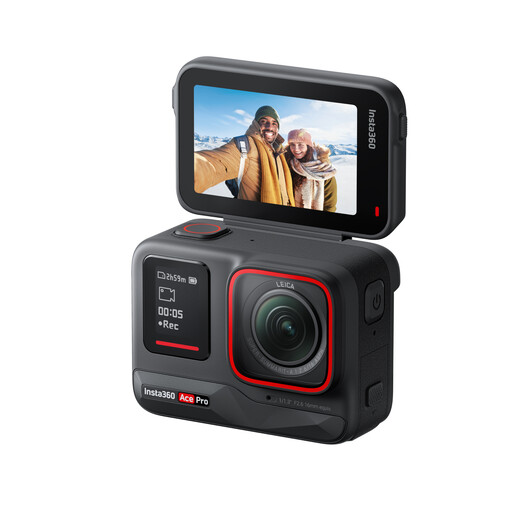
The smart choice for this profile: For those who put image quality above all else. Co-engineered with the prestigious Leica, it features a large 1/1.3" sensor and a 5nm AI chip that work wonders in low light. A very serious GoPro alternative for the most demanding users.
It shatters the trap of cut-rate "4K" by relying on high-end hardware (Leica lens, large sensor). The result: impeccable image quality, even when light is scarce.
Premium Image Quality: Large 1/1.3" sensor and a Leica-engineered lens. Waterproof to 10m without a case: Ready for action, right out of the box.
Has our guide put you on the right track? Discover even more models and accessories that meet our demanding selection criteria.
To film in 4K without issues, a high-performance microSD card is non-negotiable. Aim for at least a card certified U3 (UHS Speed Class 3) or V30 (Video Speed Class 30). Also, remember to check the maximum capacity supported by your camera (usually 128?GB, 256?GB, or even more on recent models).
In the world of action cams, EIS (Electronic) reigns supreme, and for good reason. It is much better suited to smoothing out the wide, rapid vibrations of extreme sports. OIS (Optical), with its mechanical parts, is more fragile and therefore rarer in this segment. A modern 6-axis gyroscopic stabilization system now offers stunningly smooth results, often close to that of an external gimbal.
Several tricks exist to squeeze out precious extra minutes. The simplest: film in 1080p instead of 4K, as it's much less power-hungry. Also, consider turning off Wi-Fi, Bluetooth, and the rear screen when they aren't essential. But for true peace of mind, nothing beats having one or two spare batteries in your bag, or a model equipped with a battery grip.