
Livraison le jour même ou le lendemain

Qualité garantie

Débloquez vos offres de bienvenue: Livraison GRATUITE | Jusqu'à -80 % | 30 jours d'essai gratuits à JoyPlus
Téléchargez l'application
Buying an acrylic paint set may seem straightforward… until you start comparing formats, colour palettes and compatible surfaces. Between highly colourful kits, tubes that run out after just a few sessions and quality claims that can be difficult to verify, some purchases quickly prove impractical.
This 2026 selection is designed for beginners, art students, experienced artists and creative hobbyists alike. It also includes a Rubson acrylic sealant for repair, sealing and renovation work.
A 24-colour set is not necessarily more useful than a palette of 6 or 12 colours. Some shades may be very similar or difficult to use effectively when mixing. For learning purposes, primary acrylic colours — yellow, magenta or red, cyan or blue — complemented by white and black often provide a far more practical foundation.
By contrast, a themed palette made up of, for example, tropical shades is primarily suited to a specific decorative project. It is less appropriate for learning colour mixing.
12 ml acrylic paint tubes are easy to carry and ideal for studies, small formats or initial experiments. However, white and the colours used most often can run out quickly when working on a large canvas.
For regular painting, 75 ml acrylic paint tubes provide a much more generous supply. When comparing prices, it is therefore better to consider the actual quantity available for each colour rather than simply counting the number of tubes.
Paint marketed as suitable for multiple surfaces will not necessarily perform identically on every material. The surface must be clean, dry and free from dust. Depending on the material, it may also need to be slightly absorbent and thoroughly degreased.
Acrylic paint generally dries quickly. This is useful for layering, but it leaves less time to blend colours directly on the canvas. Brushes should also be rinsed with water before the paint begins to dry.
For acrylic paint for beginners, choose a palette containing at least white, black, yellow, red or magenta, blue and a complementary colour. A six-colour primary palette makes colour-theory exercises easier while avoiding unnecessary duplicates.
A 10- or 12-colour acrylic paint set is better suited to varied subjects such as landscapes, illustrations, decorative objects or school projects. Always check the precise colour list, as commercial names can vary from one manufacturer to another.
A thick, buttery texture works well with both brushes and palette knives. A more fluid paint is preferable for washes, delicate flat areas and certain decorative effects. The products featured here include finishes described by the manufacturer as satin, glossy and silky.
The phrase “water-resistant once dry” does not mean that the artwork can remain submerged or be exposed to the elements for extended periods without protection. To preserve a canvas, the choice and preparation of the surface, along with the possible application of a suitable varnish, remain decisive.
Acrylic paint for canvas is generally used on prepared canvas, suitable paper, cardboard or clean wood. According to the manufacturer’s information, the Talens sets featured in this selection can also be applied to slightly absorbent plaster, stone and cement.
For filling a crack or creating a seal, decorative paint is not the right product. Acrylic sealant in a cartridge, applied with a suitable caulking gun, is designed for a different purpose. Always check the approved surfaces and restrictions listed on the packaging.
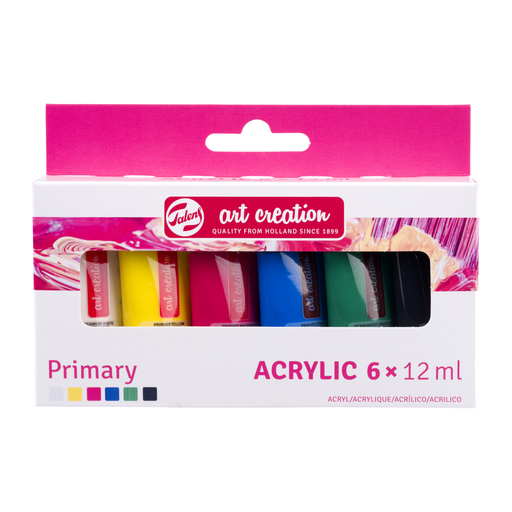
Why it is a good fit: its compact format slips easily into a bag for classes, travel and early colour-mixing exercises, without adding unnecessary tubes.
The palette focuses on six genuinely useful shades for studying colour theory rather than a long series of colours that are rarely used.
6 x 12 ml tubes, suitable for direct application or dilution with water, with use indicated on canvas, paper, wood and cardboard.
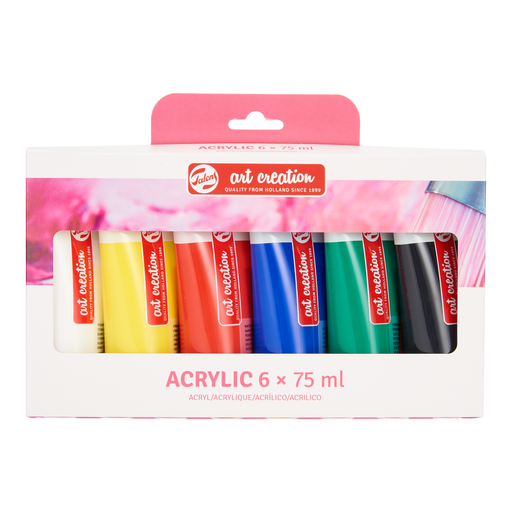
Why it is a good fit: its larger tubes are intended for painters who work regularly on canvas or larger surfaces.
The 75 ml format reduces the risk of running out too quickly of frequently used colours, especially white and darker shades.
6 x 75 ml tubes, thick texture, fast drying and a glossy, silky finish stated by the manufacturer.
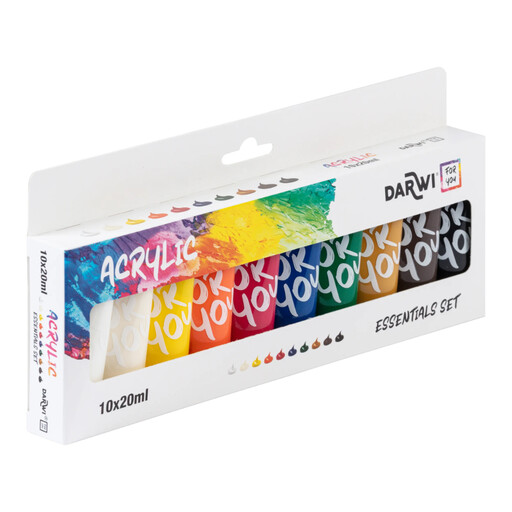
Why it is a good fit: its ten shades and mid-sized format suit studies, creative hobbies and small artworks that are easy to transport.
It strikes a strong balance between variety and quantity, without committing you to oversized tubes for occasional use.
10 x 20 ml tubes, creamy texture, satin finish and application with a brush or palette knife.
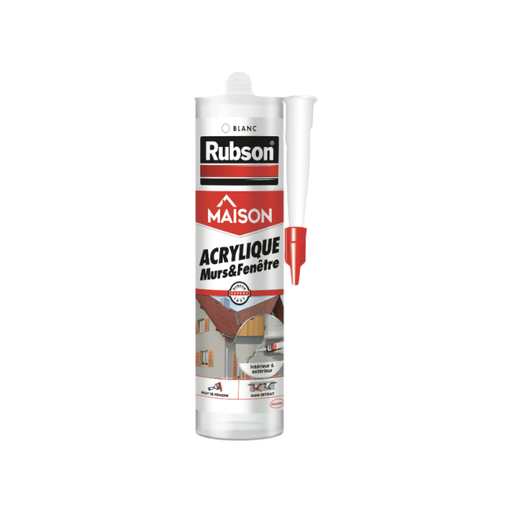
Why it is a good fit: it is intended for household projects involving crack repair or sealing around doors and windows.
It highlights that a repair product should be selected according to the surface and intended use, rather than replaced with ordinary acrylic paint.
2 x 280 ml cartridges, suitable for indoor and outdoor use, with adhesion stated on wood, plaster, cement, aluminium, PVC and brick.
We have brought together an updated selection of products that meet these criteria, for both creative projects and repair work.
The 12 ml format is suitable for beginners, students and painting on the go. The 20 ml format offers a more generous supply while remaining easy to transport. The 75 ml format is better suited to regular painting, large canvases and colours used in larger quantities.
Yes. Some products are designed for wood, cardboard, paper, canvas, plaster or slightly absorbent cement. The surface must be clean, dry and degreased. Depending on its condition, preparation or a primer may be required.
No. Paint is primarily used to create a coloured or decorative coating, while acrylic sealant is designed to fill cracks and create seals. For repairs, choose a cartridge suited to the surface, exposure conditions and desired finish.