
Livraison le jour même ou le lendemain

Qualité garantie

Débloquez vos offres de bienvenue: Livraison GRATUITE | Jusqu'à -80 % | 30 jours d'essai gratuits à JoyPlus
Téléchargez l'application
Diving into acrylic painting is a fantastic creative adventure. But with an overwhelming number of options, choosing your first acrylic paint set can quickly become a headache. Between sets promising dozens of colours and a variety of sizes, it's easy to fall into common traps that are more discouraging than helpful. As a product expert at Joybuy, my mission is to help you make an informed choice that perfectly suits your artistic ambitions.
To get you started on the right foot, let's review the 3 most common mistakes when buying a first kit:
To avoid these disappointments, focus on a few key points. This will ensure you have the right materials to improve your skills and, most importantly, enjoy the process.
A good beginner acrylic paint kit isn't judged by the number of colours, but by their relevance. For maximum versatility, your set must include:
With this foundation, you can create an almost infinite palette of shades. Colours like cadmium red, ultramarine blue, a green, and an earth tone (ochre or burnt sienna) are perfect additions, but the primary trio is the non-negotiable requirement for learning to master colour mixing.
The tube size should match your needs.
A paint's vibrancy and longevity depend on its composition. A quality paint uses a pure acrylic resin as a binder, which ensures the artwork won't yellow over time. The pigment concentration is just as crucial: the higher it is, the more opaque, intense, and stable the colour will be as it dries. Brands like Talens Art Creation paint or Clairefontaine paint are known for the quality of their formulas, offering a beautiful satin finish and excellent durability.
To illustrate these criteria, here are a few options that suit different types of artists.
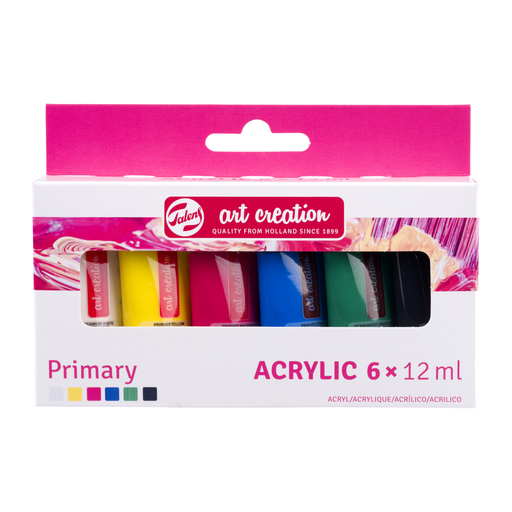
Why we chose it: This set is designed for learning. It provides only the primary colours, white, and black, forcing the user to master mixing to achieve their desired shades. It's an educational tool before it's just a kit.
It avoids the "complete" palette trap by focusing on 6 fundamental colours to get you started with colour theory.
Palette optimised for learning to mix. Compact and budget-friendly format for starting out.
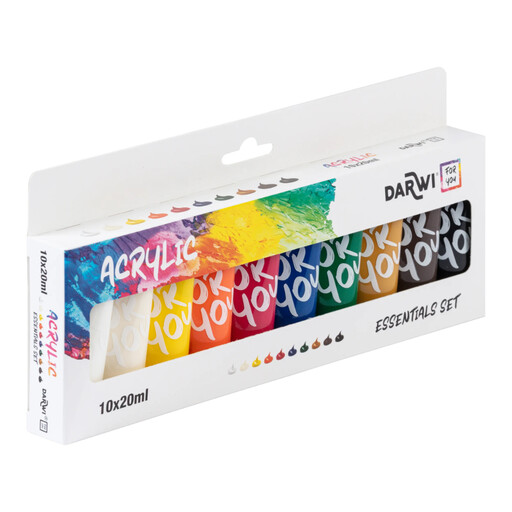
Why we chose it: For creative hobbyists, this set offers an excellent balance. The 10-colour palette is versatile, and the 20 ml tubes provide a comfortable amount of paint to tackle various projects without worrying about running out.
It avoids the trap of tiny quantities. With 20 ml per tube, it offers much better value for money than entry-level 12 ml kits.
Good volume for regular use. Creamy texture and a quality satin finish.
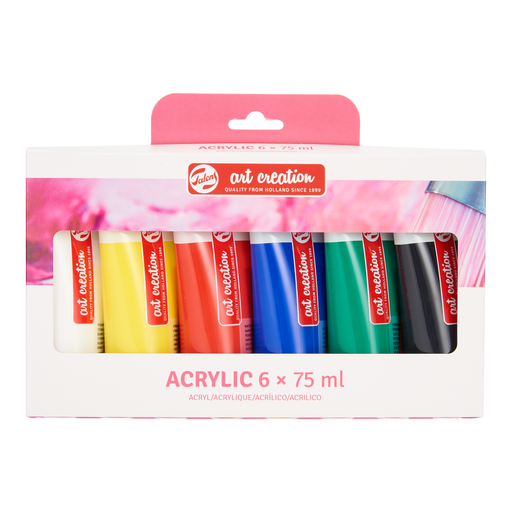
Why we chose it: For those who paint often or on large canvases, volume is crucial. This set offers 6 fundamental colours in generous 75 ml tubes. A smart, economical choice for building a core stock of paint.
It solves the problem of running out of key colours too quickly. The 75 ml size ensures you can work for longer and offers a much more attractive cost per millilitre.
Large volume (75 ml) ideal for large formats or intensive use. Palette of essential colours.
We have put together a complete selection of products that meet our quality criteria and current safety standards.
Acrylic is a very versatile paint. It adheres perfectly to most porous and properly degreased surfaces: acrylic paint on canvas, paper, cardboard, wood, plaster, or even stone. For non-porous surfaces like plastic or metal, applying a primer (like gesso) is recommended to ensure good adhesion.
One of the biggest advantages of acrylic is its fast drying time. A thin layer can be dry to the touch in a few minutes and fully cured in under an hour. This time varies, of course, depending on the thickness of the paint, humidity, and ambient temperature. This rapid drying allows you to layer colours without a long wait.
It all depends on the effect you want. Straight from the tube, acrylic has a thick, buttery texture, ideal for palette knife work (the impasto technique). For a more fluid, watercolour-like effect, or for smooth, flat areas of colour, you can dilute it with a little water. Be careful not to add more than 30% water, as this can weaken the binder and compromise the paint's adhesion. For greater dilution, it's best to use a dedicated medium or an acrylic binder.