
Livraison le jour même ou le lendemain

Qualité garantie

Débloquez vos offres de bienvenue: Livraison GRATUITE | Jusqu'à -80 % | 30 jours d'essai gratuits à JoyPlus
Téléchargez l'application
Diving into acrylic painting is an exciting adventure, but choosing your first set of materials can quickly become a daunting task. Faced with a jungle of available sets, how do you find the one that truly matches your ambitions and budget? This guide is here to help, offering simple selection criteria and a curated list of products to start your creative journey on the right foot.
As a product expert at Joybuy, my mission is to provide practical advice to help you make an informed choice, free of marketing jargon.
Before we dive into our selection, let's review a few key points to check to find the perfect acrylic paint set for you.
A beginner's acrylic paint kit doesn't need a hundred colours. A set of 12 well-chosen shades is often ideal for learning about mixing and colour theory. A 24-colour set, on the other hand, will save you time with a wider range of ready-to-use hues.
The volume of the acrylic paint tubes is also a key criterion. 12?ml tubes are perfect for starting out and experimenting without breaking the bank. More generous sizes (like 75?ml) become more economical if you paint on large surfaces or use a lot of certain colours, like the essential titanium white.
One of the major advantages of acrylic is its versatility. A good quality paint adheres to a multitude of surfaces. Whether you want to paint on a canvas, paper, cardboard, wood, or even stone, make sure the set you choose is compatible. Paints based on acrylic resin, like those in the Art Creation acrylic paint range, are specifically designed for this versatility.
The quality of an acrylic paint is judged by its consistency, pigment richness, and durability over time. A paint with a buttery consistency is pleasant to work with, whether with a brush or a palette knife. It can be used straight from the tube to create thickness (impasto) or diluted with water to achieve transparent effects. Paints from the Talens brand are renowned for their reliable quality, fast drying time, and permanent satin finish.
We have selected three options from the Talens Art Creation range that cater to different needs, whether you are a complete beginner or an experienced hobbyist.
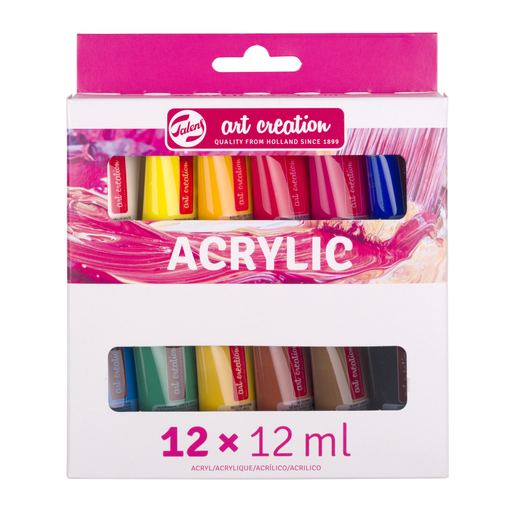
Why it stands out: It's the ideal starting point. Its palette of 12 essential colours, including the primaries, is perfect for exploring a wide range of mixes and techniques.
Advantages:
Who is it for? Beginner artists, art students, and anyone looking for a complete and accessible beginner's acrylic paint kit to practice and hone their skills.
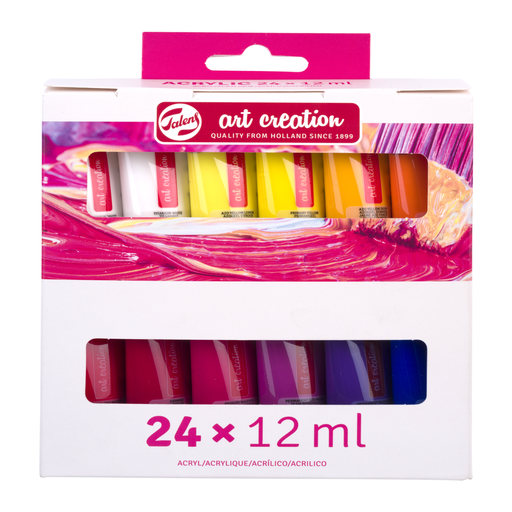
Why it stands out: With 24 colours, this acrylic paint set offers greater creative freedom and saves you from spending time searching for the perfect shade.
Advantages:
Who is it for? Ideal for amateur artists who want a broad palette from the start, or for mixed media projects that require a wide variety of colours.
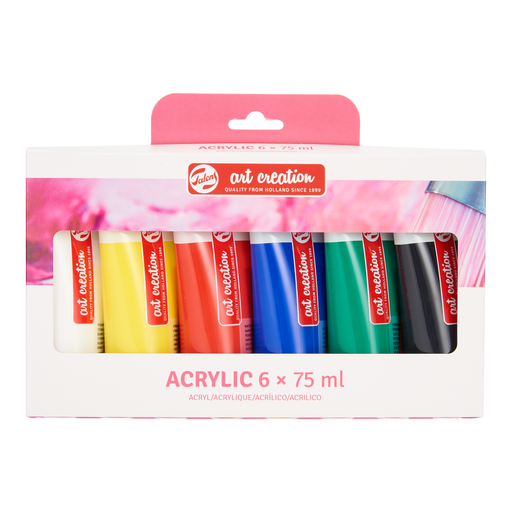
Why it stands out: Here, the focus is on quantity over variety. This set offers six fundamental colours in generous 75?ml tubes, a very economical format for large-scale projects.
Advantages:
Who is it for? For artists who work on large canvases or those who want to stock up on base colours to complement a smaller set.
Acrylic paint is permanent once dry. This is great news for your artwork, but not so much for your clothes! To paint with peace of mind, consider wearing a smock or clothes you don't mind getting stained. If you're looking for comfortable and practical clothing for your creative sessions, our selection of Lightweight Long-Sleeved Tops might give you some ideas for combining style, comfort, and protection.
For a beginner, a set of 12 to 24 colours is an excellent starting point. A 12-colour set like the Talens Art Creation is highly educational, as it forces you to practice mixing. A 24-colour set offers more convenience with ready-to-use shades. In any case, opt for a reliable quality paint to avoid frustration with your materials.
Acrylic is known for its great versatility. It adheres very well to most porous and non-greasy surfaces. The most common use is painting on canvas, but it also works perfectly on thick paper, cardboard, wood, plaster, stone, or even cement.
It all depends on the desired effect. You can use it straight from the tube to achieve a thick texture and impasto effects. You can also dilute it with a little water to make it more fluid, create washes, or achieve watercolour-like effects. A word of advice: do not exceed 30% water to maintain all the binding properties of the acrylic resin.