
Livraison le jour même ou le lendemain

Qualité garantie

Débloquez vos offres de bienvenue: Livraison GRATUITE | Jusqu'à -80 % | 30 jours d'essai gratuits à JoyPlus
Téléchargez l'application
Ready to start with acrylic painting, but feeling a bit overwhelmed by the vast array of available sets? Choosing the right materials can quickly become a puzzle, between the different types of paint, the number of tubes, and the included accessories.
As the head of product selection at Joybuy, my mission is to help you navigate your options. This guide offers practical advice and concrete choices to find the perfect acrylic paint set for you, all free of marketing jargon. Our goal: to give you everything you need to make an informed choice, whether you're a beginner or a more seasoned artist.
Before diving into our selection, let's go over the key criteria for finding the product that truly suits your needs.
The contents of the set are the first thing to evaluate.
The amount of paint is a key factor. A set of 12 tubes of acrylic paint in 12 ml sizes offers a great variety of shades to start exploring colour mixing. This is a very common and versatile format.
For large-scale projects or if you use certain colours frequently (like white or the primaries), larger volume tubes (75 ml or more) will be more economical in the long run. They allow you to create your own mixes in large quantities without the fear of running out.
Acrylic paint is renowned for its incredible versatility. It adheres to a multitude of surfaces, as long as they are clean and not greasy.
Most quality acrylic paints, like Talens acrylic paint, are perfectly suited for both these surfaces, as well as for wood, cardboard, or plaster.
Here is our selection of products designed for different needs, whether you're looking for a starter kit or an assortment of colours to complement your existing materials.
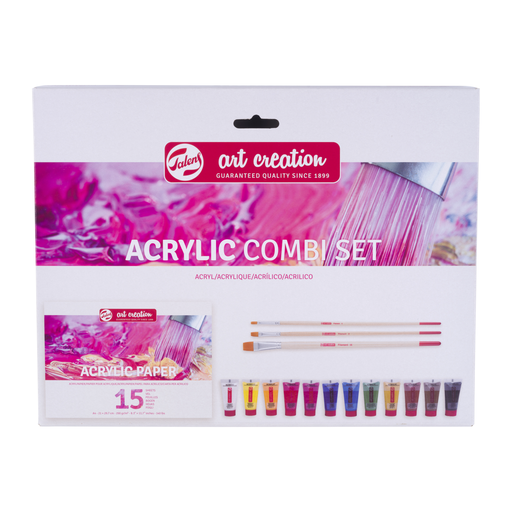
Why it stands out: This set is the ultimate starter solution. It contains not only a basic colour palette but also the essential accessories to get started right away. A cohesive package that removes any doubt about choosing initial supplies.
Key features:
Who is it for? This kit is ideal for absolute beginners or as a gift. It provides everything needed for a successful first experience without having to purchase separate items.
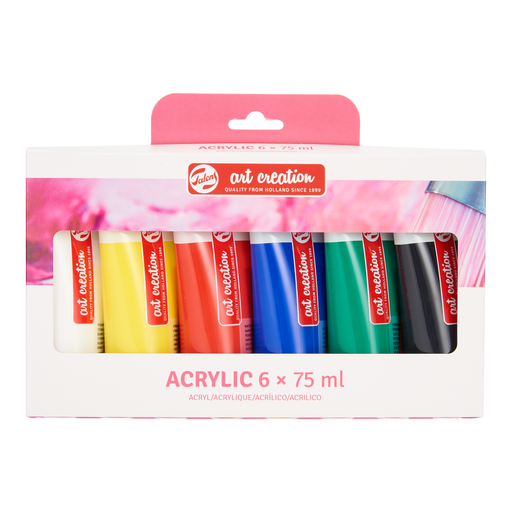
Why it stands out: This set focuses on quantity over a wide variety of shades. It offers six fundamental colours in a large format, a great asset for artists who work on large surfaces or prefer to create their own shades from the primaries.
Key features:
Who is it for? Perfect for artists and students who already have their supplies and are looking to build up a stock of basic colours in a large format for their projects.
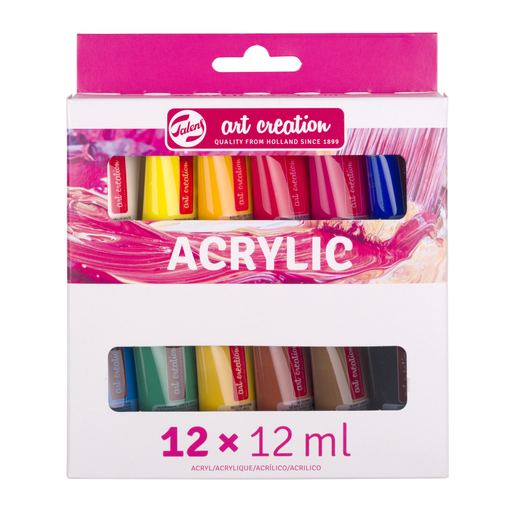
Why it stands out: This is the quintessential classic and reliable acrylic paint set. It offers a well-balanced colour palette in a standard format, making it a versatile choice for a multitude of projects. The renowned quality of Talens acrylic paint is a trusted choice for achieving beautiful results.
Key features:
Who is it for? This assortment is perfect for art students, hobbyists looking to expand their colour collection, or anyone seeking a quality paint set without accessories.
If these suggestions don't quite match what you're looking for, or if you want to explore other crafts, we've got you covered. Explore an even wider range of art supplies in our dedicated category.
The fundamental difference lies in the binder. Acrylic paint uses a plastic resin (acrylic polymer) which, upon drying, becomes permanent and water-resistant. Gouache, on the other hand, uses a soluble gum arabic binder, meaning it remains "rewettable" with water even after drying and provides a matte, opaque finish.
Acrylic is incredibly versatile. It adheres perfectly to most porous, non-greasy surfaces like canvas, paper, cardboard, wood, plaster, stone, or even cement. For very smooth or non-porous surfaces (plastic, metal), applying a primer (like Gesso) is recommended to ensure optimal adhesion.
Acrylic paint is known for its rapid drying time. A thin layer can be dry to the touch in just a few minutes. A thicker layer will require an hour or more. The time it takes to be fully cured "to the core"—the point at which all the water has evaporated and the paint reaches its final hardness—can range from a few hours to several days, depending on the thickness of the layer and the ambient conditions (humidity, temperature).