
Livraison le jour même ou le lendemain

Qualité garantie

Débloquez vos offres de bienvenue: Livraison GRATUITE | Jusqu'à -80 % | 30 jours d'essai gratuits à JoyPlus
Téléchargez l'application
Personalising a mug, decorating a pebble, doing lettering on wood or adding metallic details to a canvas: acrylic paint markers lend themselves to a huge range of creative projects. But not all acrylic pens behave the same way, depending on the surface, the nib or the ink formulation.
Before you place an order, three common pitfalls keep cropping up:
Dual-tip acrylic markers let you switch between uses without changing tools. A round or chisel nib of 3–4 mm works well for solid areas and bold lines, while a 0.7–1 mm nib makes outlines, details and writing much easier.
Brush-tip models vary the line width depending on how much pressure you apply. They are especially good for adult colouring, calligraphic effects and more fluid strokes. For covering a surface quickly, a bullet or chisel nib is generally more efficient.
Opaque acrylic pens are particularly useful on stained wood, stone, painted metal or dark-coloured objects. However, do check the exact formulation: an ink that’s described as water-resistant once dry isn’t necessarily designed to withstand repeated washing, the dishwasher or prolonged outdoor exposure.
Waterproof paint pens can work for decorations that might get splashed, but it’s best to take a few precautions:
On fabric, performance depends on the type of textile, the fixing method and how you care for it. So a “for fabric” label doesn’t automatically guarantee the design will survive every wash.
Acrylic paint markers with a “shake & pump” system need you to mix the ink, then press the nib several times to prime it. This step gives you a steady flow, but you should do it on a scrap sheet to avoid any excess ink.
After use, close each cap firmly and store the pens horizontally if the packaging recommends it. A dried-out nib, a poorly clipped cap or storage near a heat source can shorten the marker’s life. Metallic pigments and heavily loaded inks also need regular shaking to keep the colour evenly distributed.
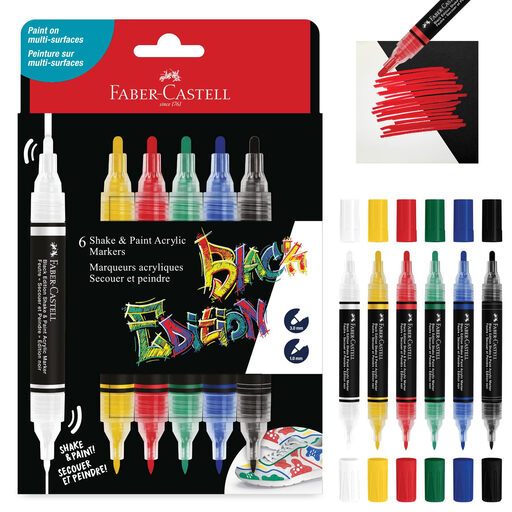
Why this choice suits this profile: This six-colour set covers the everyday needs of drawing, writing, decorating and DIY, without having to buy lots of different references from the start.
The two nibs – 3 mm and 1 mm – mean you don’t have to buy separate pens for solid areas and fine details.
Water-based opaque acrylic ink, Shake & Paint system and stated compatibility with paper, wood, glass, metal, plastic, stone and fabric.
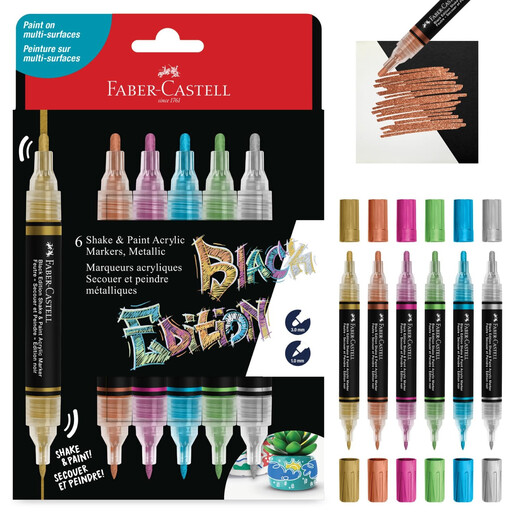
Why this choice suits this profile: Its metallic palette is aimed at decorative creations, mixed media and personalisations that need more striking visual effects.
The metallic shades and opaque ink are designed to stand out better on dark or coloured backgrounds, provided you test them first.
Six metallic colours, dual nibs of 3 mm and 1 mm, opaque acrylic ink stated to be water-resistant once dry.
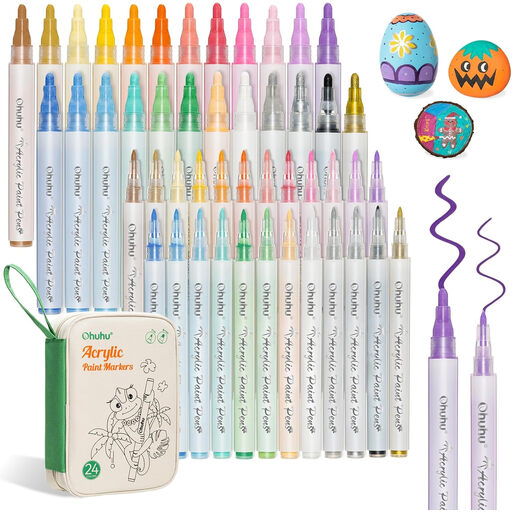
Why this choice suits this profile: The double nib assortment and 24 coordinated colours are ideal for varied workshops, object decorating and batch projects.
The fine 0.7 mm nibs and reversible round and chisel nibs reduce the compromises between precision, outlines and filling.
48 markers, 24 colours in duplicate, highly pigmented water-based ink and stated compatibility with stone, wood, glass, ceramic, plastic, paper and fabric.
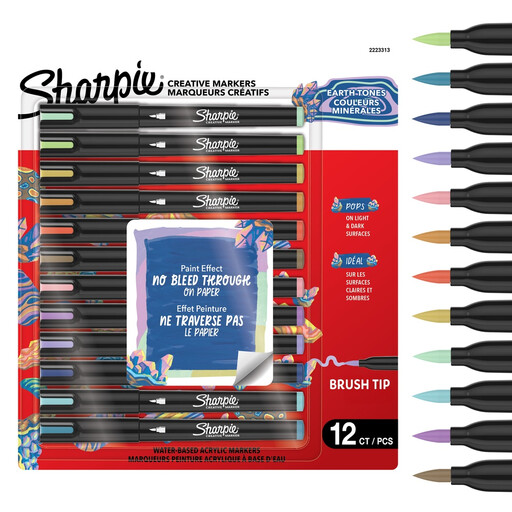
Why this choice suits this profile: The brush tip lets you vary the line width for adult colouring, lettering effects and more expressive drawings.
Direct application with no pump priming means you can start straight away. Drying between layers also helps prevent accidental colour mixing.
Set of 12 warm tones, water-based acrylic ink and brush tip for fine or broad strokes depending on pressure.
We’ve put together a comprehensive, real-time updated selection of products that meet these demanding criteria and European safety standards.
Yes, some models state they are compatible with glass and ceramic. Start by cleaning and degreasing the surface, then test the adhesion on a small area. For an item that gets washed frequently, check the manufacturer’s instructions and consider a compatible protective finish.
Replace the cap until it clicks after every use. Horizontal storage is often recommended to keep the ink flowing evenly. If the nib seems less saturated, shake the marker and reactivate it using the intended system, without pressing too hard.
Drying time depends on the thickness of the line, the porosity of the surface, the humidity and the ventilation. A fine line generally dries faster than a solid area. Wait until the surface is completely dry before layering another colour or applying a varnish.