
Livraison le jour même ou le lendemain

Qualité garantie

Débloquez vos offres de bienvenue: Livraison GRATUITE | Jusqu'à -80 % | 30 jours d'essai gratuits à JoyPlus
Téléchargez l'application
Acrylic paint markers let you personalise paper, wood, glass, metal, ceramics, stone and even some textiles. But a rushed purchase can quickly lead to disappointment: a nib that collapses, colour that is too transparent or ink that is unsuitable for the intended surface.
Before choosing your acrylic pens, it is therefore worth distinguishing the features that really matter from marketing claims that are harder to verify.
The term multi-surface acrylic markers generally means that the ink is designed for use on several types of surface. It does not guarantee identical results on absorbent paper, smooth glass or porous stone. Surface preparation, drying time and how the item will be handled all directly affect how well the design lasts.
Always clean and degrease the surface, then test the marker on an inconspicuous area. For an item intended to stay outdoors or be handled regularly, check the manufacturer’s recommendations and, if necessary, plan to apply a finish that is compatible with the material.
A well-stocked set of acrylic markers may seem like a great deal. However, a huge palette cannot make up for shades that are too similar or an unsuitable nib. For beginners, six carefully selected colours — including white, black and a few primary shades — often offer more creative possibilities for creating contrast and layering.
For colouring as well as lettering, palette cohesion matters just as much as its size. Pastel, earthy, fluorescent and metallic shades are suited to very different uses.
A fine nib is ideal for outlines and details, while a medium nib lets you cover larger areas more quickly. Dual-ended acrylic paint pens reduce the number of tools you need to carry, but they require a little more care when stored.
Close each cap firmly after use. Depending on the model, shake the marker before using it and prime the nib on a scrap sheet of paper. Horizontal storage is often recommended to maintain an even ink flow.
Water-based acrylic inks are generally popular because they have a low odour and are easier to clean before they dry. Check the information provided about opacity, finish and how the ink behaves once dry:
These permanent paint pens should not be used on skin, food items or surfaces intended to come into direct contact with the mouth. Protect your work area too, as the ink can stain textiles.
Fine-tip acrylic markers are suitable for outlines, detailed drawing, decorative patterns and precise writing. Medium-tip acrylic markers offer a good compromise for drawing, colouring and filling larger areas.
A 4 mm round nib, like that found on some Clairefontaine models, produces an even line. Faber-Castell markers with 1 mm and 3 mm dual tips let you switch from details to broader lines without changing pens. A brush tip, meanwhile, varies the line thickness according to the pressure applied, making it particularly suitable for lettering and broad brush strokes.
For acrylic markers for glass, wood, metal and ceramics, check that the product listing explicitly mentions the surfaces you are interested in. Glass and metal are smooth and not very absorbent, so a clean, dry surface is essential. Wood can absorb more ink and may require several coats. Glazed ceramics also deserve a preliminary test.
For outdoor projects, rain, rubbing and ultraviolet rays can affect the finish. Ink described as water-resistant does not automatically replace a suitable protective coating.
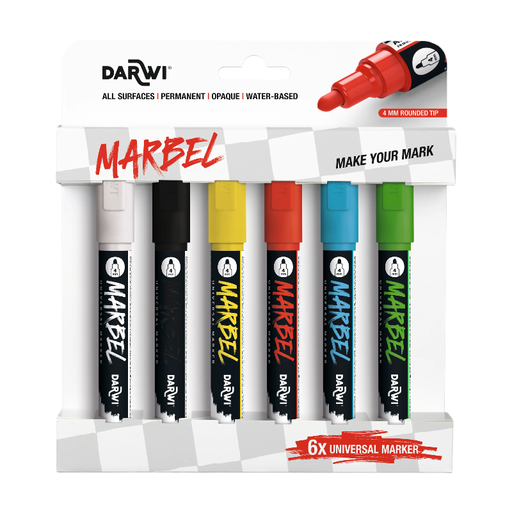
Why this choice suits this user profile : This set of six essential colours is perfect for your first drawing, personalisation and creative hobby projects, without having to buy a multitude of different products.
The palette combines white, black and four primary colours, giving you a simple, well-balanced choice without redundant shades.
Water-based acrylic ink, described as odourless in the product listing, with a medium 4 mm round nib and a matt opaque finish.
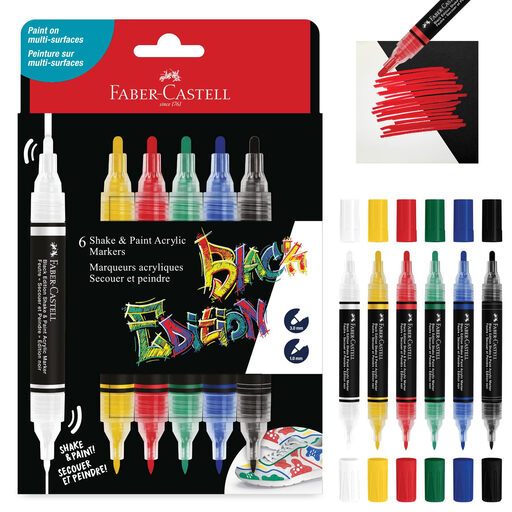
Why this choice suits this user profile : This format is designed for creatives who want to switch between broad coverage and detail in lettering, drawing or decoration projects on different materials.
The 3 mm and 1 mm nibs mean that one tip does not have to handle both precise outlines and larger areas.
Six opaque colours, “Shake & Paint” system, ink described as water-resistant once dry, and compatibility indicated for paper, wood, glass, metal, plastic, fabric and stone.
Why this choice suits this user profile : Creators who regularly decorate dark objects, stones, jars or decorative pieces may appreciate this metallic palette and its different line widths.
The 1 mm nib handles details while the 3 mm nib covers larger areas, and the push-to-prime system helps you control the ink flow.
Six metallic shades, dual 1 mm and 3 mm round tips, opaque acrylic ink described as water-resistant and suitable for several surfaces.
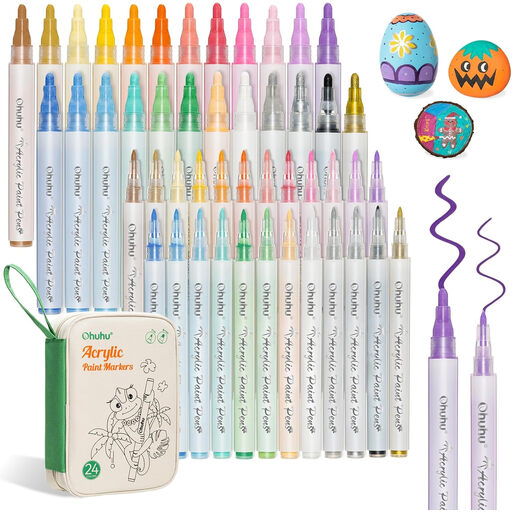
Why this choice suits this user profile : This set is ideal for anyone who alternates between colouring, detailed drawing, pebble painting and personalising objects.
The 24 fine 0.7 mm nibs are separate from the 24 markers with reversible tips, limiting the compromise between precision and coverage.
48 pieces, 24 colours, fine, round and chisel tips, with water-based ink described as highly opaque in the product listing.
We have brought together a complete, real-time updated selection of products that meet these demanding criteria as well as European safety requirements.
Products intended for creative hobbies often have small caps. Keep them out of reach of children under 3 years of age. Use them in a properly ventilated area and do not apply them to skin.
Some models explicitly list glass and ceramics among the compatible surfaces. Clean the surface thoroughly, carry out a test and then allow it to dry according to the manufacturer’s instructions. Resistance to washing and rubbing depends on the product, the finish and any treatment applied afterwards.
For details and outlines, choose fine-tip acrylic markers. A medium nib is better suited to larger filled areas and broad shapes. To vary the thickness of lettering naturally, a brush tip can be particularly useful. Dual-ended models combine two uses in a single tool.
Its usable life depends on how often it is used, the area covered, storage conditions and how securely the cap is closed. A marker that is properly capped and stored according to the instructions will generally remain usable for longer than a pen exposed to air or heat. If the nib dries out, check the model’s instructions before attempting to clean it.