
Livraison le jour même ou le lendemain

Qualité garantie

Débloquez vos offres de bienvenue: Livraison GRATUITE | Jusqu'à -80 % | 30 jours d'essai gratuits à JoyPlus
Téléchargez l'application
The acrylic paint marker has become an essential tool for artists and crafting enthusiasts. Its promise is undeniably appealing: all the richness of acrylic paint in a format as simple and convenient as a marker. The downside? The market is now saturated with options, and disappointment is common. A set that looked perfect online can turn out to be nearly unusable after just a few weeks. To ensure you invest in materials that live up to your creativity, it's crucial to know the pitfalls to avoid.
The two most common problems? Nibs that fray or dry out in record time, and ink with such poor opacity that you have to apply multiple coats, ruining the smooth finish of your work in the process. The "multi-surface" claim is also a classic source of disappointment, with adhesion that is often mediocre on non-porous materials like glass or ceramic.
This guide gives you all the keys to deciphering product specs and making the right choice.
To avoid unpleasant surprises, focus on three essential criteria: the nib type, the ink quality, and the actual compatibility with the surfaces you plan to use.
The nib is the first thing to consider, as it directly determines the type of creations you can produce.
The crucial element of an acrylic marker is its ink. If it's poor quality, it will be translucent, lack coverage, and its colours will fade over time.
The multi-surface acrylic marker argument is often highlighted, but the reality is more nuanced. Adhesion varies enormously from one surface to another.
Rather than an endless list, we have selected products that meet specific needs, keeping our criteria of quality and versatility in mind.
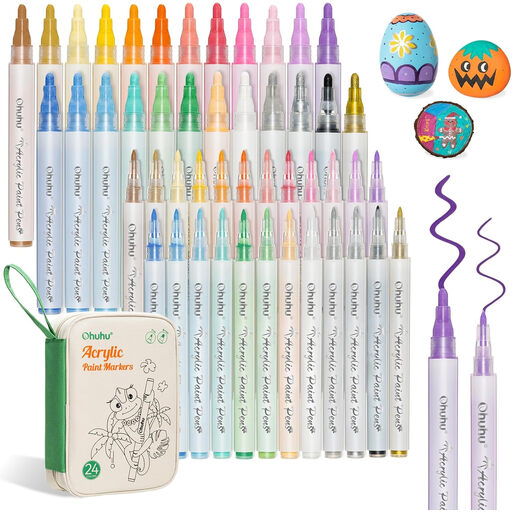
Why we chose it: This set is designed for maximum versatility. It combines 24 fine-tip markers for details and 24 reversible-tip markers (round/chisel) for solid areas, with each duo sharing the same shade for perfect consistency.
The reversible nibs double the marker's lifespan and prevent the frustration of a damaged tip. If one side frays, you just flip it over.
Two nib types for each colour, offering total flexibility to switch from fine details to broad strokes without changing your palette.
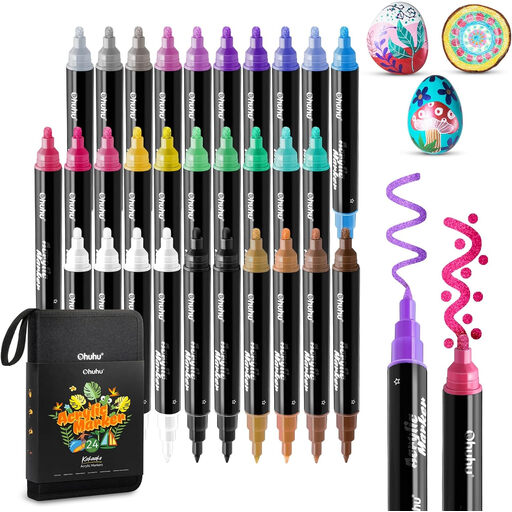
Why we chose it: This set stands out with its wide palette of 30 colours, including numerous metallic, glitter, and neon shades. It's perfect for adding spectacular effects and a touch of originality to your objects, cards, or illustrations.
Its highly opaque ink ensures excellent coverage, even on dark surfaces. No more falling into the trap of metallic or light colours that lack density and require multiple coats.
The dual tip (fine and medium) and the 8 included replacement nibs make it a long-lasting investment for all types of creative projects.
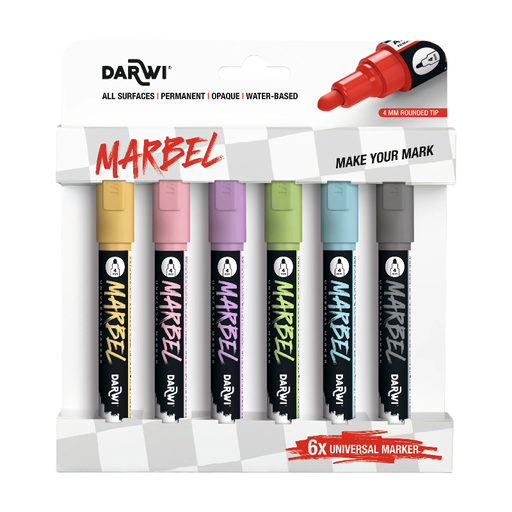
Why we chose it: Ideal for getting started with a coherent themed palette without investing in a large **set of acrylic markers**. Clairefontaine, a benchmark brand, offers several sets (pastel, metallic, primary, etc.) with renowned ink quality.
By choosing a leading stationery brand, you ensure consistent and reliable ink quality. The water-based ink is highly opaque and provides a permanent matte finish on most surfaces.
The 4 mm medium round nib is very versatile for beginners, and its odourless ink is perfect for indoor **crafting sessions**.
Explore our full selection of markers, chosen for their quality and versatility, and find the perfect tool for every project.
Most new markers need to be primed. Shake it vigorously (with the cap on) for a few seconds to mix the pigments well. Then, on a scrap piece of paper, gently pump the tip repeatedly until the ink fully saturates it and begins to flow. Your marker is ready!
For maximum durability on non-porous surfaces, a setting step is essential. After letting your creation dry for 24 hours, place the object in a cold oven. Turn on the oven and set it to about 160°C (320°F). Let it bake for 30 to 45 minutes. Then, turn off the oven and let the object cool down completely inside before handling it. Be sure to always check the manufacturer's instructions, as baking temperatures and times may vary.
The vast majority of acrylic markers for creative hobbies are water-based, formulated to be non-toxic and virtually odourless. They are therefore considered safe for indoor use, even by younger people. However, it is still recommended to work in a well-ventilated area and avoid direct contact with skin or eyes. Adult supervision is, of course, advised for children. For added safety, check for certifications like the European EN 71 or American ASTM D-4236 standards, which guarantee the absence of harmful substances.