
Livraison le jour même ou le lendemain

Qualité garantie

Débloquez vos offres de bienvenue: Livraison GRATUITE | Jusqu'à -80 % | 30 jours d'essai gratuits à JoyPlus
Téléchargez l'application
The excitement of a new creative project can quickly fade when faced with disappointing supplies. An acrylic paint marker that promises perfect opacity but turns out to be transparent on a dark surface, a tip that frays after a few strokes, ink that bleeds… These all-too-common setbacks can ruin your creations.
Instead of trusting promising packaging, it's better to understand what truly sets a good acrylic pen apart from the rest. Here are the pitfalls to avoid and the essential criteria for making the right choice.
paint pen may boast that it's a multi-surface marker, but its performance varies enormously from one medium to another. Ink that flakes off glass or fails to adhere to metal is a classic problem.To avoid these traps, focus on three key technical aspects. They will help you choose the perfect marker for your projects, whether it's for adult colouring pens or customising objects.
The tip is the signature of your stroke. Choosing the wrong shape can limit your creativity.
The effectiveness of a marker for stone or a wood paint pen rests entirely on its ink.
A quality water-based acrylic ink should offer opaque coverage even on dark surfaces, thanks to a high concentration of pigments. Modern formulas go even further, often allowing for immediate use without needing to shake the marker—a significant saving in time and effort. For sketchbook enthusiasts, an ink that doesn't bleed through the paper is also an essential criterion.
One of the superpowers of acrylic paint is its ability to be layered. A good marker should allow you to apply one colour over another (once dry) without the shades mixing or bleeding. This property is essential for adding details, highlights, or creating depth in your artwork. Make sure the product mentions a formula designed for clean layering.
Every creative project has its own demands. Here are recommended options, paired with specific uses to help you find the acrylic Sharpie or pen that fits your needs.
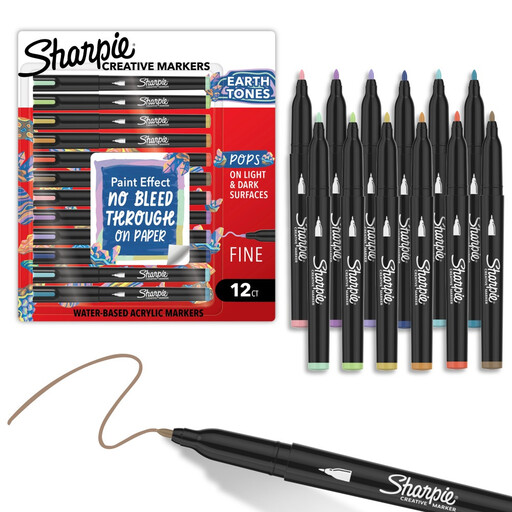
Perfect for fans of adult colouring, "mystery colouring" books, or anyone who needs to draw clean lines and precise details. The fine tip offers maximum control for meticulous work.
Its pigment-rich, water-based ink remains opaque on both light and dark surfaces, avoiding the trap of false translucency. Its formula allows for clean layering of colours without bleeding.
Fine tip for surgical precision. "No-shake" formula for immediate use and a perfectly consistent ink flow.
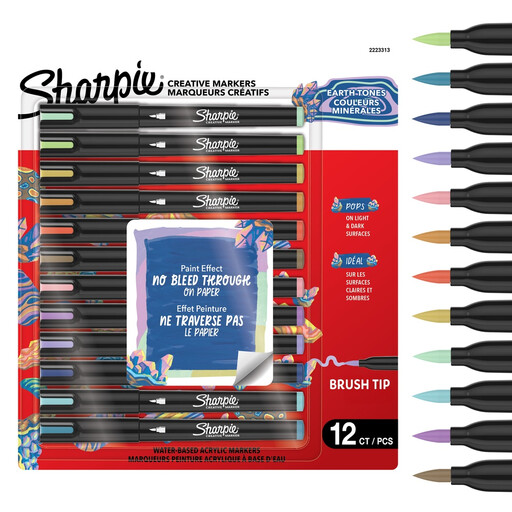
The choice for illustrators, hand-lettering fans, and artists who love to play with line weight. The brush tip offers a flexibility that mimics traditional painting with the simplicity of a marker.
Its brush tip is designed to last without fraying. The opaque, layerable ink ensures a vibrant result on a multitude of surfaces, including wood, ceramic, and canvas.
Brush tip for dynamic and expressive strokes. The "paint-like" ink provides a rich finish and layers perfectly to create effects of depth.
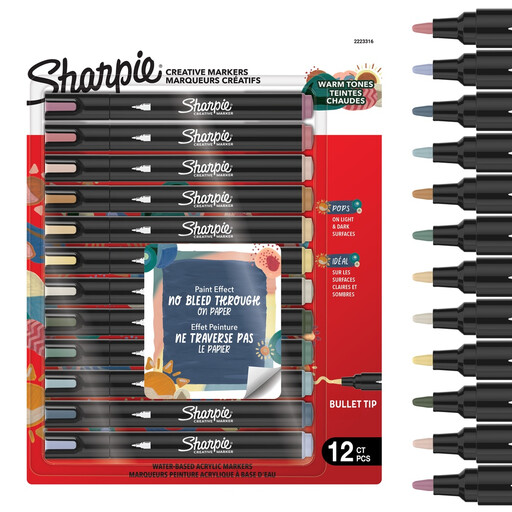
Designed for those who customise objects, paint on rocks, decorate ceramics, or work on canvas. The bullet (conical) tip is robust and delivers a consistent line, ideal for covering surfaces and drawing on all sorts of materials.
This marker lives up to its "multi-surface" promise with excellent adhesion and opacity on metal, wood, glass, and stone. Its durable formula ensures the longevity of your creations.
Bullet tip is versatile for full, even lines. Its ultra-visible ink on both light and dark surfaces makes it the perfect ally for DIY and decor projects.
We've compiled a complete selection of products that meet these demanding quality criteria.
To preserve the ink flow and tip quality, the best practice is to store your markers horizontally. This prevents pigments from settling at one end. And of course, always recap the marker tightly after each use to prevent the ink from drying out.
Absolutely, it's one of the great advantages of acrylic ink. For a flawless result, let the first layer of colour dry completely before applying the next. This will prevent the shades from merging, allowing you to create very clean depth and relief effects. Quality markers are specifically formulated for this.
It all depends on the object's use. For an artwork on paper or canvas that won't be handled, a varnish is optional. However, for decorative or everyday objects (mugs, rocks, phone cases), applying a finishing varnish (matte, satin, or gloss) is highly recommended. It will protect your creation from wear, scratches, and moisture, ensuring much greater longevity.