
Livraison le jour même ou le lendemain

Qualité garantie

Débloquez vos offres de bienvenue: Livraison GRATUITE | Jusqu'à -80 % | 30 jours d'essai gratuits à JoyPlus
Téléchargez l'application
The acrylic marker is an invaluable tool for artists, illustrators, and crafting enthusiasts. By combining the richness of acrylic paint with the simplicity of a pen, it unleashes creativity on any surface, from customising objects to drawing on canvas. The problem is, the market is flooded with products that often fail to deliver on their promises. As product experts at Joybuy, our mission is to navigate this landscape for you, helping you find the perfect marker for your projects and say goodbye to unpleasant surprises.
Before you get started, here are the common pitfalls to avoid:
To make the right choice, focus on a few technical details that make all the difference in the real-world performance of an acrylic marker.
The shape and size of the tip are crucial for the type of work you want to do.
Some models feature a dual tip (e.g., fine and bullet), providing a 2-in-1 solution that is both practical and cost-effective.
The quality of an acrylic paint pen depends on its ink. A water-based and highly pigmented ink is a hallmark of quality. It ensures opaque, vibrant colour, even in a single coat.
For creations that stand the test of time, make sure the ink is labelled "water- and light-resistant" once dry. This property is essential for customising objects that will be handled or exposed to the elements, like a marker for pebbles in the garden, a marker for wood on furniture, or a marker for glass on decorative tableware.
There's no one-size-fits-all acrylic marker. It's better to choose a model tailored to your creative needs. Here are our recommendations, tested and approved for different uses.
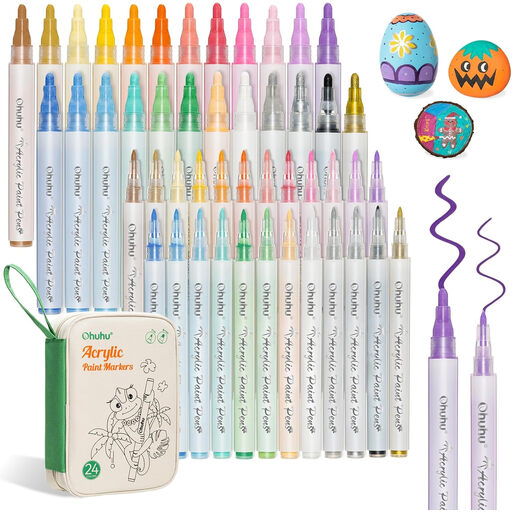
Why we chose it: Perfect for those who love to explore without limits. This set combines 24 fine-tip markers for details and 24 reversible-tip markers (bullet/chisel) for filling, all in the same shades for perfect consistency.
By offering two tip types for each colour, it saves you from buying multiple sets to vary your styles, while ensuring flawless coverage thanks to its pigmented ink.
Absolute versatility: 4 tip types (fine, bullet, chisel) in a single box set. The ink is water-resistant and works on numerous surfaces.
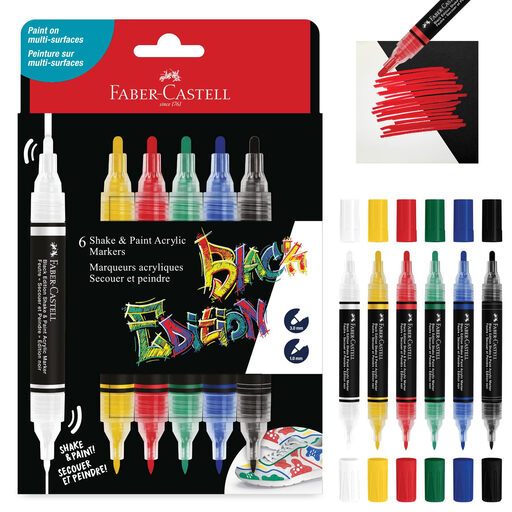
Why we chose it: For artists who make no compromises on pigment quality and reliability. Faber-Castell is a benchmark brand, and this set is no exception. The dual tip is a major asset.
Its ultra-opaque ink guarantees perfect coverage, even on dark surfaces, thereby avoiding the transparency trap. The "Shake & Paint" system ensures a constant ink flow and prevents drying.
Professional-grade pigment quality for intense, long-lasting colours. The dual tip (1 mm and 3 mm) offers great flexibility for drawing and colouring.
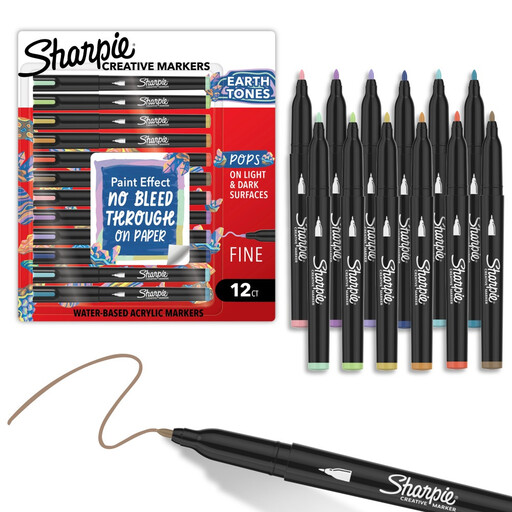
Why we chose it: The Sharpie name is synonymous with marking on the most challenging surfaces. This fine-tip set is perfect for personalising metal, wood, ceramic, or glass objects with precise details and long-lasting colours.
It debunks the myth of "false versatility." Its ink is formulated for durable adhesion on both light and dark surfaces without flaking, where other markers fail.
Its strong suit: rock-solid adhesion on a myriad of materials. The ink can be layered without bleeding, allowing you to create depth effects in your designs.
We have curated a complete range of products that meet our strict selection criteria and current safety standards.
Most models with a pump system (like the Faber-Castell ones) need to be primed before first use. Shake the marker vigorously with the cap on to mix the pigments well. Then, on a piece of scrap paper, gently pump the tip several times until the ink fully saturates it. For storage, it's advisable to store the markers horizontally to maintain an even ink distribution and always replace the cap securely after use.
Yes, and that's one of the great advantages of acrylic paint. Once a colour is dry, it becomes opaque and permanent, allowing you to apply another colour on top without them mixing. This is ideal for adding details, highlights, or correcting a small mistake. Let the first layer dry completely before applying the next to avoid smudging.
Adhesion varies. On porous surfaces like paper, cardboard, raw wood, or fabric, the ink is absorbed and becomes very permanent. On smooth, non-porous surfaces (glass, ceramic, plastic, metal), the ink adheres well once dry but may still be susceptible to scratching. For maximum durability on these materials, applying a clear protective varnish is highly recommended after the ink has fully dried. For ceramics or glass, baking at a low temperature in an oven (following the manufacturer's instructions) can set the ink permanently.