
Livraison le jour même ou le lendemain

Qualité garantie

Débloquez vos offres de bienvenue: Livraison GRATUITE | Jusqu'à -80 % | 30 jours d'essai gratuits à JoyPlus
Téléchargez l'application
Acrylic markers are used for drawing, writing or decorating paper, wood, glass, metal, ceramic, stone and, occasionally, fabric. But not all paint pens are created equal, and they aren't all suited to the same tasks. A tip that's too broad, ink that lacks opacity, or poor compatibility with your surface can quickly turn a creative project into a disappointing purchase.
Before you fill your basket, let's run through the main pitfalls to avoid and the criteria that will help you compare paint pens effectively.
Some pens are designed for colouring on paper and blend with water. They don't necessarily form an opaque, adhesive layer on a non-porous surface. Acrylic paint markers, on the other hand, deposit a layer that's generally more opaque and better suited to customising objects.
So check for the words acrylic ink, the recommended surfaces and the usage instructions. A watercolour pen can be perfect for drawing, but that doesn't mean it will work on glass or metal.
A waterproof acrylic marker may resist water once dry, according to the manufacturer's instructions. That doesn't mean your design will necessarily withstand the dishwasher, repeated rubbing, solvents or prolonged outdoor exposure.
For a durable decoration, clean and degrease the surface carefully, let the ink dry and test it on an inconspicuous area. On items that are handled regularly, applying a finish suited to the material may also be necessary.
A set of 60 or 100 pens isn't always the most sensible choice for decorating pebbles, drawing outlines or practising lettering. The shape of the tip, its diameter and its ability to stay consistent often matter more than the total number of shades.
To get started, a selection of 6 to 12 well-chosen colours already covers most everyday needs. Larger palettes become interesting for illustration, mixed media or creating gradients.
If you're working on dark wood, stone, metal or a coloured surface, look for an opaque, pigmented ink. Light shades, especially white and metallic colours, need to be opaque enough to remain clearly visible.
Water-based ink is often easier to clean when it's still wet. However, it can stain textiles and porous surfaces. Read the safety instructions and check that the product is intended for artistic use, not for food contact or application on skin.
A diameter of 0.7 to 1 mm is practical for details. A tip of 3 to 4 mm lets you cover an area quickly, but is less comfortable for small lettering.
Acrylic ink markers with a pump system usually require you to shake the closed body, then prime the tip on a scrap sheet. Ready-to-use models don't always need this step. In any case, replace the cap firmly after use and store the pens flat if the instructions recommend it.
Also check the warnings about small parts, minimum age of use, contact with eyes and ventilation. For products sold in the European Union, the manufacturer's or responsible person's information must be accessible. No artistic marker should be used on skin or on a surface in direct contact with food without explicit instructions.
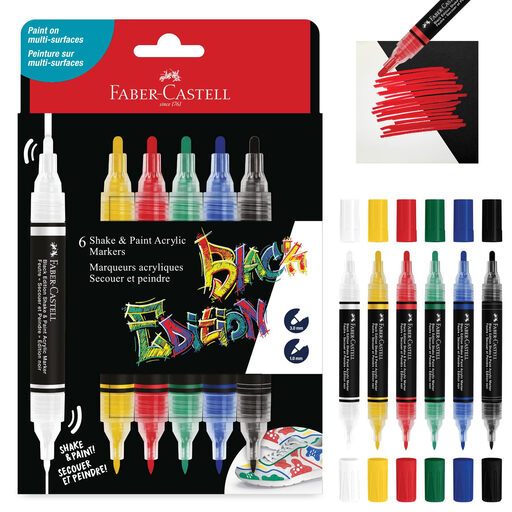
Why this choice suits this profile: This set of 6 colours covers everyday projects without multiplying the references. It's suitable for drawing, calligraphy and customising paper, wood, glass, metal, plastic, stone or fabric.
The dual tip of 3 mm and 1 mm means you don't have to buy separate markers for filling in and details. The ink is described as opaque, water-resistant and durable after drying.
6 classic shades, two round tips and compatibility stated with several surfaces.
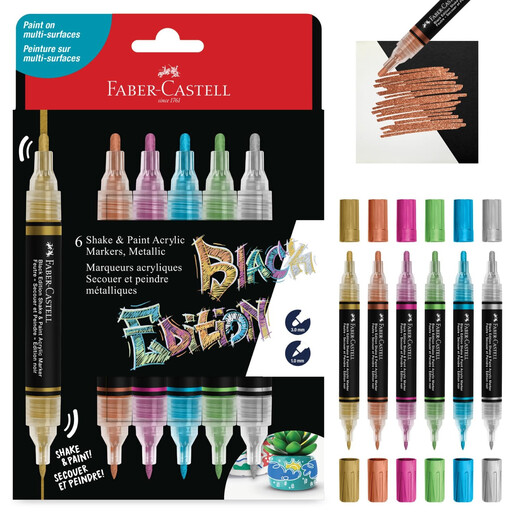
Why this choice suits this profile: The metallic shades are ideal for decorative creations and mixed media projects, where contrast on a dark surface matters more than an extensive palette.
The dual tip and opaque ink meet the needs of both precision and filling in. The preparation by shaking is clearly indicated to resuspend the pigments.
6 metallic colours, 3 mm and 1 mm tips, use stated on glass, stone, metal, wood, plastic and fabric.
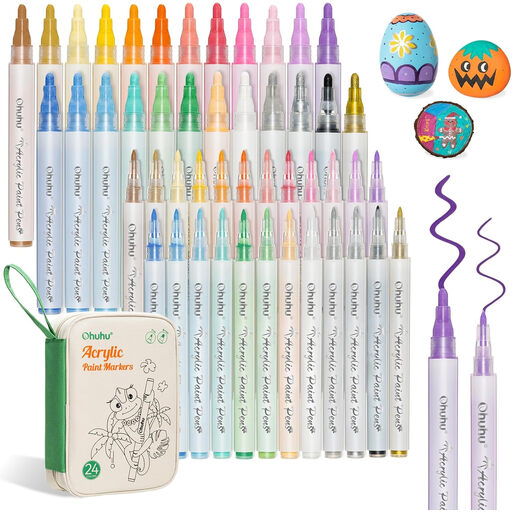
Why this choice suits this profile: This set brings together 24 fine tips and 24 reversible tips. It's aimed at people who switch between small details, filling in and projects on different materials.
The 0.7 mm, round and chisel tips minimise the compromise between precision and coverage. The manufacturer states use on wood, glass, metal, ceramic, stone, fabric and paper.
48 markers, 24 assorted colours and a water-based ink described as opaque, water-resistant and lightfast.
We've put together a comprehensive, real-time selection of products that fully meet these demanding criteria, while also taking European safety regulations into account.
They can adhere to glass if it is clean, dry and degreased. Test it first and let the ink dry following the manufacturer's instructions. For glass intended for food contact or subject to frequent washing, check the product-specific restrictions.
Close it immediately after use, clean the tip if necessary and follow the storage conditions stated. Pump models should be primed gradually, without applying excessive pressure. Also avoid leaving the markers near a heat source or in direct sunlight.
A fine tip produces a more consistent line, suitable for outlines, details and writing. A brush tip varies according to the pressure applied and is ideal for thick and thin strokes, lettering and expressive illustrations. So the choice depends above all on the stroke you're after, rather than the number of colours in the set.