
Livraison le jour même ou le lendemain

Qualité garantie

Débloquez vos offres de bienvenue: Livraison GRATUITE | Jusqu'à -80 % | 30 jours d'essai gratuits à JoyPlus
Téléchargez l'application
Acrylic markers let you draw, write or personalise paper, wood, glass, metal, ceramic, stone, plastic and sometimes fabric. However, not all acrylic paint pens are suited to the same tasks. A nib that’s perfect for colouring may lack the precision needed for lettering, while an ink described as permanent might need extra protection on an item you handle regularly.
Before buying a set, it’s worth focusing on the practical features rather than just the number of colours.
The term “multi-surface” usually means the ink can be applied to several materials. It doesn’t guarantee the same durability on porous paper, smooth glass or fabric that’s washed frequently. Surface preparation, drying time and finishing all play a key role in the final result.
For a project you want to last, clean the surface, remove any dust and test on an inconspicuous area. On fabric, check the manufacturer’s instructions and test the resistance after drying.
A set of 48 acrylic markers might look appealing, but it won’t necessarily replace six well-chosen colours with complementary nibs. To start with, a palette that includes white, black, primary colours or easy-to-match shades will often be more useful than a large, poorly coordinated box.
Metallic acrylic markers and neon acrylic markers are especially handy for adding accents, working on dark surfaces or decorating objects. However, they don’t cover every drawing need.
A nib that dries out or becomes clogged quickly makes a marker frustrating to use. Pressure-priming models need to be shaken with the cap on, then pumped on a test surface. Other markers may be ready to use straight away, but storing them horizontally is still often recommended.
Always replace the caps after use and avoid leaving markers in direct sunlight or near a heat source.
The shape of the nib isn’t everything: its flexibility, ink flow and ability to maintain a consistent line matter just as much.
An opaque acrylic ink covers coloured or dark surfaces more easily. A water-based formula can be more pleasant to use and simpler to clean up before it dries, but it can still stain clothes and furniture.
Terms like water-resistant, permanent or durable should be interpreted according to the surface. They don’t necessarily mean the decoration will withstand the dishwasher, repeated rubbing or the elements. For outdoor use or on an item that’s handled regularly, check the manufacturer’s guidelines and consider a compatible finish.
Compare the number of markers, the colours included, the nib type and the ink volume when that information is available. A set of six colours can be perfectly suited to specific projects, while a larger assortment will be better for decorating, adult colouring or creations that combine several techniques.
To follow safety precautions in France, do not use these markers on skin or on surfaces intended for food contact. The caps are small parts: keep markers out of reach of children under 3 years old and work in a well-ventilated area, especially on non-porous surfaces.
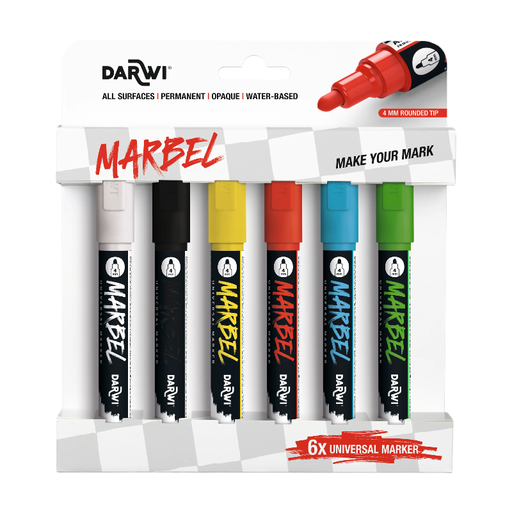
Why this choice suits this profile: This set of six essential shades offers a 4 mm round tip for starting out with drawing, colouring and personalisation without buying lots of extras.
The primary palette limits unnecessary duplicates, while the medium tip stops you being restricted to just one type of stroke.
Water-based acrylic ink, odourless according to the product sheet, opaque finish and colours include white, black, yellow, red, cyan and green.
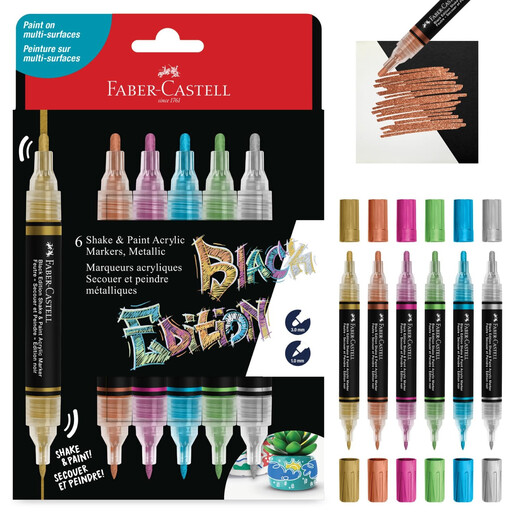
Why this choice suits this profile: Creators who value polished finishes and object personalisation get a metallic palette and two line widths here.
The Shake & Paint system and priming on a test surface make the ink flow easier to control than with a marker that has an unpredictable output.
Six metallic shades, dual round tip of 1 mm and 3 mm, opaque ink described as water-resistant once dry.
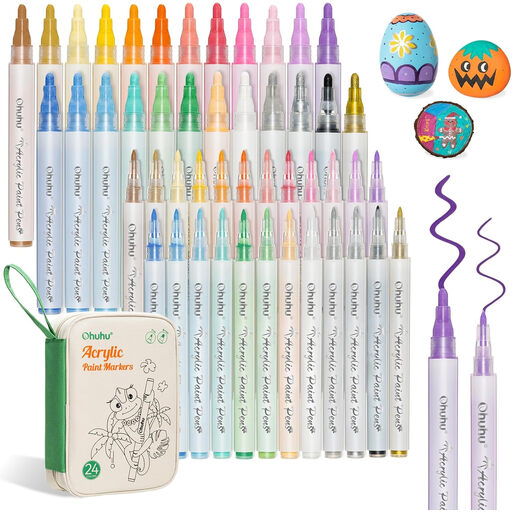
Why this choice suits this profile: This large set is ideal for frequent projects, creations on multiple surfaces and people who switch between details, blocks of colour and outlines.
The 24 colours come with a fine tip and a reversible round or chisel tip, rather than limiting you to a single width.
48 markers in total, highly pigmented water-based ink according to the product sheet, ink level indicators and storage case.
We’ve put together a complete, real-time selection of products that meet these demanding criteria and comply with European safety regulations.
For pump-action models, such as some Faber-Castell Shake & Paint, shake the marker with the cap on, then press the tip several times on a test surface. Sharpie models described as ready to use don’t need this step. In any case, check the instructions and recap the marker immediately after use.
The lifespan depends on how often you use them, the pressure applied and storage conditions. A cap that isn’t properly closed can dry out the nib quickly. Store markers horizontally in a cool, dry place, and gently clean the nib if the instructions allow. The shelf life doesn’t guarantee the drawing will hold on all materials.
Not always. “Permanent” usually describes how well the deposit holds on certain surfaces, but wash resistance varies depending on the fabric, preparation, drying and finishing. Test it, let it dry completely and follow the manufacturer’s recommendations. For an item exposed to water or subject to rubbing, plan a compatible protective layer rather than relying solely on the label.