
Livraison le jour même ou le lendemain

Qualité garantie

Débloquez vos offres de bienvenue: Livraison GRATUITE | Jusqu'à -80 % | 30 jours d'essai gratuits à JoyPlus
Téléchargez l'application
The acrylic marker has become a go-to tool for creative hobbyists, artists, and object customisation pros. Promising to combine the richness of acrylic paint with the simplicity of a pen, it opens up a world of creative possibilities. The problem? The market is saturated with products that don't always deliver. Make the wrong choice, and your creative project can turn into a nightmare of faded colours, prematurely dry tips, and chipping ink.
To help you see clearly, let's cut through the marketing jargon and focus on what really matters. Here’s a breakdown of the pitfalls to avoid and the key features to check to find the perfect acrylic paint pen for your projects.
To avoid these disappointments, you need to examine a few essential technical details. These are what will ultimately determine the quality and versatility of your markers.
The tip is what brings your idea to life on the surface. Each shape has its preferred use:
The ink is the heart of the marker. Most consumer-grade models are water-based, making them nearly odourless and easier to clean up before they dry. The crucial point to check is the pigmentation. A high concentration of pigments guarantees vibrant colours and excellent opacity, even in a single pass.
When customising objects (mugs, vases, etc.), check that the ink is advertised as water-resistant once dry. For foolproof durability on smooth, washable surfaces, applying a protective varnish is often an essential final step.
A good acrylic marker must have a valve system that regulates ink flow smoothly, without drips or skips. Some models need to be shaken and primed, while others, like certain Sharpie acrylics, are ready to use out of the box. Also, keep an eye on the cap: it must close hermetically to prevent the tip from drying out.
Rather than an endless list, here are a few gems that cater to specific user profiles, based on the criteria we've just discussed.
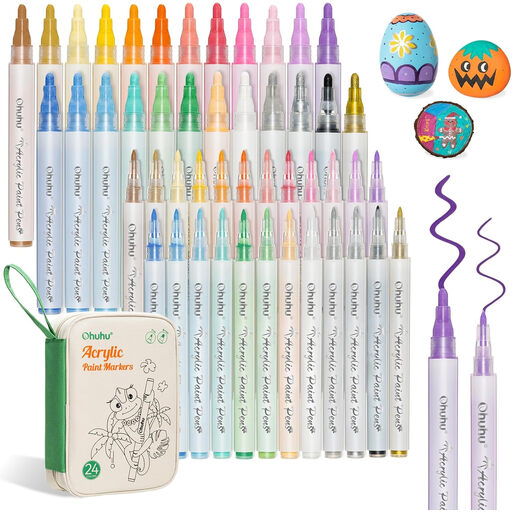
The Smart Choice: Perfect for those starting out in creative hobbies who don't want to choose between precision and filling. This ultra-comprehensive pack offers maximum versatility from the get-go, without needing to invest in multiple marker sets.
This pack avoids the single-use marker trap. With 24 fine-tip pens and another 24 with reversible tips (bullet/chisel), you're equipped for almost any situation, from fine details to large colour blocks.
An unbeatable price-to-quantity ratio. Having both fine and reversible tips for the same 24 colours ensures perfect consistency across all your projects.
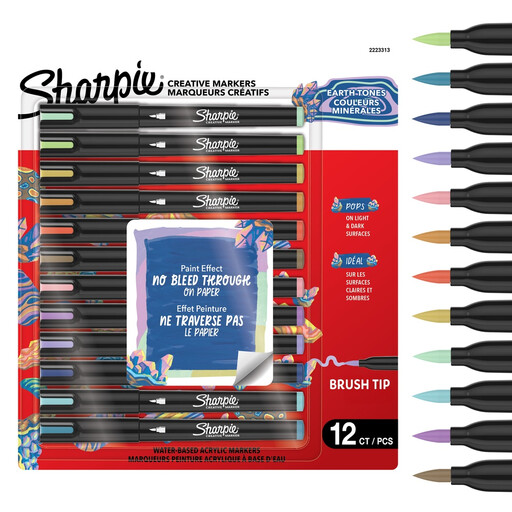
The Artists' Choice: Designed for creatives seeking control and expressiveness. The brush tip is the dream tool for lettering, modern calligraphy, and illustrations that play with varying line weights.
It tackles the lack of opacity head-on. Sharpie's acrylic ink provides a highly opaque, "paint-like" finish. Its "no-shake" formula eliminates tedious prep and the risk of the tip drying out during priming.
The flexible brush tip offers exceptional control. The colours are formulated to be layered without ever bleeding, making it easy to create depth effects.
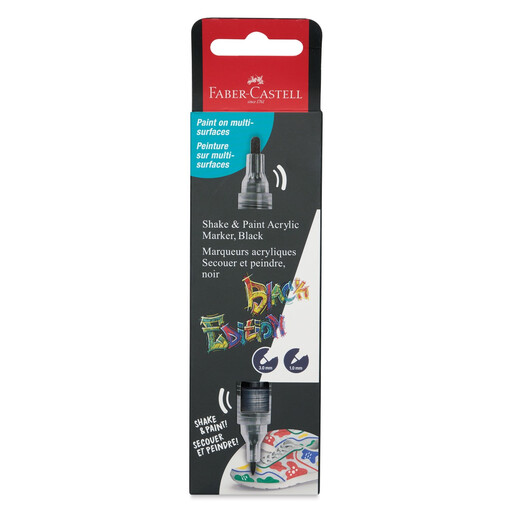
The Versatile Choice: Ideal for starting an object customisation project with a single, reliable, and versatile tool. This dual-tip marker combines two sizes to handle both large fills and fine details.
It avoids the false "multi-surface" promise trap. Its spec sheet is clear about its adhesion: paper, metal, plastic, glass, fabric, stone, and wood. The "Shake & Paint" system ensures good flow control and prevents drying out.
Its dual tip (3 mm bullet + 1 mm fine) is incredibly practical. The ink is opaque and water-resistant once dry—a non-negotiable feature for the durability of customised objects.
Discover our full selection of markers that meet our quality charter and current standards.
Most valve-action markers need to be "primed." Shake it vigorously (with the cap on!) to mix the pigments thoroughly. Then, on a scrap piece of paper, gently press the tip down several times until the ink fully saturates it. Your marker is ready to use!
It all depends on the surface! On a porous material (paper, cardboard, raw wood), the ink is absorbed and becomes very durable. On smooth, non-porous surfaces like glass, ceramic, or plastic, the ink dries on the surface. It holds up well against water but can eventually chip with friction. Pro tip: for long-lasting results, degrease the surface with alcohol before painting, and apply a finishing varnish once the paint is completely dry.
Unlike paint from a tube, it's difficult to blend colours directly on the surface while they are still wet. The go-to technique with acrylic markers is layering. You apply one colour, let it dry completely, and then apply the second one on top. Some brands, like Sharpie, even formulate their ink so that layers can be applied perfectly without bleeding or mixing.