
Livraison le jour même ou le lendemain

Qualité garantie

Débloquez vos offres de bienvenue: Livraison GRATUITE | Jusqu'à -80 % | 30 jours d'essai gratuits à JoyPlus
Téléchargez l'application
Acrylic markers have rewritten the rules in the world of creative hobbies. With the promise of combining the richness of acrylic paint with the simplicity of a marker, they appeal to seasoned artists and hobbyists alike. But that promise can quickly turn to disappointment: a tip that frays after the first use, a supposedly opaque colour that turns out to be transparent on a dark background, or ink that bleeds at the slightest contact with water.
As the Head of Product Curation at Joybuy, my mission is to help you cut through the marketing hype and identify the features that truly make a difference. Before you dive in, let's break down the common pitfalls to avoid and the essential criteria for finding the perfect acrylic pen for your projects.
The market is flooded with options, but not all are created equal. Here are the most common frustrations that can ruin your creative flow:
To avoid these pitfalls, three technical parameters should be examined closely. They are what define the quality of a good paint marker.
The tip is the heart of your marker. Your choice will depend entirely on your projects.
Some dual-tip models combine, for example, a fine tip and a brush tip for maximum flexibility.
The ink is the soul of the marker. Its properties are decisive for the final result.
Always check the surfaces recommended by the manufacturer. An acrylic marker designed for paper won't have the same adhesion on ceramic, wood, fabric, or metal. For customising objects, choose a multi-surface marker with a formula designed for lasting adhesion on smooth, non-porous surfaces.
To guide you, we've selected a few products that meet specific needs, based on the criteria we've just detailed.
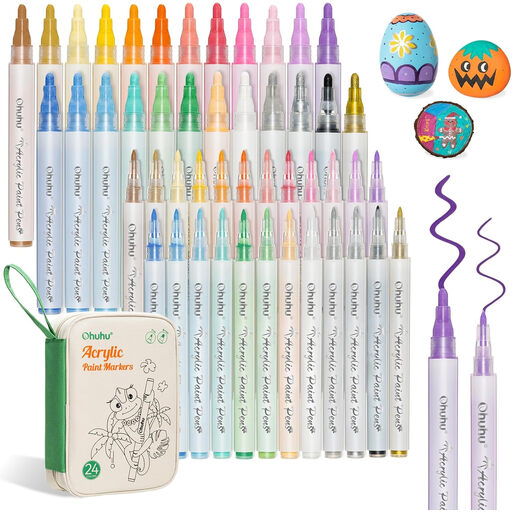
Why we chose it ? Perfect for those who love to explore different styles without investing in multiple sets. This pack combines 24 fine-tip markers for details and 24 reversible-tip markers (round/chisel) for filling, all in coordinated shades for perfect consistency.
It beats the "false versatility" pitfall by offering a complete system. No more juggling different brands for outlines and fills—everything is included and coordinated.
The reversible tip (1.8-2 mm round / 4 mm chisel) on 24 of the markers offers maximum flexibility to adapt to a multitude of projects, from drawing on paper to customising canvas.
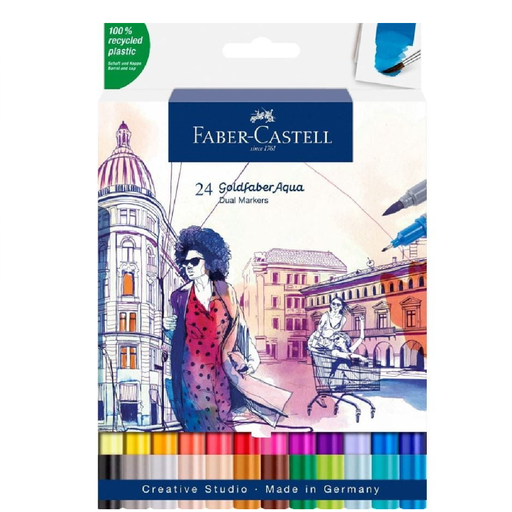
Why we chose it ? Designed for artists who expect more than just a marker. This Faber-Castell acrylic set combines a flexible brush tip for broad strokes and a fine tip (0.6 mm) for details, all with a fully water-soluble ink.
It solves the problem of ink that can't be blended with water. Unlike traditional acrylics, its water-based ink is specifically formulated to be worked with a wet brush, allowing you to create beautiful gradients and wash effects.
The dual tip (brush + fine) and water-soluble ink make it a true portable creative studio, perfect for illustration, lettering, and mixed media techniques, without bleeding through most paper.
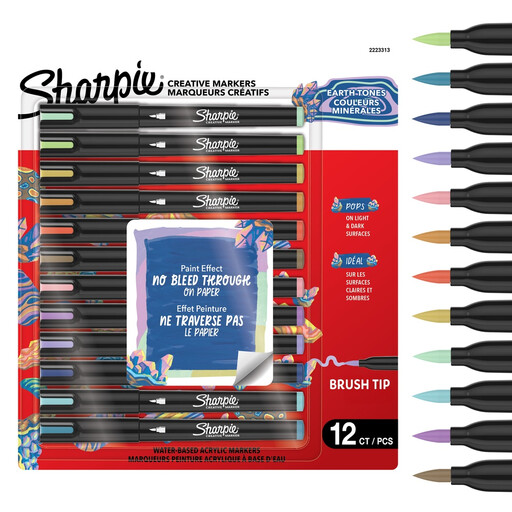
Why we chose it ? The Sharpie acrylic range is designed for direct, no-fuss application. These markers deliver an opaque, paint-like finish on a multitude of surfaces (metal, wood, ceramic, glass, stone) without needing to be primed.
It addresses the problem of disappointing opacity. Its ink is formulated to be opaque on both light and dark surfaces, and the colours layer perfectly without blending, which is ideal for creating depth.
Its "no-shake" formula (when stored horizontally) and brush tip make it ready to use and particularly intuitive for customisation, lettering, and adult colouring.
We have compiled a complete and up-to-date selection of products that meet our strict selection criteria and current safety standards.
For markers with a pump-action system (often identifiable by "shake" or "pump" instructions), shake it vigorously with the cap on. Then, on a scrap piece of paper, gently press the tip down several times to re-prime the ink flow. If the tip is simply clogged with dry paint, you can gently clean it with a damp cloth. For models without a pump system, storing it horizontally is crucial to prevent the tip from drying out.
Once dry, acrylic ink is generally water-resistant and permanent on porous surfaces like paper, raw wood, or fabric. On smooth, non-porous surfaces (glass, ceramic, plastic), adhesion is good, but the paint can remain vulnerable to scratching or repeated friction. For maximum durability on these substrates, applying a clear protective varnish after the paint has fully dried is often recommended.
The fundamental difference lies in the solvent used. The acrylic marker uses a water base, which makes it virtually odourless, quicker to dry, and easy to clean with water before it dries. An oil-based paint marker, on the other hand, uses solvents. It emits a stronger odour and has a longer drying time, but in return, it often provides a glossier finish and better weather resistance, without necessarily requiring a varnish. The choice, therefore, depends on the project and your working environment.