
Livraison le jour même ou le lendemain

Qualité garantie

Débloquez vos offres de bienvenue: Livraison GRATUITE | Jusqu'à -80 % | 30 jours d'essai gratuits à JoyPlus
Téléchargez l'application
An A5 spiral notebook slips easily into a bag and is practical for taking notes, organising your studies or keeping a personal diary. However, not all models are created equal depending on how you plan to use them. A flimsy binding, paper that’s too thin or a misidentified format can turn a bargain into a purchase you’ll need to replace again and again.
Before choosing your spiral notebook, check three features that are often overlooked in favour of design and marketing claims:
For lessons, meeting notes and to-do lists, a lined A5 notebook remains the simplest choice. The lines help you write neatly and make it easier to read back. For diagrams, tables and geometry exercises, a grid notebook will be more versatile.
Paper weight gives you a useful starting point:
The result also depends on the ink you use. A gel pen or marker can bleed through more than a pencil, even with a higher paper weight. If you write on both sides, look at the weight, but also the finish and the manufacturer’s specifications.
A spiral binding lets you flip pages quickly and lay the notebook completely flat. That’s a real plus in a lecture hall, during a meeting or when writing in a diary. A hard cover provides better support when you need to write without a desk and protects the pages more effectively inside your bag.
The diameter of the spiral, the number of sheets and the thickness of the cover all affect how the notebook opens. For heavy use, go for a twin-wire binding or a spiral that feels sturdy enough not to bend easily. An elastic closure can also keep the notebook shut and stop loose pages from escaping.
The A5 format measures approximately 148 × 210 mm. It gives you enough room for note-taking while staying more compact than a notebook close to A4 size. However, do check the exact dimensions: some notepads are larger, like the Rhodia at 21 × 31.8 cm, which is better suited to diagrams and bulky folders.
Packaging is also worth a look. A pack of 4 spiral notebooks lets you separate subjects, projects or uses, but compare the number of sheets per notebook rather than the total number of notebooks. For a one-off need, a single thicker notebook can be more practical than a pack of several smaller ones.
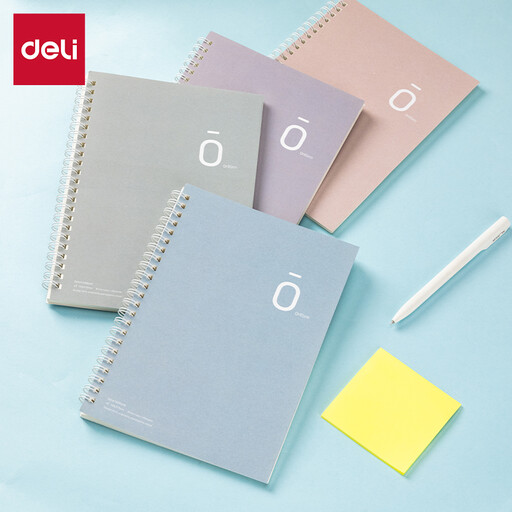
Why this suits this profile: This pack lets you split up school subjects, lists and personal notes without having to buy separate notebooks. Each notebook is A5 size and contains 60 sheets of 70 gsm paper.
The listing clearly states the size, number of sheets and packaging, reducing the risk of confusing sheets with pages.
148 × 210 mm size, spiral binding and four notebooks to organise different uses.

Why this suits this profile: With its hard cover, cream-coloured lined 100 gsm paper and elastic closure, this model is ideal for a notebook you’ll keep and carry around regularly.
The specifications detail the paper weight, cover type, twin-wire binding and closure system, rather than relying solely on appearance.
96 sheets, 100 gsm cream paper and integrated elastic band.
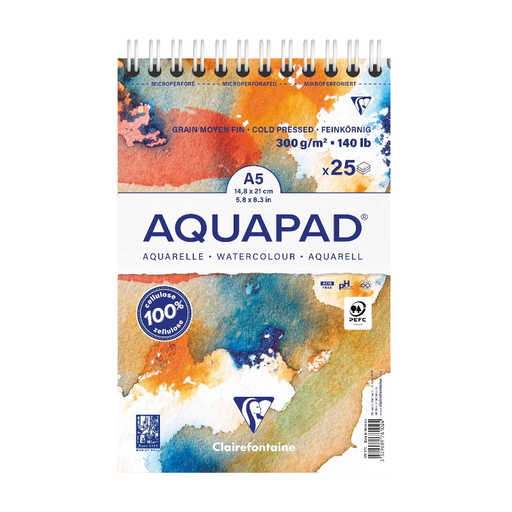
Why this suits this profile: This spiral-bound watercolour pad is designed for anyone who wants to practise watercolour, gouache or other wet techniques in a portable format.
This isn’t a writing notebook sold as a painting surface: the listing specifies it’s made from 100% cellulose, with a medium-fine grain and double-sized paper.
25 sheets, medium-fine grain surface and A5+ size suitable for both exercises and travel.
For detailed diagrams or notes that need filing, a Rhodia pad can be a larger alternative. The CLAIREFONTAINE Rhodia Spiral-Back Pad N° 19 offers 80 micro-perforated sheets, a 5 × 5 mm grid, a rigid cardboard back and 80 gsm PEFC-certified paper. At 21 × 31.8 cm, it’s closer to A4 than A5, though.
We’ve put together a comprehensive, real-time selection of products that meet these strict criteria and European safety standards.
Yes, this format works well for lecture notes, meetings, lists and short reports. For wide tables, plans or technical drawings, a larger format will be more comfortable.
A notebook with 60 sheets usually has 120 pages if each sheet can be used on both sides. Always check the exact wording on the product listing before comparing two options.
100 gsm paper provides a more substantial base than 70 gsm paper. For heavily pigmented felt-tip pens, markers or wet techniques, choose a product where the manufacturer clearly states its intended use, such as a pad specially designed for watercolour.