
Livraison le jour même ou le lendemain

Qualité garantie

Débloquez vos offres de bienvenue: Livraison GRATUITE | Jusqu'à -80 % | 30 jours d'essai gratuits à JoyPlus
Téléchargez l'application
An A5 spiral notebook can be used for taking notes in class, preparing for a meeting, keeping a diary or organising lists at home. But some models that look appealing at first glance quickly become frustrating to use: paper that’s too thin, a cover that bends, a spiral that snags or a closure that doesn’t hold.
Before you fall for a pretty design, it’s worth looking at the features that really matter. Here are the criteria to consider, along with a selection of models suited to different uses.
The A5 format measures approximately 148 × 210 mm, but the external dimensions vary depending on the thickness of the cover and the spiral. A particularly bulky notebook can take up more space than expected in a bag or desk drawer.
For classes and meetings, also check for margins, the number of sheets and the orientation of the binding. A side spiral generally works well for standard writing, while a top-bound notebook can be more practical for taking notes standing up.
Floral patterns and understated colours give character to office stationery, but they don’t tell you anything about the notebook’s durability. A soft cover is lightweight, whereas a rigid A5 notebook offers better protection for the pages inside a bag.
The finish is also worth a look. A textured laminate can improve grip and reduce minor marks, without making the notebook waterproof. So avoid leaving it next to an open bottle or in a damp place.
A higher paper weight often improves the writing experience, but it doesn’t guarantee no ink bleed-through. The result also depends on the pen’s formulation, the pressure you apply and the drying time.
For a lined spiral notebook, look at the paper type, its weight and the shade of the pages. A 100 gsm cream paper can offer a more pleasant surface than a very lightweight paper, with less contrast between the ink and the page.
The A5 format offers a good balance between portability and writing space. It works well for school and office notebooks, as well as for notepads and daily journaling.
A twin-wire metal spiral binding allows you to turn pages easily and helps the notebook stay flat. However, check the ends of the wire: they should be properly formed to minimise the risk of snagging. A hard cover provides a more stable base for writing without a desk, while a soft cover reduces the overall weight.
The number of sheets should match your usage rate. For a long-term project or regular professional note-taking, a thick notebook saves you from having to replace it too often. If you’re working on several subjects, a set of smaller notebooks can also make organisation easier.
As a guide, the 100 gsm cream offset paper featured on some models below is designed to offer smooth writing and reduce ink bleed-through. That doesn’t mean you shouldn’t test it with your usual pen, especially if it’s an erasable gel pen or a felt-tip.
A notebook with an elastic closure is easier to carry when you add loose sheets, sticky notes or bookmarks. The elastic should be firm enough to hold the cover closed, without compressing or warping the pages.
To keep it in good condition: store it in a dry place, clean the cover with a soft, dry cloth, and never force the spiral. Small parts, such as the elastic or metal ends, should be kept out of reach of children under 3 years old.
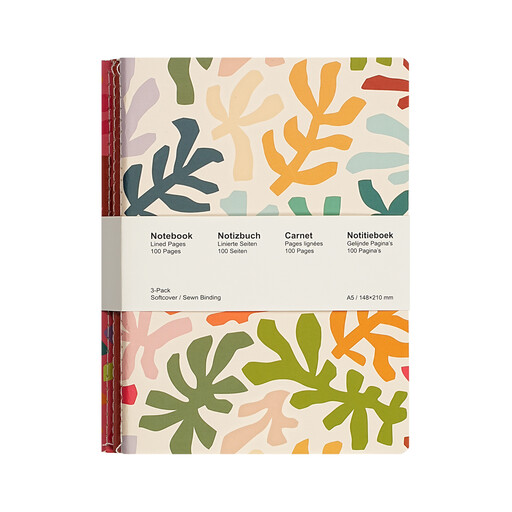
Why this choice suits this profile: This set of three A5 notebooks is ideal for students and schoolchildren who want to separate subjects, projects or lists without buying several different models.
The stitched binding avoids the drawbacks of a side spiral, while the soft cover lightens your bag. Each notebook contains 50 lined sheets of 80 gsm cream paper.
A5 format, pack of three, lined pages and lightweight design that opens flat.
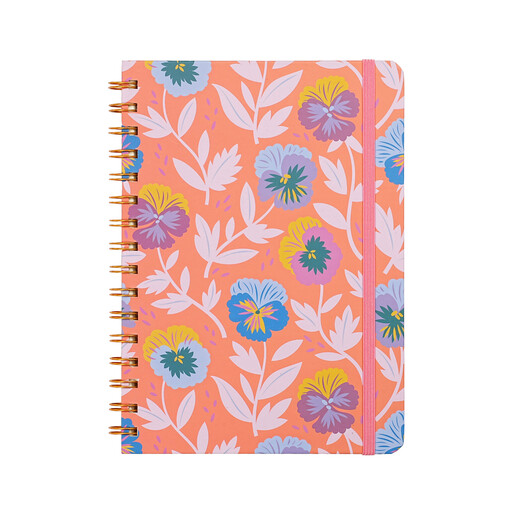
Why this choice suits this profile: Its hard cover, textured finish and floral pattern will appeal to those looking for a notebook that’s as enjoyable to use as it is to look at.
The specifications clearly state the 148 × 210 mm size, twin-wire spiral, 96 lined sheets and 100 gsm cream offset paper: this notebook doesn’t rely on looks alone.
Hard cover, elastic closure and 100 gsm paper designed to reduce ink bleed-through.

Why this choice suits this profile: This notebook is aimed at professionals, journaling enthusiasts and anyone who regularly fills pages for work, ideas or project tracking.
The hard cover and elastic closure protect the pages during travel. The twin-wire spiral keeps the notebook lying flat on your desk.
96 lined sheets, 100 gsm cream paper, hard cover and A5 format ideal for regular note-taking.
The perfect notebook can be paired with a few well-chosen accessories. An erasable gel pen 0.5 mm makes corrections easy, but its thermosensitive ink isn’t suitable for documents you want to keep or for thermal receipts. A multi-colour ballpoint pen 0.7 mm lets you distinguish headings, tasks and important information with a single tool.
For diagrams and precise annotations, a 0.5 mm mechanical pencil offers a consistent line. Sticky notes let you add a reminder without writing directly in the notebook, while a UHU glue stick can be used to attach photos, sheets or journaling elements. Always follow the usage instructions and close the glue stick after each use.
We’ve put together a comprehensive, real-time selection of products that meet these exacting criteria and European safety standards.
The hard cover offers better protection for the pages and provides a stable surface for writing. The softcover model is generally lighter and works well for travel or quick note-taking. The choice depends on how you carry and use the notebook, as well as the level of protection you need.
It all depends on the number of pages, how often you open it and the conditions it’s carried in. A hard cover, a spiral that isn’t twisted and storage in a dry place all help to preserve the notebook. For heavy use, choose a paper weight and binding that suit your writing pace.
An A5 lined format works well for classes, meetings and reports. Go for a cover that offers enough protection, a binding that’s easy to open and paper that’s compatible with your pen. For multiple subjects or projects, a pack of notebooks can also make organisation much simpler.