
Livraison le jour même ou le lendemain

Qualité garantie

Débloquez vos offres de bienvenue: Livraison GRATUITE | Jusqu'à -80 % | 30 jours d'essai gratuits à JoyPlus
Téléchargez l'application
Buying a lined, hardcover A5 notebook? A simple task, you might think. However, a few details can turn what should be a faithful writing companion into a real source of frustration. Paper that tears, binding that falls apart after a few weeks, a cover that gets damaged at the first knock... these disappointments are unfortunately common. This guide gives you all the keys to making the right choice, whether you're looking for a notebook for your personal journal, class notes, or professional use.
Stationery aisles are filled with appealing products, but not all are created equal when it comes to quality. Here are the two most common traps to sidestep so you don't regret your purchase.
To ensure you invest in a durable and pleasant-to-use A5 notebook, pay close attention to these three essential points.
Paper weight, expressed in grams per square metre (gsm), measures the density of the paper. As a benchmark, standard printer paper is around 80 gsm. For a notebook worthy of the name, a higher weight is essential.
A 100 gsm notebook represents an excellent middle ground. This paper is thick enough to prevent most inks (fountain pen, felt-tip) from bleeding through. It offers a smoother glide and better opacity, a critical feature for an A5 journal if you plan to use both the front and back of each page.
The way the pages are assembled has a direct impact on the notebook's durability and usability.
Beyond a stylish A5 notebook, the cover must be functional. A hardcover is the first line of defence for protecting your pages. Materials vary: textured laminated cardboard, fabric cloth, etc. Finishes like hot stamping or embossing add an aesthetic touch, but don't overlook the practical aspects. A ribbon bookmark and an elastic closure are not gadgets: they are the little extras that make all the difference in daily use for staying organised and protecting your notebook on the go.
To illustrate our point, here are a few models that meet specific needs.
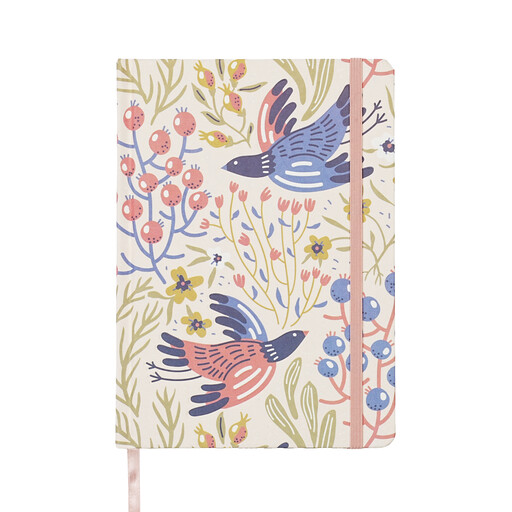
Why we chose it: Ideal for those seeking an object that is as beautiful as it is functional. Perfect as a personal journal or as a gift notebook, it combines a refined aesthetic with quality materials for a delightful writing experience.
Its 100 gsm ivory paper offers excellent opacity and effectively prevents ink show-through. The fabric cover is designed to last and has a pleasant feel.
Fabric cover with delicate patterns and neat finishes (foil stamping). Includes a ribbon bookmark and an elastic closure.
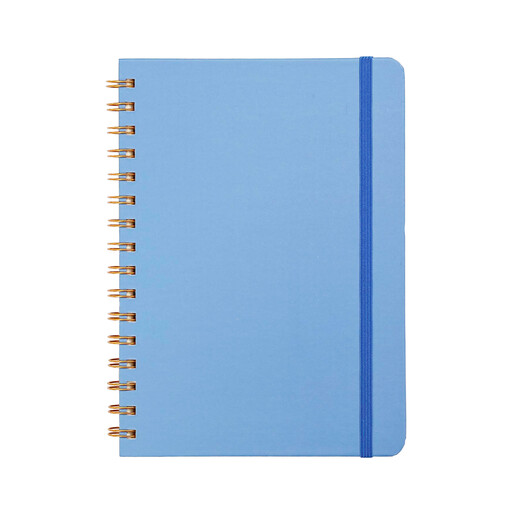
Why we chose it: For students and professionals who need a robust and flexible work tool. The spiral binding allows the notebook to lay completely flat, a major asset for quick and efficient note-taking.
The twin-wire metal spiral binding is designed to withstand heavy use without pages coming loose. The textured, laminated hardcover protects your notes from bumps and daily wear and tear.
Lays flat at 180° and folds back 360°. 100 gsm cream paper for optimal writing comfort. Elastic closure for secure transport.
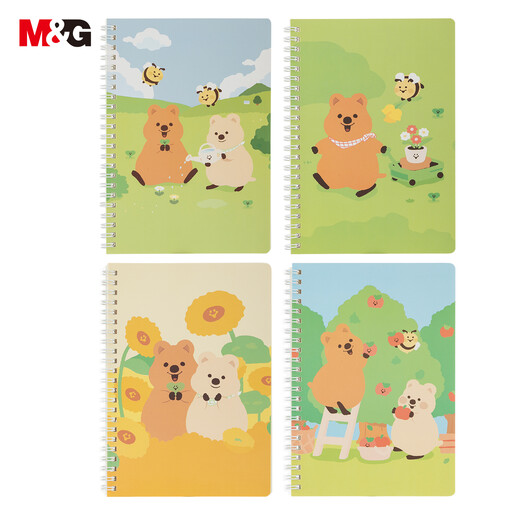
Why we chose it: An affordable and practical solution for those juggling multiple projects, school subjects, or activities. The four-pack allows for colour-coded organisation while maintaining a consistent style.
Although lighter, the 80 gsm paper is suitable for everyday use with ballpoint pens or pencils. The single spiral binding is functional for regular use.
Unbeatable value for money. The illustrated covers make them easy to tell apart at a glance. Practical and portable A5 format.
We have selected a full range of products that meet our quality criteria.
A 100 gsm paper is about 25% thicker and denser than an 80 gsm paper. In practical terms, this translates to much better opacity, which significantly limits ink show-through on the reverse side. It also provides a smoother, more pleasant writing surface, especially with liquid ink pens or fountain pens.
The first step is to choose a notebook with a high paper weight, ideally 100 gsm or more. Your choice of pen also plays a crucial role. Alcohol-based inks (like those in some permanent markers) are more prone to bleeding than water-based inks or the pigmented inks found in fountain pens.
It all depends on the manufacturing quality. A sturdy twin-wire metal spiral binding can be very durable for daily use. However, for very long-term archiving, a sewn binding is often considered more permanent: it won't get bent out of shape, and the pages are securely integrated. The choice therefore depends on your use case: the flexibility of a spiral for everyday tasks, the robustness of a sewn binding for preservation.