
Livraison le jour même ou le lendemain

Qualité garantie

Débloquez vos offres de bienvenue: Livraison GRATUITE | Jusqu'à -80 % | 30 jours d'essai gratuits à JoyPlus
Téléchargez l'application
An A5 notebook may seem like a simple object. Yet, finding the perfect companion for your thoughts, projects, or class notes can sometimes be a real challenge. The shelves are overflowing with models that have tempting covers but whose quality leaves much to be desired after just a few weeks. To save you from unpleasant surprises and buyer's remorse, our editorial team has broken down the classic mistakes and the essential criteria to check.
Buying a notebook shouldn't be a lottery. Two classic traps await the unsuspecting buyer?:
To make an informed choice, you just need to master a few technical specifications that make all the difference in quality and user comfort.
The paper weight, expressed in grams per square metre (gsm or g/m?), is the key indicator of the paper's thickness and opacity.
The method used to assemble the pages has a direct impact on the notebook's durability and user comfort.
The cover protects your notes, but it also defines the style of your notebook. A hardcover provides a stable writing surface even without support, while a softcover is lighter to carry in a bag. Also, consider the details that make all the difference in daily use: an elastic closure, one or more ribbon bookmarks, or a gusseted pocket at the back of the notebook for slipping in a few documents.
Because every user is unique, here is our selection of recommended models, categorised by use case to help you find the notebook that's right for you.
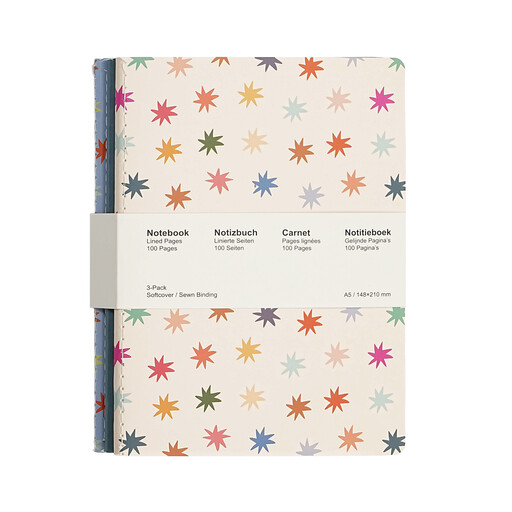
Why we love it : For those who juggle multiple projects or subjects, this three-pack is a solution that's as budget-friendly as it is functional. Their lightweight design makes them perfect companions for classes or meetings.
Its sewn binding guarantees it opens perfectly flat. No more frustration from not being able to write properly near the centre fold.
The three-pack offers excellent value for money. The 80 gsm paper is a smart compromise for everyday note-taking with a ballpoint pen or pencil.
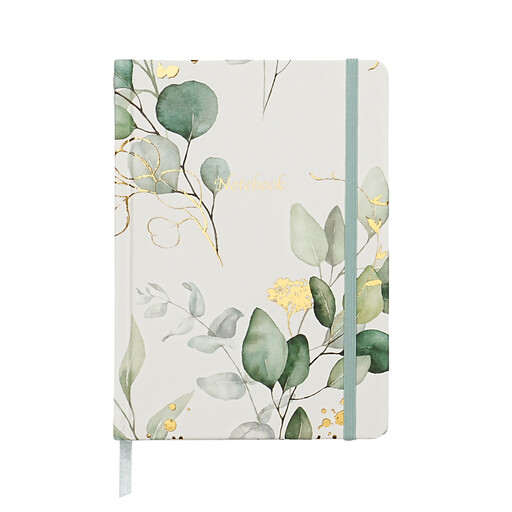
Why we love it : Designed for those who see their notebook as a personal object and a true creative tool. It's perfect for a personal diary or bullet journaling, where aesthetics and paper quality are essential criteria.
Its ivory-coloured 100 gsm paper is the perfect defence against ink bleed-through. It handles fountain pens, fine-liners, and highlighters without any issue.
Its textured hardcover is as pleasant to the touch as it is durable. The ribbon bookmark and elastic closure are practical details that make organisation easier.
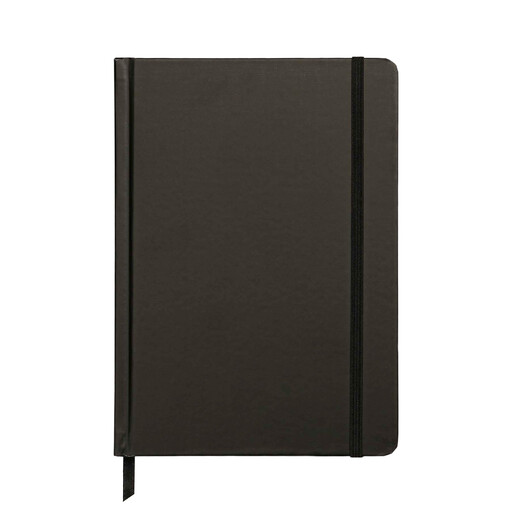
Why we love it : This undated planner is the solution for professionals and students who want long-term planning with the freedom to start at any time of the year.
It puts an end to the waste of traditional dated planners. Its flexible structure adapts to your schedule, while its hardcover and 100 gsm paper ensure it will hold up over 18 months of heavy use.
A functional layout with undated monthly and weekly views. It is available in several understated colours for a consistently professional look.
Our editorial team has selected a full range of notebooks that meet our strictest quality criteria.
80 gsm paper is sufficient for everyday use with a ballpoint pen or pencil. However, if you're a fan of fountain pens, fine-liners, or like to highlight your notes, 100 gsm paper (or higher) is essential. The writing experience is much smoother and, most importantly, the ink won't show through on the other side. This keeps both sides of the page perfectly usable.
Absolutely. The A5 format is often seen as the perfect balance: large enough to write comfortably, yet compact enough to be carried anywhere. For a personal diary, we recommend a model with a hardcover for durability, paper of at least 100 gsm for a smooth writing experience, and an elastic closure to ensure the privacy of your thoughts.
The secret is in the binding. For a 100% flat opening, choose notebooks with a sewn binding (sometimes referred to as lay-flat) or a spiral binding. Be wary of simple glued bindings, especially on entry-level models: they are often too stiff and tend to break over time.