
Livraison le jour même ou le lendemain

Qualité garantie

Débloquez vos offres de bienvenue: Livraison GRATUITE | Jusqu'à -80 % | 30 jours d'essai gratuits à JoyPlus
Téléchargez l'application
An A5 hardback notebook needs to follow you everywhere without warping at the bottom of your bag, losing its pages, or becoming a nuisance to use. Yet product listings don't always let you judge its real quality. A "premium" label, an eye-catching cover, or a high page count aren't enough to guarantee a good purchase.
Here are the criteria to examine before choosing a lined A5 notebook, an A5 diary, or a journal for your studies, office work, and personal projects.
Manufacturers sometimes list the number of pages, sometimes the number of sheets. However, one sheet written on both sides equals two pages. A notebook advertised as having 96 sheets therefore typically contains 192 pages. This distinction is essential for comparing models on an equal footing.
Also look at the interior layout: lined pages, blank pages, monthly calendars, or weekly views. A lined A5 notebook won't serve the same purpose as an 18-month undated planner.
GSM (grams per square metre) tells you about the paper's weight, but it doesn't fully describe the writing experience. The shade, texture, ink type, and binding quality all play a part.
100 gsm paper is generally suitable for note-taking with a ballpoint pen, rollerball, or pencil, with limited risk of show-through. For very wet fountain pens or certain felt-tip pens, however, it's best to test first: GSM alone doesn't guarantee no bleed-through.
A textured or beautifully printed cover catches the eye, but it's the practical details that make the difference day to day: elastic closure, bookmark, lay-flat binding, and pen loop. Without these, pages can get damaged, and the notebook becomes less convenient for commuting or using on a shared desk.
A hardback cover protects your notes better than a soft cover, at the cost of extra weight. If you plan to carry it everywhere, check its dimensions and the space available in your bag.
The A5 format measures approximately 14.8 × 21 cm. It offers enough room to write a report, track a project, or keep a journal, while still fitting in most backpacks and work bags.
The A6 format, measuring roughly 10.5 × 14.8 cm, is easier to carry but reduces writing space. It's best suited for quick lists, jotting down ideas on the go, and notes while travelling.
For a versatile notebook, look for the following details:
Mentions of "acid-free" or "FSC certified" should appear in the product listing. You can't deduce these from the notebook's appearance alone.
A sewn binding or one designed for lay-flat opening makes writing easier, especially near the centre of the notebook. The elastic band keeps it closed, while the bookmark lets you quickly find the right section. An inner pocket can also hold receipts, index cards, or a few loose sheets.
If you're looking for a notebook with an elastic closure and bookmark, check that these accessories are mentioned in the description. They can vary from one model or collection to another.
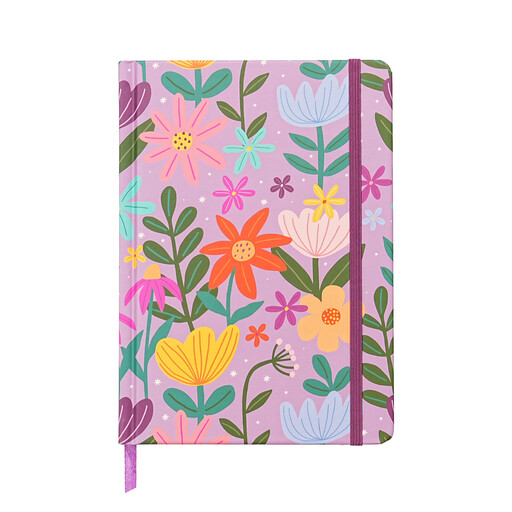
Why this suits them: Its A5 format and lined pages work well for classes, lists, and office notes, without adding unnecessary organisational features.
The listing specifies the size, 96 sheets, and 100 gsm cream offset paper: enough to compare models more easily.
Hardback cover, 100 gsm lined paper, ribbon bookmark, and elastic closure.
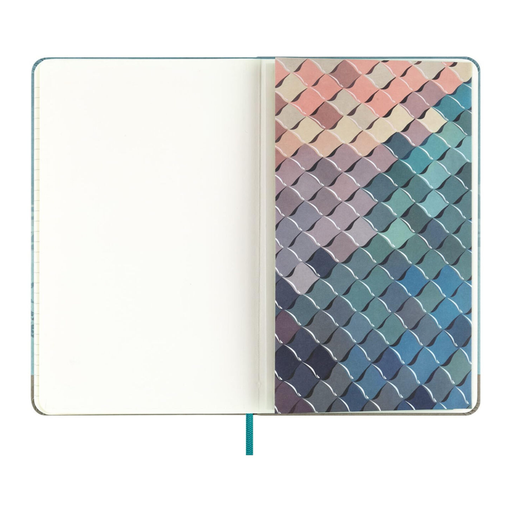
Why this suits them: It combines a fabric-covered hardback cover with architecture-inspired design, making a premium notebook for regular writing or as a gift.
Its features detail the 100 gsm ivory paper, lay-flat binding, inner pocket, and the two closure and bookmark accessories.
Acid-free ivory paper, 180° opening, elastic closure, ribbon bookmark, and expandable pocket.

Why this suits them: Its undated monthly and weekly pages are ideal for project tracking, professional goals, and flexible organisation.
The undated format avoids leaving pages unused when your habits change or a period remains empty.
112 sheets, 224 pages, 100 gsm offset paper, and monthly and weekly organisation.
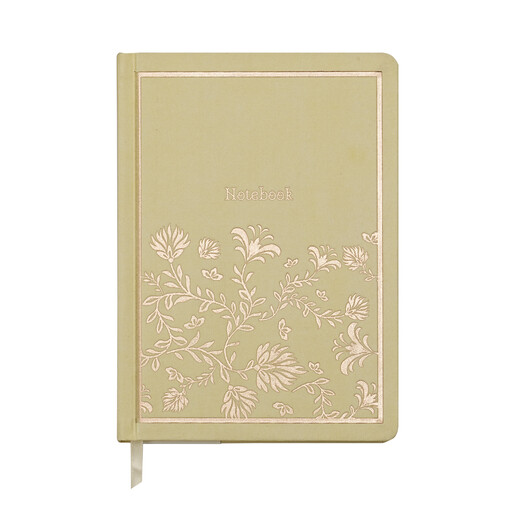
Why this suits them: Its floral fabric cover adds a decorative touch to an A5 diary, a writing journal, or a gift.
The listing clearly distinguishes the decorative cover, 100 gsm ivory paper, and 96 sheets, rather than relying solely on style.
Lined paper, fabric cover with decorative finish, elastic closure, and ribbon bookmark.
We've put together a comprehensive, real-time updated selection of products that meet these exacting criteria as well as European safety standards.
Its lifespan depends on how often you use it, how you transport it, and its exposure to moisture. A hardback cover, an elastic band that isn't overstretched, and storage in a dry place all help to preserve it. Avoid forcing it open or folding the pages.
It's generally suitable for note-taking with a ballpoint pen, rollerball, or pencil. With a fountain pen, liquid ink, or felt-tip pens, the result depends on the ink and the pressure you apply. Check the manufacturer's guidance and test your pen on a page before heavy use.
Not quite. The planner offers a monthly and weekly structure, supplemented by note spaces, whereas the lined notebook gives you more freedom for writing. The right choice therefore depends on your priority: planning your tasks or recording continuous notes.