
Livraison le jour même ou le lendemain

Qualité garantie

Débloquez vos offres de bienvenue: Livraison GRATUITE | Jusqu'à -80 % | 30 jours d'essai gratuits à JoyPlus
Téléchargez l'application
Pending post, bills to file, work folders and magazines piling up on your desk: an A4 wall organiser for documents can quickly free up space. Provided, of course, you choose a model that suits your needs. Whether it's a French home, a shared office or a small business, the dimensions, fixing system and capacity matter far more than just the sleek metal look.
An A4 sheet measures 21 × 29.7 cm. Some models hold documents in landscape orientation, with a width of around 35 cm and a limited height. Others stack compartments vertically, with a structure that's generally narrower and taller.
An A4 wall document holder can therefore work for bills, folders or magazines without functioning as a vertical A4 wall sorter. Check the orientation stated on the product page, but also the internal width of each compartment.
A wall-mounted mail organiser filled with folders puts far more strain on the wall than an empty rack. The screws supplied make installation easier, but they aren't necessarily suitable for all wall types. A plasterboard partition, a brick wall or a concrete surface all require different wall plugs.
Since the maximum load per compartment isn't always specified, avoid filling every level with heavy ring binders from day one. Also check the tightness of the screws after a few days of use.
A 14-tier wall organiser might seem ideal for a large volume of documents, but it needs a wall that's tall enough. Conversely, a single-pocket model won't let you effectively separate incoming post, documents to sign and papers to archive.
Start by defining your different categories. For everyday use, three to six tiers should be plenty. Larger capacities really come into their own when several people share the same vertical storage.
For a wall rack intended for A4 documents, go for an internal width of at least 30 cm if you plan to slide in folders or soft files. A depth of 9 to 11 cm generally works for post and loose sheets, but may prove tight for thick ring binders.
A cut-out or rounded opening makes it easier to retrieve documents. Label holders are also handy for quickly identifying different categories: "To do", "To sign", "Bills" or "Courses".
A metal wall magazine rack or a metal document holder with a powder-coated finish can work perfectly for regular use. The product sheets for the models shown mention a powder finish designed to limit oxidation and rust. That doesn't mean you can skip protecting them from excessive humidity and abrasive products.
Open metal mesh lets you see some of the contents, while a solid surface hides documents more. In a hallway, also pay attention to the safety of the edges and the strength of the fixing.
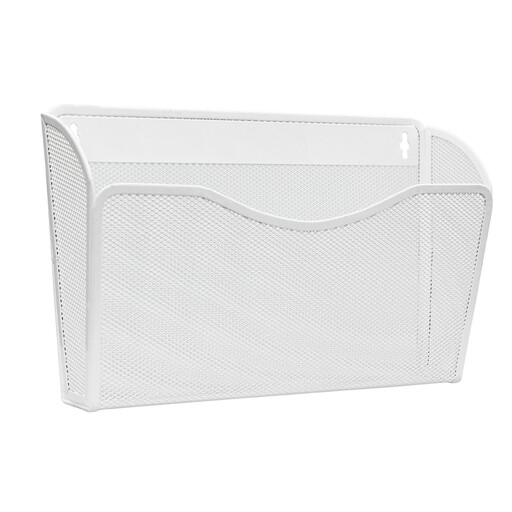
Why this choice suits this profile: With dimensions of 35 × 9 × 21.5 cm, this single pocket lets you start simply, near a desk, door or printer, without installing a bulky unit.
Its clearly stated format and design dedicated to A4 documents reduce the risk of choosing a storage solution that's too small for sheets and post.
A powder-coated metal structure, mounting screws included and the option to install several units separately.
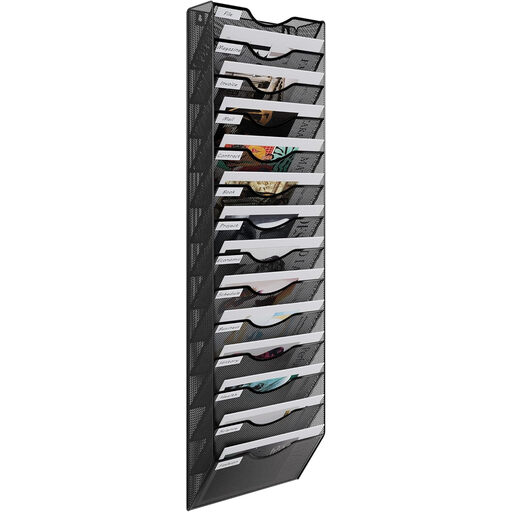
Why this choice suits this profile: Its 14 tiers and label holders lend themselves to detailed filing in a professional environment or shared office.
The stated total height of 112 cm lets you check wall compatibility before buying, rather than relying solely on the promise of saving space.
Fourteen compartments, a stated internal width of 31.5 cm, integrated labels and no assembly required.
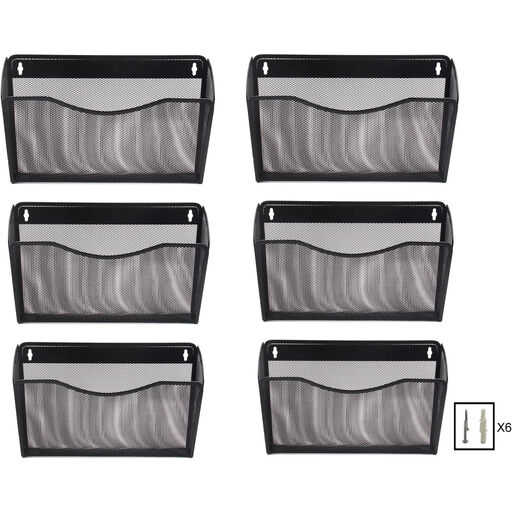
Why this choice suits this profile: The set of six pockets makes it easy to sort post, client files, bills and documents to process into several categories.
The units can be mounted together or separately. This means you can spread the pockets across available walls, rather than being forced into a single block.
Six metal pockets, individual dimensions of 35 × 9 × 21.5 cm and mounting screws included for modular organisation.
Before drilling, measure the available height and width, not forgetting the swing area of a door or cupboard. Use a spirit level to align the compartments, then choose wall plugs suited to the wall type. On a lightweight partition, try to locate a stud or opt for reinforced fixings.
To extend the life of your A4 wall document holder, dust it with a dry cloth. A slightly damp wipe is enough for stubborn marks, as long as you dry the surface straight after. Avoid abrasive products and prolonged exposure to humidity. Finally, distribute the weight between compartments and regularly remove documents you no longer need.
We've put together a comprehensive, real-time updated list of products that fully meet these strict selection criteria and European safety regulations.
Use wall plugs specifically designed for plasterboard and check the load the partition can support. For several metal pockets or a multi-tier model, fixing into a stud or onto a reinforced support will provide better stability. The screws included aren't always suitable: choose them according to your wall.
One to three pockets are enough for light personal use. To separate incoming post, documents to send and current folders, five or six compartments offer more flexibility. A 14-tier model is more suited to heavy-duty filing, after checking the available height.
Yes, provided it accepts A4 format and its depth allows you to slide in your folders or files. Also check the storage orientation, its internal width and the recommended load. For confidential documents, an open model makes access easy, but doesn't protect the contents from prying eyes.