
Livraison le jour même ou le lendemain

Qualité garantie

Débloquez vos offres de bienvenue: Livraison GRATUITE | Jusqu'à -80 % | 30 jours d'essai gratuits à JoyPlus
Téléchargez l'application
Piles of documents cluttering your desk are a daily struggle for many of us, both in the office and at home. An A4 wall file organizer is the ideal solution to free up space and gain clarity. But be careful: the wrong choice can quickly turn this investment into a source of frustration. Too many models that look appealing at first reveal their weaknesses after just a few weeks of use.
To avoid throwing your money away, let's review the most common pitfalls.
To ensure you choose a wall-mounted document holder that will stand the test of time, it's crucial to look beyond aesthetics and check a few technical details.
The longevity of your file organizer depends primarily on its material. While plastic may be suitable for very light use, steel remains the gold standard for professional or heavy-duty applications. Opt for a metal wall file rack made of powder-coated steel. This powder coating offers dual benefits: it effectively protects against oxidation and rust while also being more scratch-resistant than standard paint. This guarantees a sturdy vertical document storage solution capable of supporting significant weight day after day.
Don't just rely on the number of slots. The true capacity of an organizer is revealed in its daily use. Check two key points:
An improperly mounted wall office organizer is a real hazard. A good product comes with screws and wall anchors, but it's essential to ensure they are suitable for your wall type (drywall, brick, concrete). For drywall installation, using specific heavy-duty anchors (like toggle bolts) is highly recommended to ensure a secure hold, even at full capacity.
Instead of a generic list, here is a selection of solutions designed for specific user profiles, keeping our criteria for durability and practicality in mind.
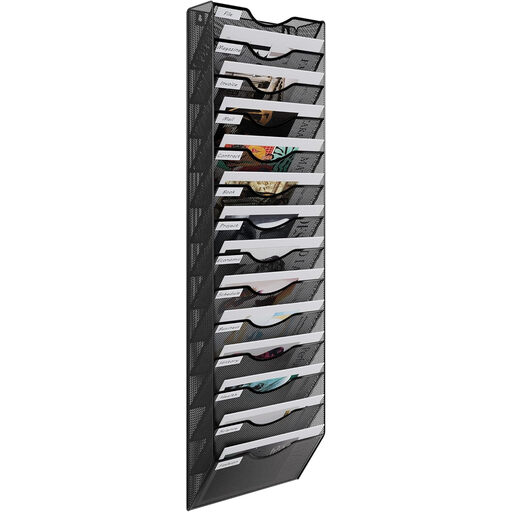
Why we chose it: With its 14 compartments, it offers impressive filing capacity, perfect for managing multiple projects, client files, or archives without cluttering your desk. Its tall design makes the most of vertical wall space.
Its structure is made entirely of powder-coated steel, giving it excellent rigidity and preventing it from warping under the weight of documents, unlike simple mesh models.
Each compartment features a label holder for clear, instant identification of its contents. Essential for meticulous organization.
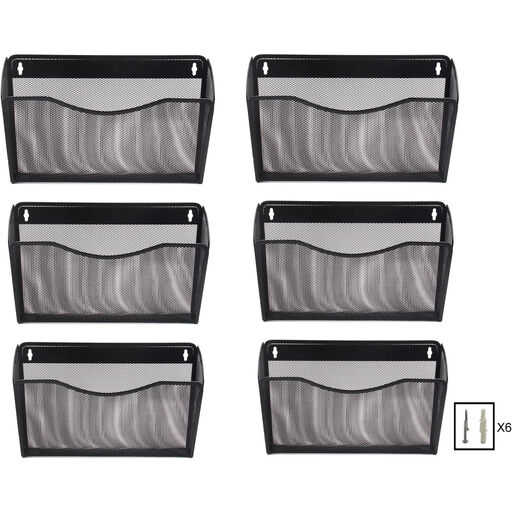
Why we chose it: This set of 6 individual baskets is the perfect solution for creating multiple sorting zones: one for incoming mail near the door, another for invoices in the office, and a third for magazines in the living room. A truly custom **wall mail organizer**.
Its modular design bypasses the problem of a single, bulky unit that can be difficult to place. Each basket is an independent and sturdy wall file holder, ready to be mounted exactly where you need it.
Total installation flexibility. The 6 modules can be aligned, stacked, or even distributed across different rooms according to your needs. Mounting hardware is included.
Explore our full selection of products that meet our strict selection criteria and current standards.
For installation on a drywall partition, do not use the standard anchors that are often included. You must use heavy-duty drywall anchors (like toggle bolts or self-drilling anchors). They anchor securely behind the wallboard and offer a much higher load capacity. This ensures your organizer won't pull out of the wall, even when fully loaded. Always check the maximum weight supported by the anchor.
It all depends on the quality of the metal and its finish. A metal wall file rack with a quality powder-coated finish, used indoors under normal conditions, can last for decades. This coating effectively protects it from rust and scratches. A simple wipe with a dry cloth is all it takes to keep it in perfect condition.
Capacity varies wildly from one model to another. Entry-level organizers often struggle to hold more than 20 to 30 sheets per slot. In contrast, more robust steel models with well-designed compartments can easily hold a hundred sheets (about 1 to 2 cm thick), or even a slim binder. The best approach is to check the product's technical specifications or user reviews to get an accurate idea.