
Livraison le jour même ou le lendemain

Qualité garantie

Débloquez vos offres de bienvenue: Livraison GRATUITE | Jusqu'à -80 % | 30 jours d'essai gratuits à JoyPlus
Téléchargez l'application
Back-to-school season, professional files, administrative paperwork at home… A good filing system is a life-changer. A4 pocket dividers are an incredibly convenient 2-in-1 solution, but be warned: not all models are created equal. The wrong choice guarantees you'll end up with loose papers and messy binders.
To avoid buyer's remorse, here are the three main pitfalls to watch out for.
For a filing system that stands the test of time, a few technical details need close inspection. This is what separates an everyday ally from a disappointing gadget.
The durability of your A4 plastic dividers depends primarily on their material. Opt for models made from PVC or polypropylene (PP), two plastics known for their flexibility and strength. Thickness is the key indicator: a 170-micron (0.17mm) or thicker plastic will offer far better durability over time than a flimsy film. Thick A4 transparent pockets not only protect your documents but also ensure better readability.
To keep your documents from sticking out or getting dog-eared, the A4XL size is your best option. Slightly wider than standard A4, it easily accommodates sheets, sub-folders, and stapled documents. Also, be sure to check the punching. In France, 9-hole punching is the standard that ensures compatibility with virtually all 2- or 4-ring binders, including standard binder dividers.
The number of tabs should match the complexity of your filing system.
Finally, make sure the tabs are customisable. The inclusion of insertable cardstock labels is a real bonus for creating a filing system that's truly your own.
Here are models that meet specific needs, checking all the boxes for durability and practicality.
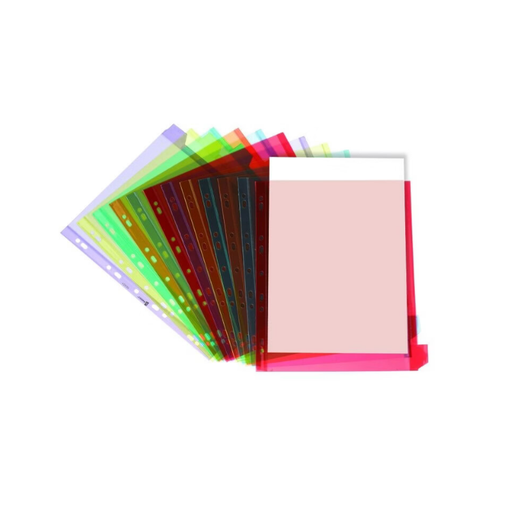
Why it stands out: Ideal for students juggling multiple subjects or professionals managing complex projects. Its 12 tabs allow for fine-grained segmentation, monthly organisation, or detailed thematic sorting. A robust solution designed for heavy use.
Its smooth, 170-micron PVC plastic withstands frequent handling without flinching. The A4XL size perfectly protects documents, and the included cardstock labels ensure full customisation.
It combines protection and organisation with 12 perforated pockets with tabs, offering a huge filing capacity in a single product.
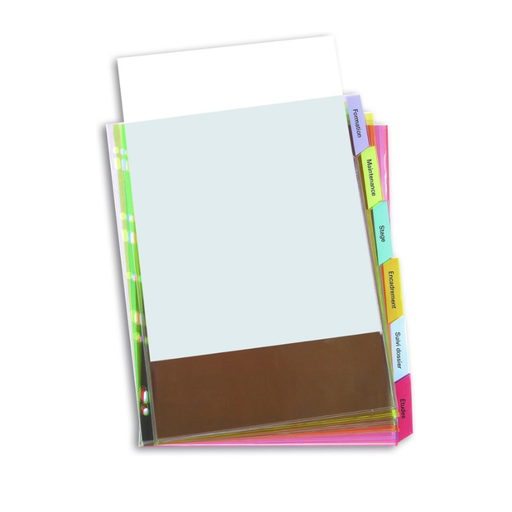
Why it stands out: Perfect for organising your home (invoices, warranties, administrative papers) or for simpler office files. Its 6 tabs are sufficient for clear, visual categorisation without overcomplicating things.
It features the same build quality as the 12-tab version: durable plastic, a protective A4XL size, and universal 9-hole punching. No compromises on sturdiness.
A simple, visual solution thanks to its 6 coloured sections that help you find what you need at a glance. Each pocket can hold about 25 sheets, which is more than enough for everyday use.
Getting organised is also about treating yourself to beautiful stationery. Discover our selection of office supplies that are as stylish as they are practical.
A regular divider is just a sheet, often made of card or plastic, used only to separate sections in a binder. A pocket divider, on the other hand, is a 2-in-1 product: it separates sections with its tab, but it also doubles as a protective pocket. You can slip unpunched documents, receipts, or notes inside while structuring your binder.
It all depends on the quality and thickness of the plastic. For benchmark models like those from Oxford, each pocket can hold approximately 25 sheets of standard paper (80 gsm) without strain. It's best to avoid overstuffing the pockets to prevent stretching the plastic and weakening the seams.
That depends on the type of plastic used. Polypropylene (PP) dividers, identified by the #5 recycling symbol, are more easily recycled than those made of PVC (#3). To be sure, it's best to check your local recycling guidelines. In any case, choosing a product designed to last is always the best way to reduce waste.