
Livraison le jour même ou le lendemain

Qualité garantie

Débloquez vos offres de bienvenue: Livraison GRATUITE | Jusqu'à -80 % | 30 jours d'essai gratuits à JoyPlus
Téléchargez l'application
An A4 graph paper notebook is just as suited to taking notes in lectures as it is to preparing a plan, technical drawing, or organising information at the office. But not all models are created equal: a notebook that’s easy to slip into a bag isn’t necessarily right for archiving, while a pad with detachable sheets is practical out in the field but less suitable for keeping bound notes together.
Before you place an order, there are three pitfalls to avoid.
The 5 × 5 mm graph notebook is particularly versatile. Its small squares help you align columns, draw tables, represent shapes, or structure calculations. They suit students, engineers, architects, and anyone who switches between text and diagrams.
However, make sure the product page clearly states a 5 × 5 mm ruling. Simply mentioning “graph” can also refer to larger squares, which are less practical for precise drawings. A violet ruling, like that on several Rhodia pads, generally remains readable without cluttering the page.
With 80 g/m², the paper offers a good balance between weight, price, and writing comfort. Vellum or superfine vellum paper is usually smooth, which works well with ballpoint pens, mechanical pencils, and fountain pens, depending on the ink used. For heavy markers and felt-tip pens, it’s best to check the risk of show-through before filling several pages.
The PEFC certification tells you about the origin of fibres from forests managed in line with the certification system’s requirements. It doesn’t allow you to judge water resistance or how each type of ink behaves. Some Moleskine notebooks instead highlight acid-free paper from FSC-certified forests and other controlled sources: this is a different feature, so compare based on your priorities.
A detachable-sheet notepad with micro-perforations lets you remove a page cleanly. Handy for handing over a meeting summary, submitting an exercise, or filing a sheet in a folder. On the downside, the remaining pages become less compact as the pad empties.
If you work with a ring binder, look for a 4-hole punched notebook and check the spacing stated. The Rhodia and Cornell models shown below advertise perforation suitable for filing. A stapled binding is often thinner than a spiral one, while the latter allows you to keep the notebook open flat for drawing or taking notes without interruption.
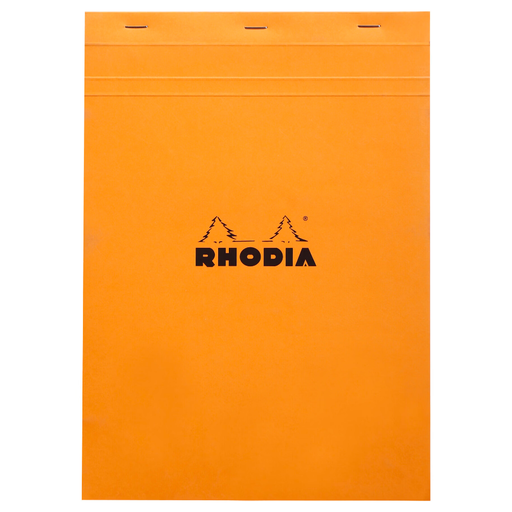
Why this choice suits this profile: This A4 pad, measuring 21 × 29.7 cm, contains 80 graph-ruled sheets (5 × 5 mm) and has a rigid cardboard back. It’s ideal for lectures, lists, and sketches when you need to write without a desk.
The product page specifies the format, ruling, and number of sheets, reducing unpleasant surprises related to dimensions or a grid that’s too large.
Superfine vellum 80 g/m² paper, micro-perforated sheets, and PEFC-certified paper, according to the description provided.
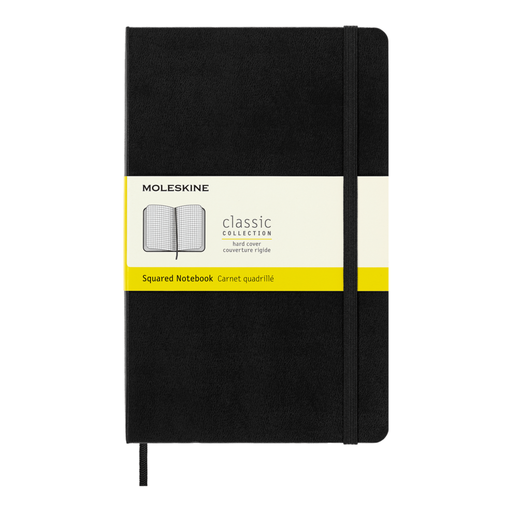
Why this choice suits this profile: With its Large format of 13 × 21 cm, hard cover, and 240 pages, this notebook is aimed at those seeking a durable medium for their ideas, notes, and sketches.
The hard cover and elastic closure protect the pages during transport, unlike a soft pad designed for tearing out.
Acid-free ivory 70 g/m² paper, elastic closure, bookmark, and expandable inner pocket.
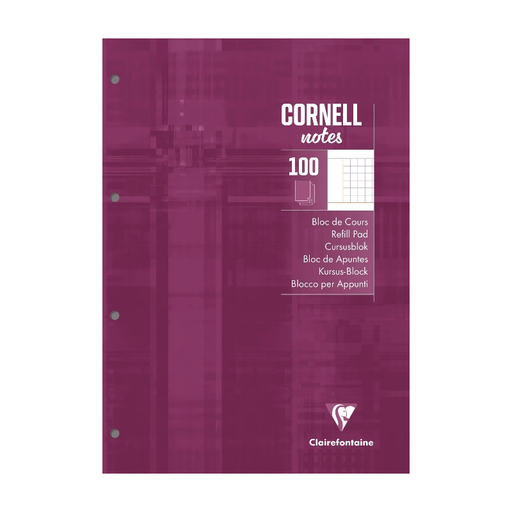
Why this choice suits this profile: Students, teachers, and professionals who regularly file their documents will benefit from the A4 format, detachable sheets, and four-hole perforation.
The product page details the 200 detachable pages, the glue binding on the long side, and the four holes spaced 80 mm apart for filing.
Clairefontaine Vélin Velouté 90 g/m² paper, laminated cover, and rigid cardboard back, with PEFC certification stated.
We’ve put together a comprehensive selection, updated in real time, of products that meet these exacting criteria as well as European safety regulations.
For versatile use, a Clairefontaine graph notebook in A4 format offers a large working surface and a regular grid. A model with detachable sheets will suit files that are likely to evolve, while a bound notebook will keep all your notes together in a compact set.
For drawing, an A4 spiral or a binding that allows flat opening makes it easier to draw across two pages. The Clairefontaine Zap Book A4 offers 160 sheets of 80 g/m² recycled paper, acid-free and pH neutral. Please note, however: the version described here is plain, not graph-ruled. So it can complement an A4 graph paper notebook, but not replace it for plans that require a grid.
Yes. A 5 × 5 mm grid makes alignment, approximate measurements, and creating tables easier. For a plan subject to precision requirements, however, use appropriate drawing tools: the notebook’s grid does not constitute an official technical scale.
The notebook keeps its pages together and is carried like a journal. The detachable-sheet notepad allows you to remove, hand over, or file each sheet individually. If you use a ring binder, choose a model with compatible perforation, such as a 4-hole punched notebook.
It can be suitable, depending on the ink used and the pressure applied, but the result varies from one model to another. Test it on a page before committing to heavy use. For felt-tip pens and markers, a thicker paper can reduce show-through, at the cost of a heavier and generally more expensive notebook.