
Livraison le jour même ou le lendemain

Qualité garantie

Débloquez vos offres de bienvenue: Livraison GRATUITE | Jusqu'à -80 % | 30 jours d'essai gratuits à JoyPlus
Téléchargez l'application
A cluttered desk is not always a sign that you lack storage. The problem often lies with equipment that is not suited to A4 documents, bulky folders or small stationery items. An A4 document organiser should make everyday filing easier without taking up all your space or making your paperwork difficult to access.
Students, secondary school pupils, teachers, homeworkers and office staff generally face the same challenges: mixed-up documents, piles of post and accessories that disappear at the bottom of drawers. So, before you buy, there are three common pitfalls to watch out for.
A product advertised as A4-compatible may not be deep enough to hold folders, punched pockets or flap files. Check the usable dimensions rather than relying solely on the format stated in the title. For filing A4 documents, there must be enough space to remove sheets without creasing them.
An expandable file with eight compartments is useful for separating subjects, projects or administrative paperwork. However, if the sections are too small, they quickly become awkward to use. Conversely, a single, oversized compartment encourages mixed piles of documents. The right number of dividers therefore depends on how you intend to use it: lessons, bills, post, work files or documents that need attention.
A metal desk organiser generally offers good stability, but it should rest on a stable surface and have protective feet. For storage in a drawer, the dimensions and finish of the edges are essential. Rigid polypropylene is better suited to flexible folders and portable files, while metal is ideal for a fixed desk document holder.
To store A4 sheets, folders or envelopes, measure the space available on your desk or inside the drawer. A multi-tier A4 letter tray should remain easy to access, even when placed under a shelf. Sliding trays make it easier to retrieve documents from the back, but avoid overloading them.
A good file organiser should also make its contents easy to identify at a glance. An index sheet, label or colour code reduces the time spent searching for a document.
A file with fixed compartments is suitable for regular volumes. An expandable model adapts better to busier periods, particularly at the start of the school year or during an administrative session. The sliding spine on the OXFORD model allows you to adjust its thickness to the volume of sheets. It is still essential to respect the stated capacity and avoid forcing it closed.
Rigid opaque polypropylene protects documents from creasing and can be cleaned with a soft, dry cloth. Keep it away from heat sources and direct sunlight to reduce the risk of warping or fading.
Painted or coated metal is particularly well suited to fixed use. Choose models with rounded edges, an even finish and non-slip feet. For maintenance, a slightly damp cloth is sufficient, provided you dry the surface immediately afterwards. For use in a drawer, choose dividers whose width genuinely matches that of the furniture.
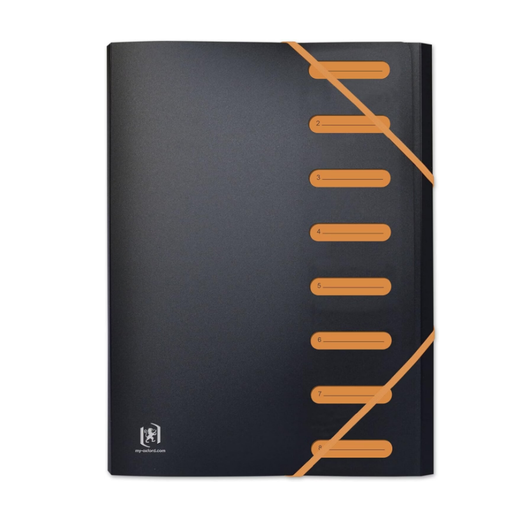
Why this choice suits this user profile : This file is ideal for students and secondary school pupils who want to keep lessons, homework and administrative documents together in a single, easy-to-carry A4 organiser.
Its eight compartments prevent different subjects from getting mixed together. The sliding spine adapts to the volume of sheets, while the wide flap keeps documents securely closed.
A4 format, opaque polypropylene cover, customisable index and zipped pocket for storing pens, glue or scissors.
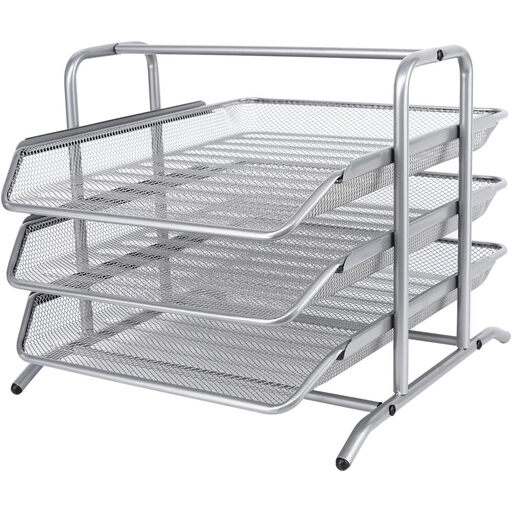
Why this choice suits this user profile : This model is ideal if you are looking for fixed, visible storage that complements a tidy professional or home workspace.
The three separate trays prevent unstable piles. The rubber feet reduce slipping and protect the desk surface.
Coated metal frame, three sliding tiers, A4 compatibility and dimensions of 35,5 × 29,5 × 26 cm.
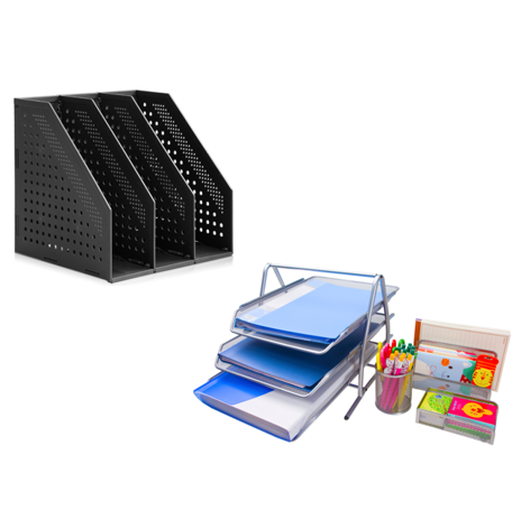
Why this choice suits this user profile : This set is well suited to shared offices, home working and spaces that need both A4 filing and storage for small accessories.
The combination of a three-tier tray, pen holder, letter sorter and three-section organiser prevents a collection of mismatched accessories from building up.
Metal and plastic set, A4 document storage, accessory pockets and press-stud fastening on the file organiser.
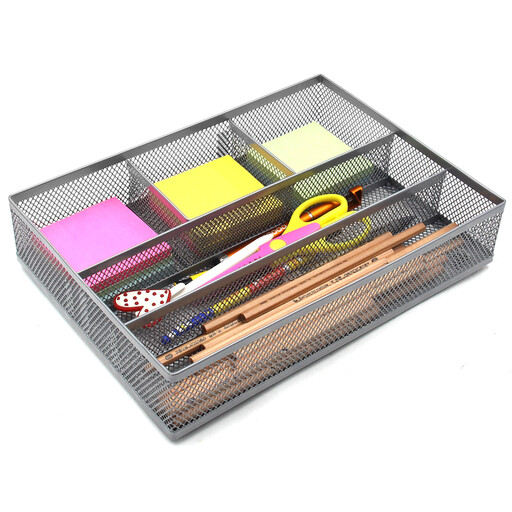
Why this choice suits this user profile : This drawer organiser frees up your desk while keeping pens, cables and stationery close at hand.
Its five compartments keep accessories separate instead of letting them pile up in a single tray. However, measure your drawer before buying.
Dimensions of 30 × 21,5 × 7 cm, mesh metal frame and four non-slip feet.
We have put together a complete, real-time updated list of products that meet these demanding selection criteria and European safety standards.
To keep your desk functional, assign each compartment to an action: “to deal with”, “to archive”, “to sign” or “to take with you”. In a school document file, organising by subject is still the simplest approach. For professional use, separate current files, bills and incoming post.
Avoid filling the compartments completely. Leaving a little free space makes documents easier to consult and helps prevent distortion. Stationery that is rarely used can go in a drawer, while documents you refer to every day should stay in an easily accessible desk document holder.
An expandable file or tray organiser offers greater flexibility than a document holder that is too narrow. Check the usable depth and whether it can accommodate pockets, folders or slim binders.
Place the heaviest documents in the bottom tray and do not exceed the stated capacity. Raised edges and sliding trays help keep sheets in place, but stability also depends on the surface on which the tray is placed.
Its lifespan depends on the material, load and frequency of handling. A metal holder should be kept dry and not overloaded. A polypropylene model should be protected from excessive heat. Regular cleaning and organising documents without forcing the fastenings will help preserve the equipment.