
Livraison le jour même ou le lendemain

Qualité garantie

Débloquez vos offres de bienvenue: Livraison GRATUITE | Jusqu'à -80 % | 30 jours d'essai gratuits à JoyPlus
Téléchargez l'application
Whether you're a student cramming for exams or a professional looking to streamline your meeting reports, the Cornell method has proven its effectiveness for structured note-taking and active recall. However, not all notebooks labelled "Cornell" are created equal. The wrong choice can quickly turn this powerful tool into a source of frustration: pages that tear, ink that bleeds through, binding that falls apart... This guide is here to help you decode the essential criteria and choose THE A4 Cornell notebook that will live up to all its promises.
Marketing can often be misleading. Before you check out, keep an eye out for these deal-breakers that can make a notebook unusable for daily use.
To ensure you make the right choice, focus on these three key points. They are the hallmark of quality and longevity for your future Cornell method notebook.
Paper weight (expressed in g/m?) is the primary indicator of quality. For a truly comfortable, bleed-free writing experience, 90 g/m? paper is the gold standard. The famous Clairefontaine 90g paper, for example, is praised for its perfect smoothness and exceptional opacity. It handles most inks, including those from fountain pens, with ease and no ghosting. This is a non-negotiable feature for a revision notebook where every single page must be usable.
A notebook's durability is directly dependent on its binding. A wire-o (spiral) binding or even simple staples will always be more durable than a glued spine. For those who like to archive their notes, perforated, detachable pages are a real plus. Double-check that the micro-perforations are clean and that the holes (usually 4) match the standard for A4 binders for hassle-free filing.
An A4 Cornell notebook worthy of the name must strictly follow the method's layout. Make sure each page is properly divided into three sections?:
This structure is the very heart of the method: it forces structured note-taking and turns each sheet into a true standalone study guide.
Instead of a random list, we've selected models that meet specific needs, strictly applying the quality criteria we've just discussed.
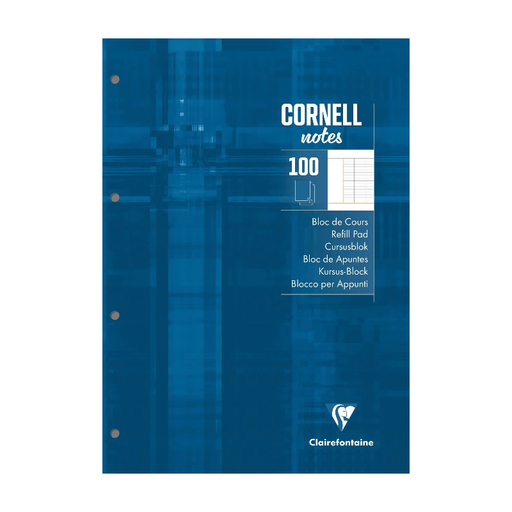
Why we chose it: With 200 pages, it's ready for an entire semester. Its ultra-rigid cardboard back is a real bonus: it allows for comfortable note-taking, even on your lap in a crowded lecture hall.
Its Clairefontaine 90g Vellum paper puts an end to any worries about ink bleeding through. The micro-perforated sheets detach cleanly, and the 4 holes allow for direct filing in a binder.
It checks all the boxes: the Cornell layout, premium paper, and the practical features (detachable and perforated pages) you'd expect from a notebook designed for studying.
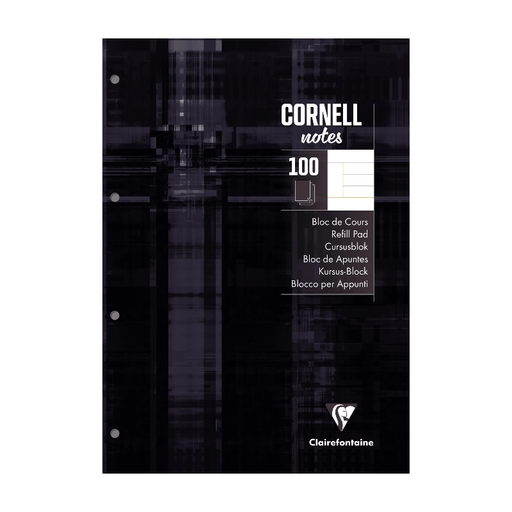
Why we chose it: Perfect for structuring meeting minutes, project plans, or to-do lists. Its 8mm ruling is comfortable for writing, and its plastic-coated cover protects your notes from coffee spills.
Its ultra-rigid cardboard back lets you take notes anywhere, even without a desk. The 90g paper handles the most demanding pens without issue, ensuring your writing is always crisp and clean.
The combination of the Cornell structure and detachable pages streamlines the workflow from note-taking to project filing. A real time-saver for organising your projects.
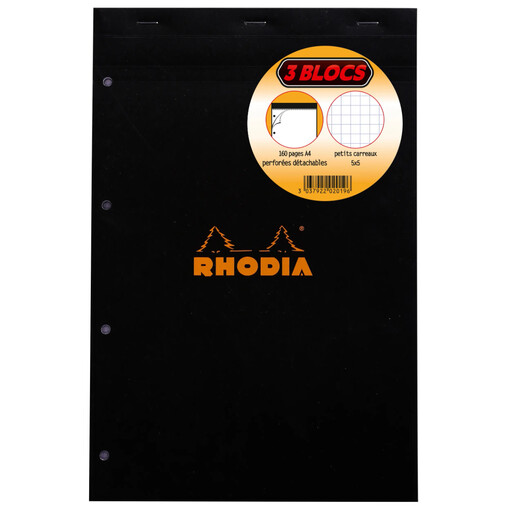
Why we chose it: For anyone who loves the quality of Rhodia paper but doesn't want to be constrained by the Cornell layout. The 5x5 grid ruling offers total versatility for combining text, diagrams, and sketches.
Even at 80g, the Clairefontaine vellum paper provides perfect smoothness and very good opacity. The stapled binding holds up well, and the micro-perforated sheets detach without a snag.
The versatility of the grid ruling and an economical multipack format, without sacrificing the essentials: quality paper and reliable detachable pages.
Discover our full selection of products that meet our strict quality and performance criteria.
1. What's the difference between a Cornell notebook and a standard notebook? The entire difference lies in the layout. A Cornell notebook imposes a specific structure: a column for keywords, a main area for notes, and a space at the bottom for a summary. This organisation is designed to facilitate memorisation and revision, unlike a standard notebook.
2. Is 90g/m? paper really necessary? 80 g/m? paper can be sufficient if you write exclusively with a ballpoint pen. But 90g/m? paper is your best insurance against ghosting and bleed-through. It blocks ink from most pens, fineliners, and fountain pens, ensuring the back of every page remains perfectly usable. For a revision notebook, it's a level of comfort that makes all the difference.
3. Can you use a fountain pen on a Clairefontaine Cornell notebook? Yes, and it's highly recommended?! Clairefontaine's 90g Vellum paper is a benchmark for fountain pen enthusiasts. It offers exceptional smoothness, the nib doesn't scratch, and its exemplary opacity prevents ink from feathering or showing through (the infamous "ghosting" effect). The result: writing that is always crisp and flawless.