For a household of three to four people, 8 to 9 kg is generally enough, according to UFC-Que Choisir. Consider a 10 to 12 kg drum if you often have full laundry baskets and bulky items to wash. If you also do smaller loads, compare the energy label figures and the load limits for each programme.
Which households are these capacities suitable for?
How often you do large loads matters more than the size of your household alone.
Families with frequently full laundry baskets
If sheets, towels and clothes regularly fill the drum, a capacity of over 9 kg can help you combine these loads. For three to four people whose laundry loads are smaller, UFC-Que Choisir says that 8 to 9 kg is generally enough.
Households that often wash duvets and throws
A larger drum is worth considering mainly if you wash these bulky items frequently. Check the manual for the recommended programme and its load limit: the rated capacity does not guarantee that a particular duvet can be washed in the machine.
Families alternating between large and small loads
Sportswear, delicate fabrics or separate colour loads can leave the drum partly filled. Compare the energy label figures and look for small-load functions, but don’t assume on their own that they guarantee measured savings.
What should you check before choosing?
Start with the loads you actually wash, then compare programmes, label information and the space needed for installation.
| Criteria |
What to check |
What I need |
| Usable capacity |
Count your usual large loads and check the maximum load for the programme you use. UFC-Que Choisir gives 8 to 9 kg as a general guide for three to four people; some fabrics may have a lower limit. |
Are my baskets often full enough to justify 10 to 12 kg, or will a more modest capacity handle my usual loads? |
| Small loads |
Compare kWh per 100 cycles and litres per cycle on the European labels of models suited to the same use. According to the European Commission, the weighted energy consumption for the Eco 40-60 programme takes account of rated, half and quarter loads. |
I alternate large loads with smaller washes. A load-sensing function appeals to me, but I don’t want to mistake it for guaranteed savings. |
| Installation and noise |
Measure the space, room for connections and clearance for the door to open. Also compare the spin noise level shown on the label. |
The door must open without obstructing the walkway, and noise matters if the machine is near living areas. |
| Washing performance |
For the exact model, look at washing, rinsing and spinning test results where available, as well as programme duration. UFC-Que Choisir includes these criteria in its comparison testing. |
I want a suitable capacity without basing my decision solely on the kilograms shown. |
What mistakes should you avoid?
-
Choosing the biggest drum “just in case”
A large drum that is rarely filled can lead to unnecessary consumption, and you’ll also need enough room to install it.
Before choosing a capacity, keep track for a few weeks of how often your baskets are genuinely full and how often you wash duvets or throws at home.
-
Assuming the stated capacity applies to every programme
The stated capacity does not necessarily match the permitted load for synthetics, woollens or bulky fabrics. UFC-Que Choisir gives the example of an 8 kg model with a limit of 3.5 kg for synthetics.
Check the programme table for the model you’re interested in, especially if these fabrics make up a large part of your laundry.
-
Relying on the energy rating alone
The rating does not replace the consumption figures, nor does it describe every small wash or programme on its own.
Compare the kWh per 100 cycles and litres per cycle on the European label for models suited to your needs. Treat savings claims for a brand-specific function separately.
-
Measuring only the alcove
The washing machine’s depth may not account for all the space needed once the connections are in place and the door is open.
Measure the available width, height and depth, then check the model’s dimensions, any protruding parts and the door’s opening clearance.
What do the brands have to offer?
These range examples can help you identify features to compare. They don’t indicate the performance of any specific model or whether it appears in the selection below.
Bosch
The brand offers front-loading washing machines in different capacities: Bosch lists the WGE03207FR as an 8 kg model and features a “Mini Load” programme on the WGB254A2FR.
- Bosch lists a “Mini Load” programme for the WGB254A2FR, a feature worth looking at if you often do small washes.
- Its presence alone does not prove that it uses less energy than another model on a small load.
LG
LG lists the F14R35MBS with a 10 kg capacity, load detection and automatic water-level adjustment.
- These features are worth considering if the size of your household’s loads varies from one cycle to the next.
- They aren’t enough to establish that it uses less energy than another 10 kg washing machine; compare the standardised figures.
Miele
Miele’s product page for the WCK360 WCS PWash&10kg provides figures you can compare with those for other models suited to the same use.
- For this model, Miele lists 52 kWh per 100 cycles and 52 L per cycle on its product page.
- These figures alone don’t show that it offers better washing performance or lower consumption on every programme.
Washing machines to consider on Joybuy
These 9 or 10 kg models let you compare two capacities for family laundry loads that vary in size or are often bulky. Check the load limits for each programme before choosing a model for washing duvets.
 Image unavailable
Haier X Series 11 HW100-BD14397PGU1, 10 kg
Its 10 kg capacity is worth considering if you often have large loads. The model name indicates a 1,400 rpm spin speed, along with AutoDose and Wi-Fi features; these details don’t prove that it saves energy on small loads. Also check the space needed for connections and to open the door.
View on Joybuy
 Image unavailable
Electrolux EWF1410N2, 10 kg
This capacity may suit households with frequently full laundry baskets. The product name mentions TimeSave and Steam Anti-Allergy features, but doesn’t establish any health benefit or measured result. For a duvet, check the programme and its maximum load; also measure the clearance needed for installation.
View on Joybuy
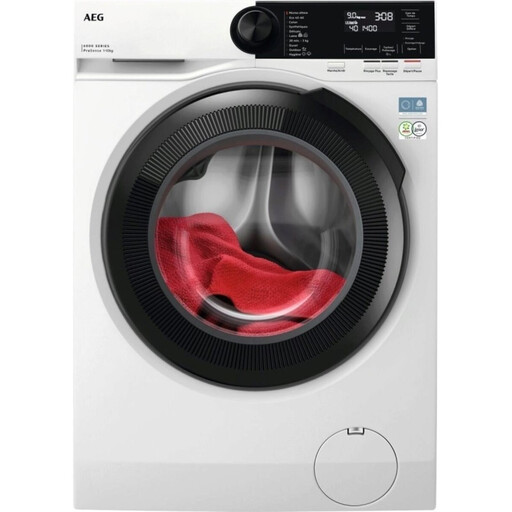 Image unavailable
AEG LFR62E114S, 10 kg
The stated 10 kg capacity is worth considering if you often do large loads; the model name also indicates a 1,400 rpm spin speed. If you plan to wash bedding, check the recommended programme and its load limit. Compare the energy label figures and the dimensions against the space available.
View on Joybuy
 Image unavailable
Electrolux EW7FI259160V, 9 kg
This capacity is close to UFC-Que Choisir’s 8 to 9 kg guide for three to four people. The model name mentions a 1,600 rpm spin speed and SteamCare and SmartSelect features. Check the load limits for the programmes you’ll use, and compare the standardised figures if you often do small washes.
View on Joybuy
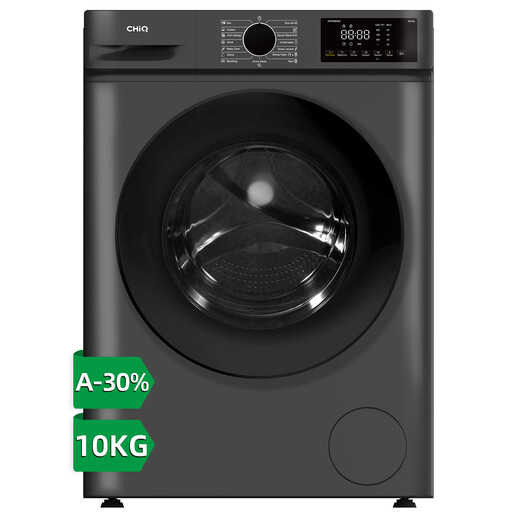 Image unavailable
CHiQ JW105883G, 10 kg
The stated 10 kg capacity is worth considering for large family loads. The model name indicates 1,400 rpm and 16 programmes, but the number of programmes doesn’t tell you what load is permitted for a duvet: check the manual. Also check the installation dimensions and standardised water and energy figures before comparing this model.
View on Joybuy
Frequently asked questions
Should a family of four move up to 10 kg if they wash duvets?
Not necessarily: UFC-Que Choisir says that 8 to 9 kg is generally enough for a household of three to four people. Consider a larger capacity if you often have large loads and wash duvets at home, then check the maximum load for the programme suited to these items.
Does the energy label show consumption at half load?
It allows for a standardised comparison, but doesn’t necessarily show a separate figure for half load. According to the European Commission, the weighted energy consumption for the Eco 40-60 programme includes tests at rated, half and quarter capacity. Compare the kWh per 100 cycles for models suited to your needs.
Does load detection make a 10 kg washing machine more energy-efficient for small washes?
The function alone doesn’t prove that it does. It may be useful if you alternate between different load sizes, but compare the label figures and, where available, tests on the exact models rather than assuming that a sensor guarantees savings.


