
Livraison le jour même ou le lendemain

Qualité garantie

Débloquez vos offres de bienvenue: Livraison GRATUITE | Jusqu'à -80 % | 30 jours d'essai gratuits à JoyPlus
Téléchargez l'application
When a heatwave hits, a portable air conditioner can feel like a miracle solution for finding relief, especially in an apartment or a home without central air. But here's the catch: the market is a jungle of models with tempting promises, making it easy to make a mistake and regret your purchase. To help you avoid going down the wrong path, let's review the most common pitfalls.
The two main pitfalls are almost always the same, stemming from misunderstood features:
This guide is here to help you cut through the noise and focus on the criteria that truly matter for a cool summer with no unpleasant surprises.
To ensure you don't regret your investment, here are the essential technical points to verify. These factors will determine the unit's real-world effectiveness, user comfort, and suitability for your home.
Cooling power, measured in BTU, is the number-one criterion. It's your guarantee of effective cooling. For a living room, bedroom, or office, a power of 9000 BTU is the recommended standard to cover an area up to 30?m?.
Choosing the right power is the first step toward optimal comfort without sending your electricity bill skyrocketing.
For a bedroom, a quiet portable air conditioner isn't an option—it's a non-negotiable requirement. The noise level, expressed in decibels (dB), must be watched closely. Here are a few benchmarks:
Be sure to check if the model has a "Night" or "Sleep" mode. This feature reduces the fan speed, and therefore the noise, so it won't ruin your sleep.
Most recent models are versatile 3-in-1 units that do more than just cool the air. These extra functions often prove very practical for daily use:
Your appliance then becomes a truly versatile spot cooler, useful far beyond just heatwaves.
To illustrate how these criteria apply in practice, here is a selection of models that meet specific needs while avoiding the classic pitfalls.
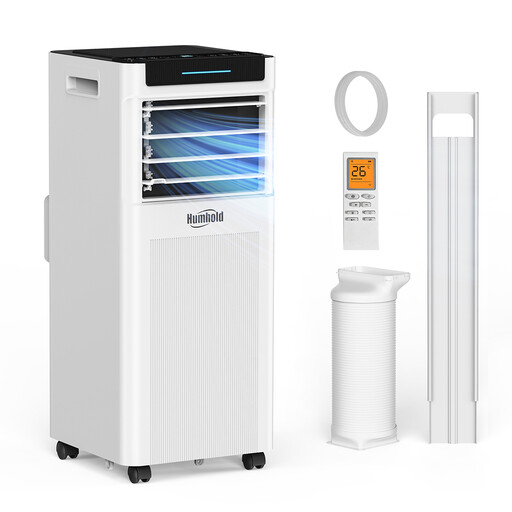
Best for: Perfect for those seeking a high-performance solution for their living room or a large bedroom. Its power is ideally calibrated to cool a space up to 30 m? without breaking a sweat.
With its 9000 BTU (2.6 kW), it eliminates the risk of being undersized. Its night mode, which operates below 51 dB, meets the quietness criterion for nighttime use.
Its 3-in-1 versatility (cool, dehumidify, fan) and its self-evaporating system that reduces the chore of emptying the water tank.
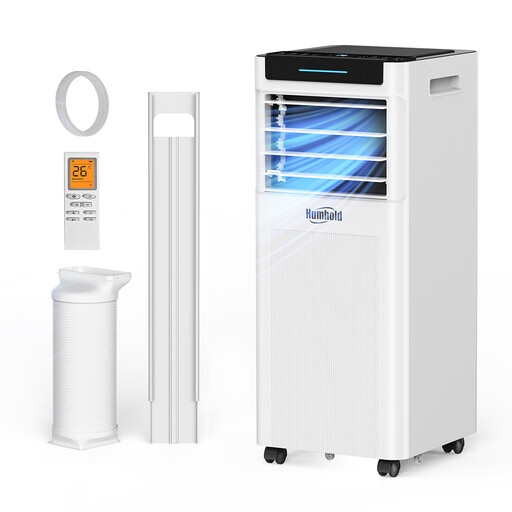
Best for: Ideal for a bedroom, office, or small living room (up to 28 m?). It offers an excellent balance of performance, size, and price, especially if you're looking for an end-of-season deal on a portable AC.
Its night mode drops below 49 dB, a remarkable threshold for a portable air conditioner. Its 7000 BTU power is perfectly matched to its target, so you avoid paying for superfluous power in a small space.
Its compact format (30 x 29.2 cm footprint) makes it easy to store, and its very low noise level is a real bonus for nighttime use.
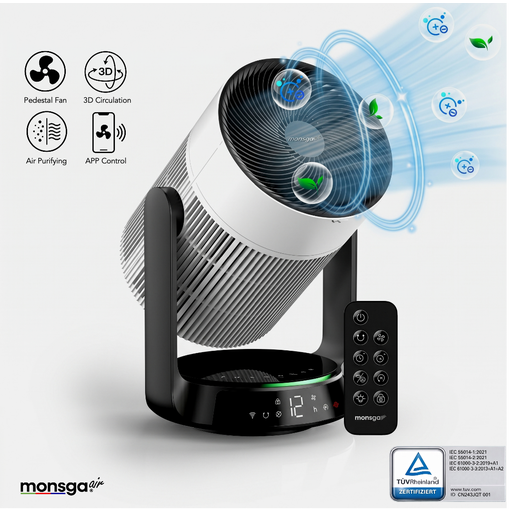
Best for: Note: this is not an air conditioner, but an excellent companion to one. It's aimed at those who want to maximize their AC's efficiency or are looking for a versatile solution to circulate and purify air year-round.
It tackles the problem of uneven cool air distribution. Ultra-quiet (only 25 dB in night mode), it's easy to forget it's there, unlike a second, noisy air conditioner.
Its 360° oscillation for even air distribution and its purifier function (CADR of 280 m?/h) for healthier air.
If setting up a portable air conditioner seems too cumbersome, or if you're simply looking for an effective supplement, a good fan can be an excellent alternative. We have selected models that meet strict criteria for quietness and performance.
Consumption depends on its energy class and your usage. A 9000 BTU model typically has an electrical power rating of around 1000 watts (or 1 kWh). For 4 hours of use per day, that amounts to about 4 kWh. To keep your bill in check, choose a properly sized unit and make liberal use of the timer to run it only when truly necessary.
Yes, but the frequency depends on the model and the ambient humidity. Most modern units include a self-evaporation system that expels much of the condensed water with the hot air through the exhaust hose. However, in dehumidifier mode or if the air is particularly humid, the internal tank will eventually fill up. Don't worry: an indicator light will alert you when it's time to empty it.
No. A true portable air conditioner must have an exhaust hose that runs to a window or other opening. This is how it expels the hot air it has removed from your room. Devices marketed as "hose-free air conditioners" are actually evaporative coolers (or "swamp coolers"). They work by evaporating water (adiabatic cooling) and have nowhere near the cooling power of a compressor-based air conditioner. Their effectiveness is far more limited, and worse, they increase the room's humidity level.