
Livraison le jour même ou le lendemain

Qualité garantie

Débloquez vos offres de bienvenue: Livraison GRATUITE | Jusqu'à -80 % | 30 jours d'essai gratuits à JoyPlus
Téléchargez l'application
Whether you want to keep your RV cosy during a winter getaway, heat your garage for comfortable DIY projects, or ensure consistent warmth in your truck's cabin, the 8?kW portable diesel heater has become the go-to solution—both self-contained and effective. The problem? The market is flooded with models making tempting promises that sometimes hide deal-breaking flaws.
As a Product Specialist at Joybuy, my role is to guide you through this jungle of offers. Let's break down the pitfalls to avoid and the essential criteria to ensure you make the right choice.
The promise of fast, affordable heat often leads to impulse buys. Here are three red flags to watch for to ensure you don't regret your purchase.
To ensure you choose a high-performance, durable unit, here are the three features to examine closely.
An 8?kW output is comfortable and allows for the rapid heating of large spaces (up to 25?m?). But raw power isn't everything—far from it. A heater's ability to modulate its power is what truly makes a difference. A good portable diesel air heater must be able to maintain a stable temperature without constantly running at full blast, which helps to optimise fuel consumption and reduce noise. For users at high altitudes, an automatic adjustment mode is a major plus to ensure clean and efficient combustion.
As we've seen, the power source is crucial for versatility. A model that accepts both DC power (12V or 24V diesel heater) and AC power (110-240V) covers all scenarios:
When it comes to safety, there are no compromises. Check for essential protections: overheating, short-circuit, and overvoltage. Although these devices are designed for safe use, adding an independent carbon monoxide detector is highly recommended in any enclosed space. On the ergonomics side, having multiple control methods (LCD screen, remote control, and Bluetooth app) is a daily game-changer.
Rather than a long-winded list, we chose to highlight one model that ticks all the boxes for versatility, reliability, and ease of use.
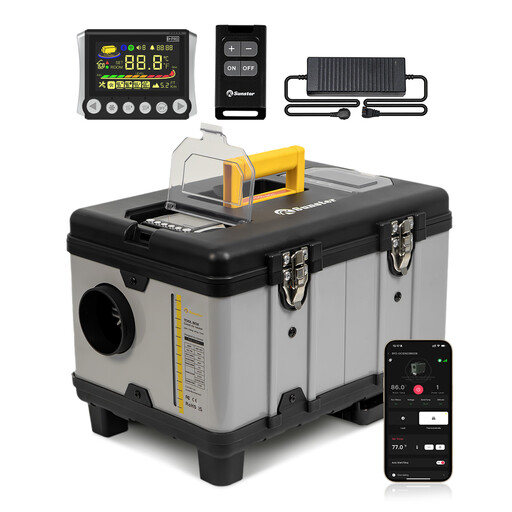
The Verdict: Ideal for the craftsperson who heats their workshop during the week and heads out in a converted van on the weekend. Its "toolbox" design with an integrated 6L tank and carrying handle makes it a truly self-contained, all-in-one unit that's easy to transport.
It features dual AC 230V and DC 12V/24V power, eliminating the single-source trap. Its all-in-one design houses the pump, which helps mitigate noise. It's a ready-to-use solution that bypasses any complex installation.
Triple control methods (LCD, remote, Bluetooth app). Automatic altitude adjustment mode for use up to 5,500m. Ventilation-only function for air circulation without heat.
This model is the perfect answer for those needing maximum flexibility. For more specific solutions, such as units designed for permanent installation in heavy-duty trucks, feel free to explore a wider range.
For more specific needs, like permanently integrated units or other types of accessories, explore our complete selection.
Consumption depends on the power level used. For a model like the TB10, it typically ranges from 0.11 to 0.45 litres per hour. In regulation mode to maintain a temperature, consumption is at the lower end of the range, allowing you to get through a full night on less than 4 litres of diesel.
Yes, but only if you follow strict safety rules. The unit must be positioned so that the exhaust fumes are vented outside the living space (tent, cabin, room). NEVER operate the unit with the exhaust inside. Adding a carbon monoxide detector is an essential and non-negotiable safety measure. Also, remember to ensure minimal ventilation in the room.
Installing a portable model like the one we're featuring is a breeze: you just set it down, direct the exhaust pipe outside, and plug it in. In contrast, a conventional stationary diesel heater requires more work: drilling through the vehicle's body for the air ducts and exhaust, connecting to the vehicle's diesel tank, and handling the electrical wiring. The process requires solid DIY skills or the help of a professional.