
Livraison le jour même ou le lendemain

Qualité garantie

Débloquez vos offres de bienvenue: Livraison GRATUITE | Jusqu'à -80 % | 30 jours d'essai gratuits à JoyPlus
Téléchargez l'application
Switching to an electric car is a major step, but the question of home charging quickly becomes a key concern. Opting for a 7?kW Type 2 charging station is often the best compromise for private individuals. The problem is, the market is flooded with models making tempting promises, and it's easy to fall into costly traps. As the Head of Product Recommendations at Joybuy, my mission is to help you see more clearly and make a choice that truly fits your needs and your electrical system.
Navigating the jungle of EV chargers can quickly become a headache. Many offers use marketing claims that sometimes hide deal-breaking flaws. Here are the three most common pitfalls to be aware of.
To avoid these unpleasant surprises, a few technical criteria are simply non-negotiable.
A power rating of 7?kW (or 7.4?kW) corresponds to a single-phase 32?A installation. This is the ideal compromise for most UK households: it allows you to recover about 25 to 30 miles of range per hour of charging, without needing to switch to a three-phase subscription, which is often more expensive. As for the connector, there's no debate: the station must be equipped with a Type 2 (or T2) connector, the European standard for AC charging. It is compatible with virtually all electric and plug-in hybrid vehicles on the market.
A good Wi-Fi connected charging station should allow you to:
Dynamic load balancing is a critical feature. A charger equipped with this technology measures your home's real-time electricity consumption. If the total consumption approaches your subscription's limit, the station automatically reduces the vehicle's charging power to prevent an overload. As soon as other appliances are turned off, the station increases the power again. It's the guarantee of an optimised and safe charge, without ever tripping the breaker. This technology is often found under the name Type 2 EVSE charger with a load management function (or Dynamic Load Balancing).
To help you take action, we've selected models that tick all the right boxes, matching them with typical user profiles.
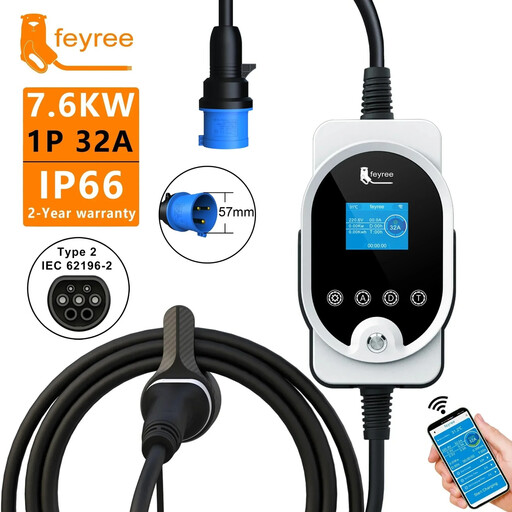
Why it's a good fit: Ideal for a first-time setup, this charger offers the essential smart features (Wi-Fi app control, scheduled charging) at a very competitive price. It allows you to take advantage of off-peak hours without breaking the bank.
It includes genuinely useful smart features (scheduling, monitoring) without the extra cost of superfluous gadgets. It also includes basic safety protections, including DC leakage detection.
Unbeatable features-to-price ratio; adjustable charging current (from 8 A to 32 A) for greater flexibility.
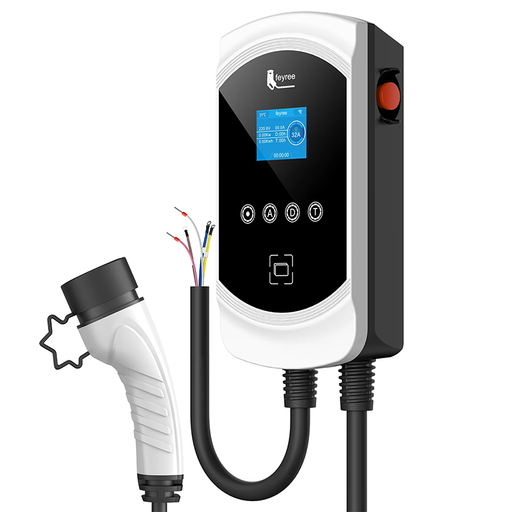
Why it's a good fit: For those who want absolute peace of mind. Dynamic load balancing is the ideal solution for homes already well-equipped with power-hungry appliances or for those who simply don't want to worry about it.
It directly solves the problem of potential overloads. The system automatically adjusts the charge, ensuring the fastest possible charging speed without ever tripping the house's circuit breaker.
Dynamic Load Balancing (DLB) function for intelligent power management; full control via the Tuya app.
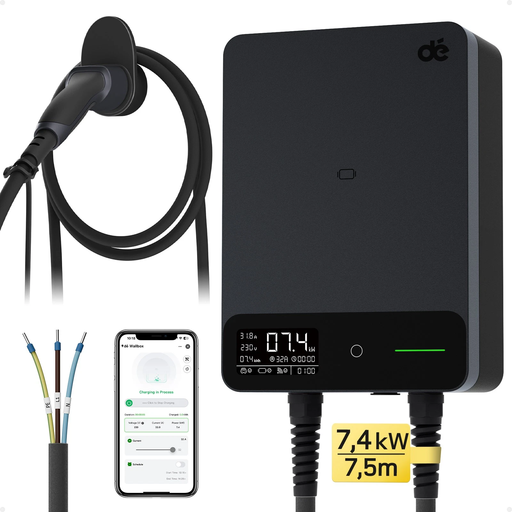
Why it's a good fit: This model is perfect for those looking for a reliable and user-friendly solution. RFID card access allows you to start charging without needing your smartphone, which is convenient in a shared car park or for family use.
It bypasses reliance on an app by offering simple and quick activation via RFID card. Better yet, it integrates Type A + 6mA DC residual current protection, which simplifies installation and ensures an optimal level of safety.
Secure access via RFID card; comprehensive integrated residual current protection; 7.5-metre cable for added convenience.
We've put together a complete, up-to-date selection of chargers that meet all our selection criteria and current safety standards.
A heavy-duty socket (like a Commando socket) delivers about 3.2?kW of power. While that's more than double a standard domestic socket, it's still less than half the power of a 7?kW charger. A dedicated charger allows for a much faster full charge (usually overnight) and offers smart and safety features that a heavy-duty socket does not.
Not necessarily. A 7?kW charger requires a dedicated circuit, protected by a 40?A circuit breaker on your electrical panel. Most standard domestic electricity plans can support it. However, if you have a lower-power plan and many energy-intensive appliances, a charger with dynamic load balancing is highly recommended to prevent overloads. In all cases, installation by a qualified electrician is mandatory.
It's not mandatory, but it is highly recommended if your electricity supply is limited, if you frequently use power-hungry appliances (electric heating, oven, pool pump, etc.), or if you simply want peace of mind. It optimises charging speed by using all the available power from your system without ever risking an overload.