
Livraison le jour même ou le lendemain

Qualité garantie

Débloquez vos offres de bienvenue: Livraison GRATUITE | Jusqu'à -80 % | 30 jours d'essai gratuits à JoyPlus
Téléchargez l'application
Switching to an electric car is a major step, but choosing a home charging solution can quickly become a headache. Between marketing promises and impenetrable spec sheets, the risk of buyer's remorse is very real. An underpowered charger will slow you down daily, while a model that’s incompatible with your electrical system can cause repeated power outages.
As a product expert at Joybuy, my mission is to help you see things more clearly. Together, we'll break down the essential points for choosing the right 7?kW EV charger with dynamic load balancing and avoid the common, costly pitfalls.
The EV charger market is booming, and not all offers are created equal. Here are two frequent issues that can turn your home charging experience into an uphill battle.
1. The Trap of Raw Power Without Intelligence
Many chargers proudly display a 7?kW (32?A) power rating, promising lightning-fast charging. The problem? Without smart management, this power can easily overload your home's electrical service, especially if other power-hungry appliances (oven, washing machine, heater) are running at the same time. The result: the main circuit breaker trips, and the entire house is plunged into darkness. You're then forced to manually limit the charger's power, which completely negates the benefit of a fast charge.
2. The Illusion of a "Smart Charger" with a Clunky App
A Wi-Fi connected wallbox is a major asset for optimising your electricity bill. It allows you to schedule charging during off-peak hours, track your consumption, and control the charger remotely. The catch? Many entry-level models come with unreliable apps, are overly complicated to configure, or are loaded with gimmicky features. In the end, you pay for a "smart" function that is unusable in practice and saves you no money.
To make an informed choice, you need to focus on a few non-negotiable parameters. They guarantee not only your convenience but also the safety of your installation.
A 7?kW (or 7.4?kW) charger is the current standard for home electric car charging on a single-phase installation. It operates at an intensity of 32?A. In practical terms, it allows you to recover about 40 to 50?km of range per hour of charging, which is more than enough to fully charge most electric or plug-in hybrid vehicles overnight. Installing such a charger requires a dedicated and protected electrical line, which must be set up by a professional.
This is THE essential feature for hassle-free home charging. Dynamic load balancing, also known as dynamic charge balancing, is a smart system that keeps a watchful eye. A sensor measures your household's total real-time power consumption. If the overall consumption approaches your service's limit, the charger automatically reduces the car's charging power. As soon as another appliance turns off, the charger instantly ramps the power back up. It's the guarantee that you'll never trip your breaker, all while charging your vehicle at the maximum speed allowed by your grid at that very moment.
A good smart EV charger must offer a stable Wi-Fi connection and a responsive, intuitive mobile app. Check for essential features like charge scheduling and consumption monitoring. On the safety side, one point is non-negotiable: ensure the charger includes protection against DC leakage current (often called Type B RCD protection or an equivalent DC 6?mA sensor). This is a crucial safety standard specifically designed for charging electric vehicles.
Rather than a long list, here are options that cater to distinct user profiles, taking into account the criteria we've just discussed.
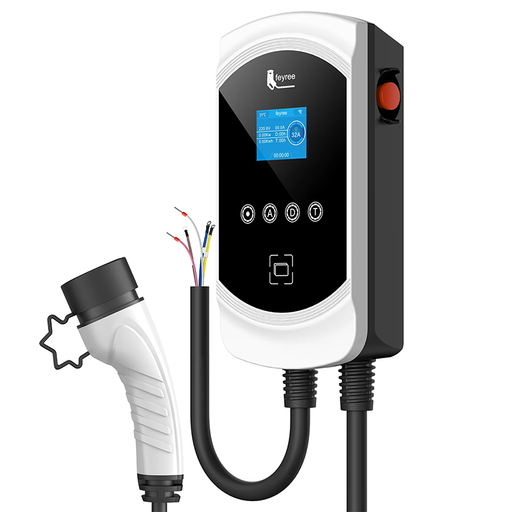
Why this model stands out : Ideal for the homeowner who wants absolute peace of mind. They can run the laundry, cook dinner, and charge their car simultaneously without ever fearing a power outage.
Its built-in Dynamic Load Balancing (DLB) feature directly tackles the problem of overloading. It manages power autonomously for consistently optimised and uninterrupted charging.
Its automatic charge management guarantees total serenity. The Tuya app enables remote control and scheduling.
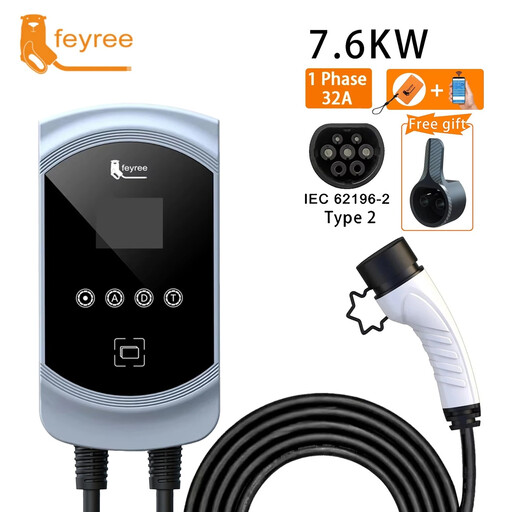
Why this model stands out : Perfect for those who have enough headroom on their electrical panel and don't critically need load balancing, but still want the cost-saving benefits of a smart charger.
It offers a reliable Wi-Fi connected wallbox experience via the Tuya ecosystem, avoiding the gimmicky app trap. The current is manually adjustable (from 8 A to 32 A) for simple and effective charge management.
Excellent value for money to access smart charging and schedule your sessions during off-peak hours.
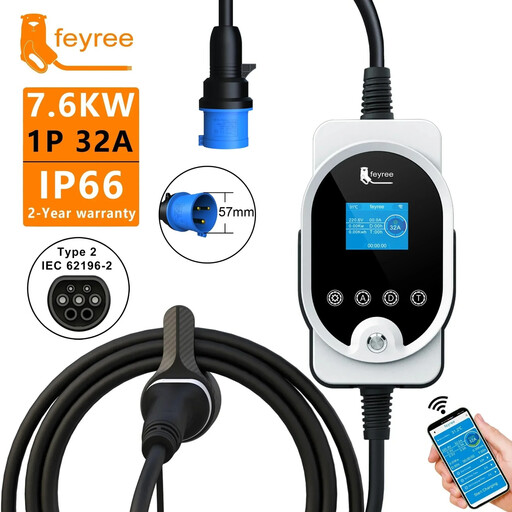
Why this model stands out : For renters, second-home owners, or anyone who moves frequently. This model can be installed on a wall but can also be taken with you as a powerful portable charger.
It doesn't sacrifice any features for portability. You get fast 7 kW charging and all the smart functions (Wi-Fi, app, scheduling) in an ultra-versatile package.
Maximum flexibility: a single charger for fixed use at home and portable use on the go, with no compromise on performance.
We have curated a full range of products that meet our strict selection criteria and safety standards.
Is dynamic load balancing really necessary for a 7?kW charger?
It depends on your electrical setup and your habits. If you have a smaller electrical service (e.g., under 60?A) and you often use power-hungry appliances while charging, this feature is highly recommended to prevent tripped breakers. For a larger service (e.g., 100?A or more), the risk is lower, but dynamic load balancing remains a comfortable safety net.
Do I need an electrician to install a 7?kW wallbox?
Yes, it is imperative. The installation of a charging station with a power greater than 3.7?kW must be carried out by a qualified electrician, ideally one certified for EV charger installations. This is often a legal requirement that guarantees the safety of your installation, its compliance with local electrical codes, and may be a prerequisite for accessing government incentives.
What is the difference between Type A and Type B RCD protection?
A Type A RCD (Residual Current Device) protects against alternating current (AC) leakages. However, electric vehicle chargers can generate direct current (DC) leakages, which a Type A device cannot detect. A Type B RCD is specifically designed to detect both types of leakages (AC and DC), offering a much higher level of safety. Some chargers have this protection built-in, which can simplify and reduce the cost of the installation at your electrical panel.