
Livraison le jour même ou le lendemain

Qualité garantie

Débloquez vos offres de bienvenue: Livraison GRATUITE | Jusqu'à -80 % | 30 jours d'essai gratuits à JoyPlus
Téléchargez l'application
Switching to an electric car is a game-changer, but one question quickly arises: how do you charge it at home? While a standard household socket can help in a pinch, it quickly shows its limitations in terms of speed and safety. This is where the 7?kW EV charger comes in, establishing itself as the ideal solution for fast and hassle-free daily charging.
As the Head of Product Recommendations at Joybuy, my mission is to guide you through this tech jungle. In this guide, we'll break down the key points for choosing the right charger and present our selection of the best models to equip your garage or parking space.
Before taking the plunge, let's look at a few technical criteria that will make all the difference in your daily routine. Here are the three essential points to check to ensure you make the right choice.
A 7?kW charger (or 7.4?kW to be precise) is installed on a single-phase electrical system—the most common type in homes—and requires a dedicated 32?A circuit. It's the perfect balance between a comfortable charging speed and reasonable installation requirements. In practical terms, you'll gain between 40 and 50?km of range per hour, enough to fully charge your battery overnight, stress-free.
On the connectivity side, check that the charger has a Type 2 connector: this is the European standard for almost all electric and plug-in hybrid cars. Finally, a crucial point: the installation must be carried out by a qualified electrician. This guarantees a safe and compliant installation.
Opting for a smart charger connected via Wi-Fi or Bluetooth offers a major everyday advantage. Through a dedicated mobile app (like Tuya Smart), you take control:
In short, these features transform your simple wall-mounted charging station into a true smart energy manager.
Worried about tripping the circuit breaker when you plug in your car while the oven and washing machine are running? It's a legitimate concern. The solution is a charger with dynamic load balancing (DLB).
This clever system constantly monitors your home's total electricity consumption. If the total demand approaches your plan's limit, the charger automatically reduces the car's charging power to prevent an outage. As soon as an appliance turns off, the charger restores full power to your vehicle. It's absolute peace of mind, plain and simple.
We've selected three models for you that tick all the boxes, but with different philosophies to suit every type of user.
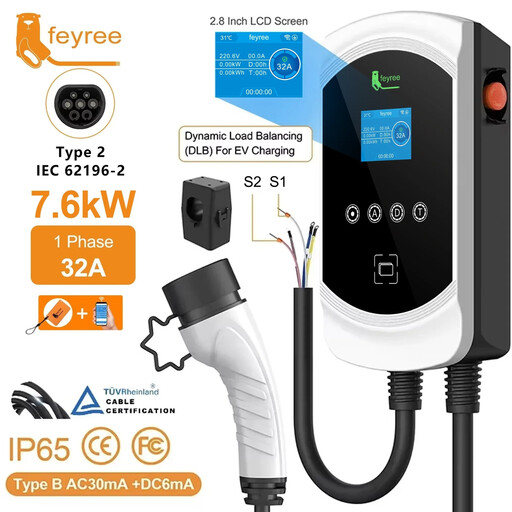
The standout feature: This is the ultimate "no-fuss" model. Thanks to its dynamic load balancing, it manages power like a conductor to ensure you never trip the breaker.
Advantages:
Who is it for? For anyone living in an active household where electrical appliances run at full tilt. It's the choice for total serenity, allowing you to plug in your car and forget about it.
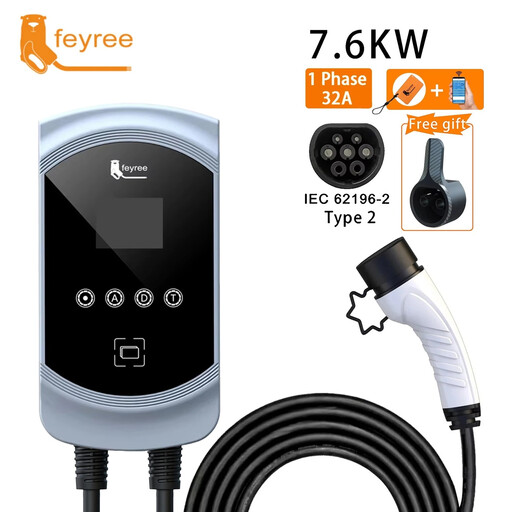
The standout feature: Here, everything is managed via your smartphone. This is the charger for tech enthusiasts who love to control their charging with precision to optimise consumption.
Advantages:
Who is it for? For the connected user who wants to control their electricity bill by scheduling charges during off-peak hours and keeping an eye on consumption, all from the comfort of their sofa.

The standout feature: No frills. This charger gets straight to the point: plug in, charge. Its robust aluminium alloy construction and single-button operation make it a simple, effective, and built-to-last model.
Advantages:
Who is it for? For those looking for a "plug-and-play" 7?kW Wallbox. You mount it, you plug it in, and that's it. The ideal solution if you don't care for apps and complex settings.
This selection highlights three excellent choices, but the world of EV charging is vast. To explore other models, compare power ratings, or find practical accessories, feel free to browse our complete catalogue.
? Explore our full range of charging equipment
A heavy-duty socket (like a Green'up) delivers about 3.2?kW of power, whereas a 7?kW EV charger goes up to 7.4?kW. Put simply, the charger recharges your vehicle more than twice as fast. More importantly, it incorporates much more advanced safety features, making it the most reliable solution for daily use.
In most cases, no. You just need to check the power rating of your electricity contract. A 6?kVA plan might be a bit tight if you're charging while other large appliances are running. To be completely worry-free, a 9?kVA or 12?kVA plan is ideal. It will allow you to use the charger at full power without any risk of tripping the breaker, especially if your charger doesn't have a load balancing system.
The installation itself isn't complex, but it must be carried out by a professional, ideally a certified EV charger installer. This is non-negotiable for safety. They will run a dedicated line from your electrical panel and install the necessary protections (circuit breaker, RCD). It's the only way to guarantee a 100% compliant and perfectly safe installation.