
Livraison le jour même ou le lendemain

Qualité garantie

Débloquez vos offres de bienvenue: Livraison GRATUITE | Jusqu'à -80 % | 30 jours d'essai gratuits à JoyPlus
Téléchargez l'application
You've made the switch to an electric car. But to get the most out of it, you need to optimise your home charging setup. Faced with an overwhelming number of options, finding the right station can quickly become a headache. The 7kW charging station often stands out as the ideal compromise for residential use: it cuts charging time in half compared to a standard socket, without requiring a complete overhaul of your electrical system.
This guide is designed to shed light on the essential criteria and introduce you to the models that have caught our eye for equipping your home in 2026. The goal: to give you the keys to finding the electric car charger that is perfectly suited to your habits and your vehicle.
Before we dive into our selection, here are the key points to consider to make the right choice.
The first question to ask is about the format.
7kW wallbox): Mounted on your garage wall or outdoors, it's a robust, always-ready solution. It's the preferred choice for a primary home charging station.portable electric car charger: Much more mobile, it goes wherever you go (second home, office, etc.), as long as a suitable outlet is available. Some clever models can also be wall-mounted via a bracket, offering the best of both worlds.A smart charging station unlocks life-changing daily features. Thanks to Wi-Fi and a mobile app, you can:
Safety is paramount. Ensure the station includes all essential protections (overvoltage, overcurrent, current leakage, etc.). In Europe, the Type 2 charging station is the universal standard for almost all electric vehicles.
The installation of a 7kW charger, which operates on a dedicated 32A single-phase circuit, must be handled by a qualified electrician. This guarantees a safe installation that complies with local standards and is often a prerequisite for receiving government incentives.
Here is our selection of models that have captured our attention, each meeting a specific need while combining performance, safety, and functionality.

The choice for simplicity and robustness This wallbox gets straight to the point: simple, solid, and efficient. Its aluminium alloy body inspires confidence, while its single control button makes it incredibly easy for daily use.
Key features
Who is it for? For those looking for a reliable and durable 7kW wallbox without connected frills. It's the perfect solution for a primary home installation, designed to be a plug-and-forget solution.
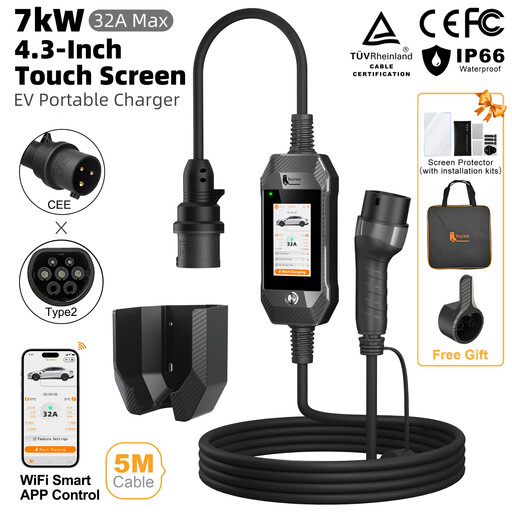
For tech enthusiasts who love total control This portable charger's standout feature is its large 4.3-inch colour touchscreen. It provides a clear, modern interface to monitor all charging data in real-time, which will delight fans of detailed stats and precise control.
Key features
Who is it for? For drivers who like to keep an eye on every detail of their charge directly on the device. Its portability is a real bonus for those who frequently move between different charging locations.
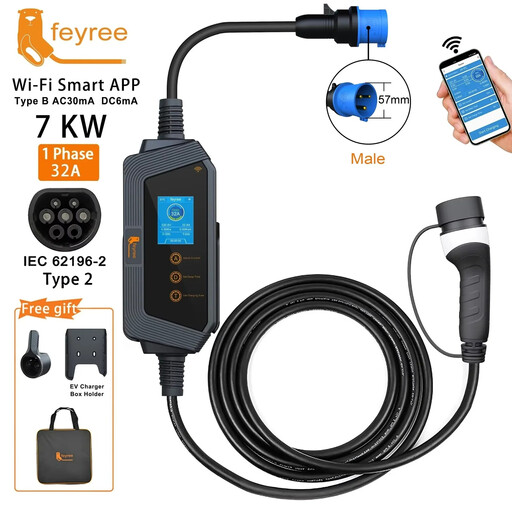
Smart, portable charging This model is the Swiss Army knife of charging: it's both portable and can be controlled remotely via an app. It's the ideal solution for optimising costs by scheduling charges during off-peak hours, all from your smartphone.
Key features
Who is it for? For pragmatic users who want to control their electricity budget by taking advantage of off-peak rates. Its dual-purpose design (portable and wall-mounted) makes it an ultra-versatile option.
This selection highlights 7kW chargers suited for specific use cases. If these don't quite fit your needs or if you simply want to see other options, a much wider range awaits you.
To discover other power ratings, designs, and features, feel free to browse our complete category of T2 chargers.
It's simple: a 7kW (32A) charger charges about twice as fast as a 3.7kW (16A) one. For a 50 kWh battery, a full charge will take about 7-8 hours at 7kW, compared to 13-14 hours at 3.7kW. The 7kW power level is therefore much more convenient for daily use, ensuring a full "tank" overnight.
Yes, and it's non-negotiable. The installation of a charging station with a power rating above 3.7 kW must be carried out by a professional electrician, ideally one certified for EV charging point installation. This guarantees a safe and compliant installation, and it's also a mandatory condition for qualifying for government grants or incentives.
Almost all 7kW chargers sold in Europe use a Type 2 plug, which is the universal standard for all new electric and plug-in hybrid vehicles (Tesla, Renault, Volkswagen, Peugeot, etc.). The models presented here are therefore compatible with the vast majority of the current and future electric vehicle fleet.