
Livraison le jour même ou le lendemain

Qualité garantie

Débloquez vos offres de bienvenue: Livraison GRATUITE | Jusqu'à -80 % | 30 jours d'essai gratuits à JoyPlus
Téléchargez l'application
Whether you're a gamer, developer, or writer, a well-organized desk is the key to productivity. The challenge: striking the right balance between a compact form factor and maximum functionality. While full-size keyboards devour space and 60% models sacrifice essential keys like the function row (F1-F12) or arrow keys, there is a better way.
The solution? The 75% mechanical keyboard. It's the ideal compromise, retaining most essential keys in a layout that's only slightly wider than a 60% keyboard. This guide will give you the keys to choosing wisely and introduce you to our favorite models.
The 75% layout is booming in popularity, and the market is flooded with options. To help you make the right choice, here are the three technical criteria you shouldn't overlook.
Your daily use will dictate the most suitable connectivity.
The type of switch (the mechanical component under each key) defines your entire typing experience.
A hot-swappable keyboard allows you to remove and replace switches without any soldering. This is a major advantage for enthusiasts, allowing them to:
This feature not only ensures the longevity of your keyboard but also offers unparalleled modularity.
Here are three models in the 84-key layout that perfectly illustrate this versatility. Note that they come in a QWERTY US layout (we'll explain below why this isn't an issue!).
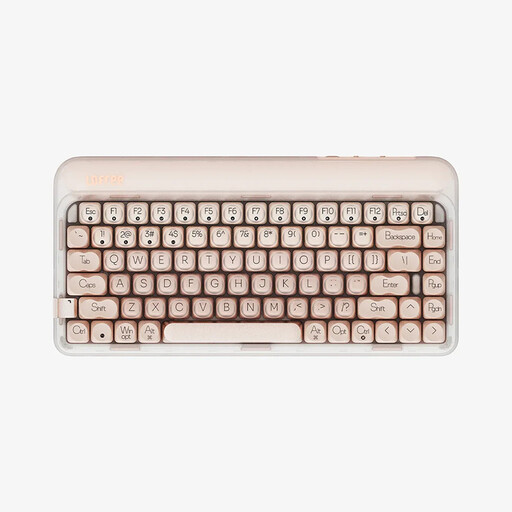
Why it stands out: The Lofree OE914 shines with its meticulous design and obsession with acoustic comfort. Its internal structure uses multiple layers of sound-dampening material (PORON, IXPE) to muffle vibrations and deliver a soft and muted typing sound (thocky, for those in the know), a far cry from the clatter of a classic mechanical keyboard.
Advantages:
Who is it for? Ideal for those seeking a keyboard that performs as well in the office as it does for casual gaming, with a refined aesthetic and a quieter typing experience. Its versatility makes it an excellent companion for digital nomads and multi-device users.
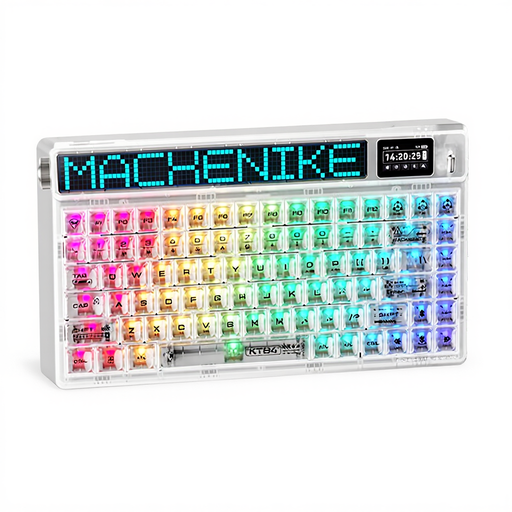
Why it stands out: The Machenike KT84-B84W is a true tech powerhouse. It is distinguished by its HD TFT screen and its customizable LED matrix on top of the chassis. This screen can display system info, images, GIFs, or the time, for a level of visual customization never seen before.
Advantages:
Who is it for? For tech enthusiasts, gamers, and streamers who love to push their hardware customization to the limit and display real-time information on their setup.
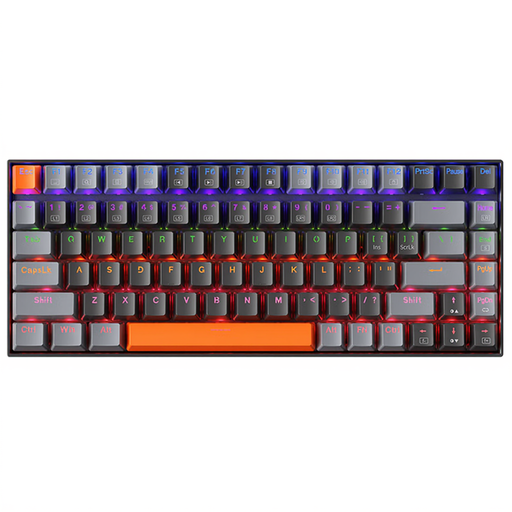
Why it stands out: The Machenike K500A-B84 gets straight to the point. It's a robust and reliable wired mechanical keyboard, built for pure performance. Its key strength: tactile switches (Brown) perfect for intensive typing.
Advantages:
Who is it for? For developers, writers, and all professionals who demand a flawless wired connection and the comfort of a tactile typing experience. A pragmatic and high-performance option for those who live on their keyboard.
Our selection focuses on the 75% layout, but the world of mechanical keyboards is vast. Want to explore other form factors, more explosive RGB backlighting options, or different designs? We invite you to browse our complete collection of LED Keyboards.
A TKL (for Tenkeyless, or 80%) keyboard is simply a full-size keyboard with the number pad removed. It retains the standard, spaced-out layout of the key clusters (arrows, navigation, etc.). A 75% keyboard takes compactness a step further: it condenses all the keys, removing the gaps between the different blocks and often reorganizing the navigation keys (Insert, Delete...) into a single vertical column for maximum space saving.
Absolutely! Even if the physical keys are in a QWERTY layout, it's your operating system's language setting (Windows, macOS) that matters. By setting your OS to your local language (e.g., French AZERTY, German QWERTZ), your QWERTY keyboard will behave exactly like a native one. Many enthusiasts even prefer this, as the selection of custom keycaps is infinitely larger for the QWERTY layout.
A mechanical keyboard outperforms its membrane counterpart on several fronts: durability, precision, and typing feel. Each key has its own mechanical switch, which guarantees flawless responsiveness and prevents missed keystrokes. Most importantly, the ability to choose your switches (linear, tactile...) and swap them on the fly (on a hot-swappable model) offers a tailor-made experience that is simply unimaginable on a membrane keyboard.