
Livraison le jour même ou le lendemain

Qualité garantie

Débloquez vos offres de bienvenue: Livraison GRATUITE | Jusqu'à -80 % | 30 jours d'essai gratuits à JoyPlus
Téléchargez l'application
Switching to an electric vehicle is one thing, but choosing a home charging solution can quickly become a headache. Faced with a jungle of models and technical jargon, it's hard to know where to start. Our mission: to help you see clearly and make the right choice by sidestepping the most common marketing traps.
The first pitfall? Being tempted by low-cost, "all-in-one" chargers that, in reality, cut corners on essential electrical protections. The consequence: often hefty additional costs to make the installation compliant and safe. Another trap concerns so-called "smart" features: some apps are unnecessarily complex, impractical for daily use, or worse, hide paid subscriptions for basic functions.
This guide gets straight to the point: it focuses on the criteria that truly matter for choosing the 7.4?kW charging station that fits your needs, far from the siren song of marketing.
To ensure you invest in a reliable and high-performance solution, three technical points must be scrutinised. They determine not only the charging speed but also the safety of your installation and its ease of use on a daily basis.
A power output of 7.4?kW on a single-phase electrical system is the ideal and most common pairing for home charging in Europe. Here's why:
The Type 2 connector has established itself as the European standard for alternating current (AC) charging. Almost all new vehicles sold in the region are equipped with it. Choosing a charger with an attached Type 2 cable ensures maximum compatibility.
Cable length is a practical detail that should never be overlooked. A 5-metre cable may be sufficient if you always park the same way, but a 7.5-metre model offers much greater flexibility, allowing you to plug in your vehicle regardless of its parking orientation or the location of its charging port.
Safety is non-negotiable. A quality charging station must include protections against overcurrents and leakage currents. The presence of a Type A Residual Current Device (RCD) with 6?mA DC leakage detection, or even better, a Type B RCD, is a true hallmark of safety. This can also simplify the installation and reduce costs by avoiding the need to add an expensive differential switch to the electrical panel.
For those living in a condominium or who simply want to control access to their charger, an RFID charging station is the ideal solution. It allows charging to start only by presenting an authorised card or fob, preventing any unwanted use. Paired with a charger with an app, it provides precise tracking of consumption for each user.
Rather than an endless list, we have selected models that meet very specific user profiles, based on the objective criteria defined above.
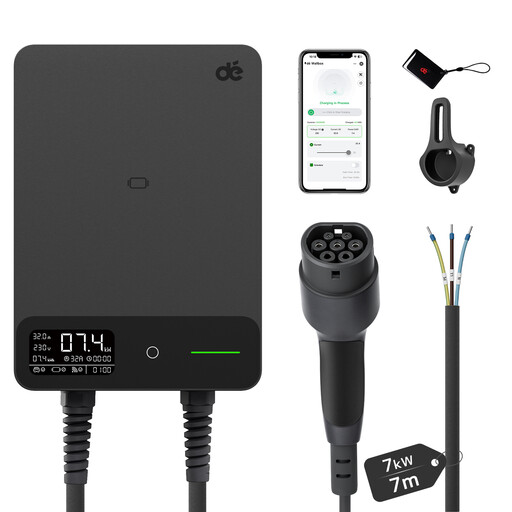
Why it's a perfect match: In a shared car park, access control is non-negotiable. The integrated RFID function ensures that only authorised residents can use the station. Furthermore, the protection provided by a Type B RCD is a compelling argument to reassure the building management about the installation's safety.
It integrates a Type B RCD, one of the most comprehensive protections on the market. This saves you the cost of often expensive external equipment. The RFID function is hardware-based, so there's no risk of a hidden subscription.
Maximum electrical safety and foolproof access management, perfect for shared use.
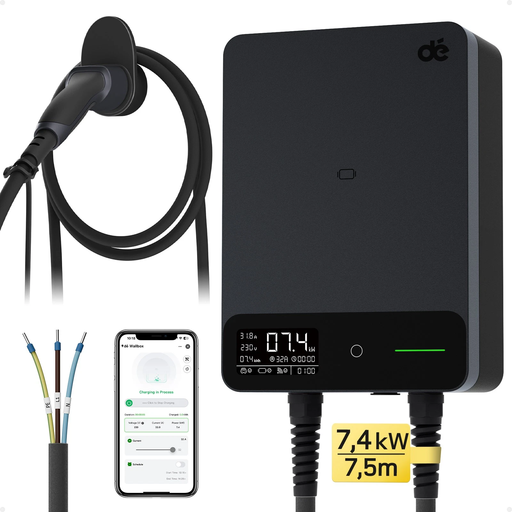
Why it's a perfect match: For a detached house, you want both flexibility and cost optimisation. The long 7.5-metre cable adapts to any garage or driveway configuration. The charger with an app and its delayed start function are perfect for initiating charging during off-peak hours to lower your electricity bill.
This model offers genuinely useful connected features (scheduling, consumption tracking) via a subscription-free app. The integrated protection (Type A + 6mA DC) is clearly specified and more than sufficient for most home installations.
Maximum installation flexibility and smart charging management to control your energy consumption.
Discover our full range of products that meet our strict selection criteria and current safety standards.
A heavy-duty socket (like a Green'up type) delivers about 3.2?kW of power, which is less than half that of a 7.4?kW charging station. In practical terms, for the same battery, the charging time will be more than doubled. The charging station offers far superior comfort and speed, not to mention the increased level of safety thanks to its dedicated electrical line.
For most consumer-grade charging stations, the app's basic features (scheduling, remote start/stop, consumption tracking) are free. However, it's always wise to check this point in the product description before purchasing, as some professional or high-end ecosystems may charge for advanced services.
Yes. Almost all electric and plug-in hybrid vehicles sold in Europe (including the Peugeot e-208, Renault Zoe, Tesla Model 3/Y, and Volkswagen ID.4) use a Type 2 connector for AC charging. A 7?kW (or 7.4?kW) wallbox equipped with this cable is therefore universally compatible.