
Livraison le jour même ou le lendemain

Qualité garantie

Débloquez vos offres de bienvenue: Livraison GRATUITE | Jusqu'à -80 % | 30 jours d'essai gratuits à JoyPlus
Téléchargez l'application
Drying, curling, straightening and adding volume with a single device can simplify your hair-care routine. However, the claims made by 7-in-1 hair multistylers can be difficult to compare: advertised speed, ionic technology, the Coanda effect, “professional” accessories and intelligent temperature control are just some of the features to consider.
To choose a device that genuinely suits your routine in France, it is better to look beyond the number of attachments. Airflow, settings, weight, maintenance and electrical compatibility all have a direct impact on everyday comfort.
A device may be marketed as a 7-in-1 hot-air brush, even though not all of its functions will necessarily be useful to you. Check the contents of the box carefully: two curling attachments for opposite directions, a smoothing brush, a volumising brush, a diffuser, a concentrator and a drying attachment all serve different purposes.
A kit with interchangeable attachments is only worthwhile if the attachments are easy to install, remain securely in place and can be stored conveniently.
Motors advertised at 110,000 or 130,000 rpm attract attention, but this figure alone does not predict drying time. Airflow, nozzle design, hair length and hair density are equally important.
Higher power can speed up drying, but it cannot replace precise controls. For fine, damaged or curly hair, the ability to lower the temperature is particularly important.
An ionic hair dryer may help reduce static electricity, depending on the device’s design and the nature of your hair. This does not mean that heat is harmless, however.
An air styler with a Coanda effect uses airflow to draw a section of hair around the barrel. This approach may reduce the need for extremely high heat, but the result depends on residual moisture, section size and styling technique. Claims such as “no damage” or “without extreme heat” should therefore be viewed with a degree of caution.
For everyday use, choose a device with several temperature and speed levels. The MOVA Master 10, for example, advertises 4 heat settings, 3 airflow speeds and a cool-air function. This combination makes it possible to adapt the device for drying, straightening and styling.
Cool air is particularly useful for cooling a section after using the brush or barrel. It can help set the shape, although it does not guarantee long-lasting hold.
Attachments should remain securely locked in place during use. Quick-release or magnetic systems make switching between attachments easier, but it is still essential to turn the device off and allow it to cool before handling a hot attachment.
For creating curls, two barrels designed for right- and left-facing curls are practical. To add volume, a round or oval brush provides greater lift at the roots. A diffuser is more suitable for wavy or curly hair, while a concentrator is ideal for targeted drying and brush styling.
A multifunction device may be heavier than a conventional hair dryer. Check its weight, grip and cable length. The air-intake filter should also be easy to clean regularly to maintain airflow and prevent dust from building up.
In France, also check compatibility with the domestic power supply, the applicable compliance information and the contact details of the responsible party established in the European Union. Never use an electrical appliance near a sink or bathtub, or with wet hands.
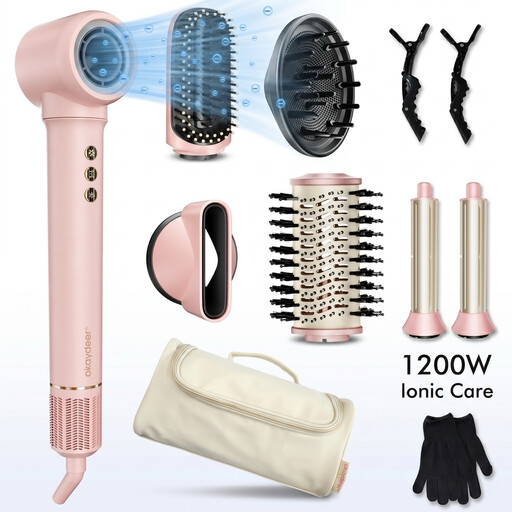
Why it suits this profile: A complete kit for anyone who wants to try drying, curling, straightening and volumising at home without investing in several separate devices.
The product listing details the included attachments, the two curling directions, 3 temperature levels and 2 speed settings.
A kit with a storage case, volumising brush, diffuser, concentrator and automatic curling barrels.
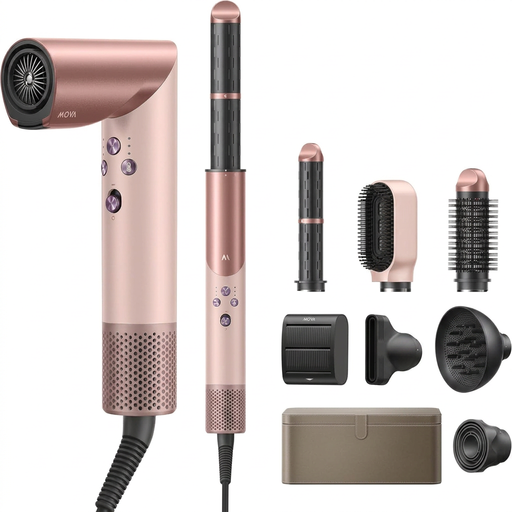
Why it suits this profile: Designed for people in a hurry who want to move from drying to styling with a single device and customisable, memorisable settings.
The product listing mentions attachment recognition and mode memory, along with 4 temperature settings and 3 speed levels.
Advertised motor speed of 110,000 rpm, 1,600 W of power, a 2.8 m cable and a cool-air function.
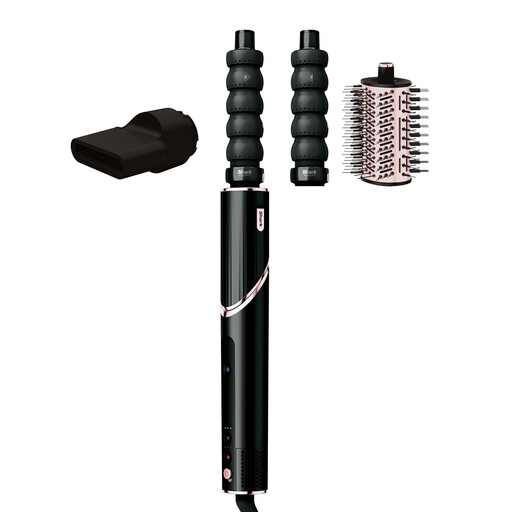
Why it suits this profile: Its convertible design is ideal for anyone who wants to switch between a hair dryer, soft curls and a voluminous blow-dry, including while travelling.
The handle converts according to the selected mode, while the attachments are clearly listed: two barrels, an oval brush and a concentrator.
Advertised power of 1,650 W, listed weight of 700 g and intelligent heat measurement according to the product listing.
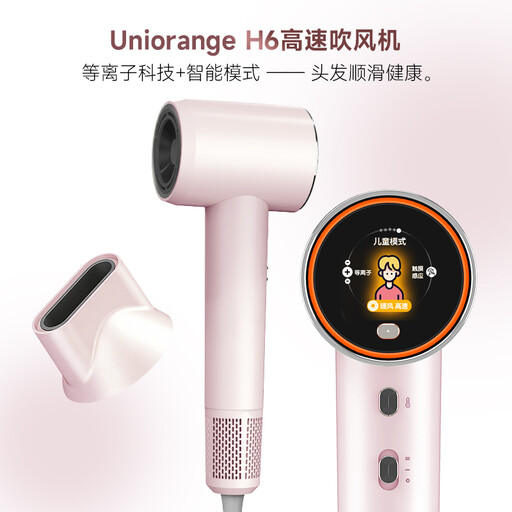
Why it suits this profile: It is aimed at people who prioritise drying and want to monitor the settings on a display, with several preset modes.
The product listing details 5 modes, an LCD screen, a grip sensor and a concentrator.
1,600 W of power and an advertised motor speed of 110,000 rpm. Claims relating to ionic technology should be regarded as features stated by the brand.
We have put together an up-to-date selection of products and accessories to help you find the right solution for your needs more easily.
It can combine the main functions of a hair dryer and styling tool, but results depend on the airflow and attachments. For very thick hair, prioritise power, the number of speed settings and the inclusion of a concentrator.
Not always. Some models are designed for damp or towel-dried hair, while other attachments—particularly curling barrels and heated brushes—may require dry hair. Always consult the instructions for your chosen model.
Consumption depends on the wattage and operating time. A 1,600 W device used for ten minutes consumes approximately 0.27 kWh. To estimate the cost, multiply this consumption by the rate specified in your electricity contract. Faster drying may reduce operating time, but it does not automatically guarantee savings.