
Livraison le jour même ou le lendemain

Qualité garantie

Débloquez vos offres de bienvenue: Livraison GRATUITE | Jusqu'à -80 % | 30 jours d'essai gratuits à JoyPlus
Téléchargez l'application
Juggling the charger for your MacBook, your iPhone 15, and your tablet is a constant headache. Your bag is drowning in a tangle of cables and adapters, and finding a free outlet for each device is a feat in itself. The solution? A single 67W USB-C charger capable of powering everything at top speed. But be warned: the market is saturated with promises that often fall short.
As a product expert at Joybuy, my mission is to help you see things more clearly. Together, we'll break down the three most common traps and the essential criteria for making an informed choice, without drowning you in marketing jargon.
To avoid making a mistake, focus on these few technical characteristics. They are what truly separate a gadget from a long-term investment.
The term 67W GaN charger is everywhere now. GaN, or gallium nitride, is a next-generation semiconductor that is replacing traditional silicon. In practical terms, it allows for the design of chargers that are:
A GaN charger is therefore the logical choice for anyone seeking portability without sacrificing performance.
A good multi-port fast charger does more than just crudely split its total power. It distributes it intelligently. Before buying, scrutinize the spec sheet to understand the exact power allocation. For example, a quality 67W charger should be able to guarantee:
This information is critical to ensure your most power-hungry devices always get the juice they need.
Most recent devices, with the iPhone 15 leading the pack, use USB-C and the Power Delivery (PD) protocol for fast charging. Make sure your future charger offers at least one, or even two, PD-compatible USB-C ports. The presence of a USB-A port remains a welcome bonus for older accessories (smartwatches, headphones, etc.).
Rather than a random laundry list, we've selected products for specific use cases. The goal is to help you find the charger that fits you.
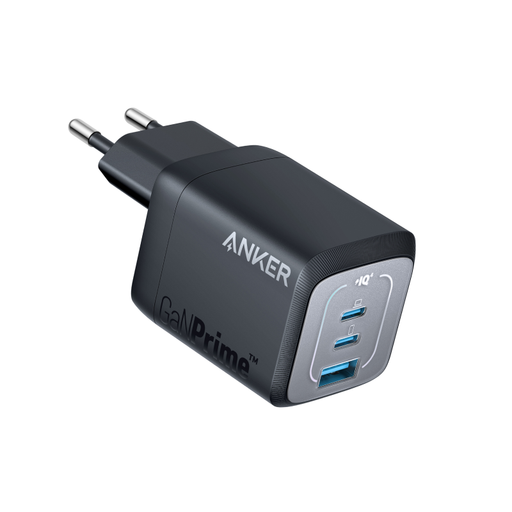
Why we chose it: The perfect ally for those who've made the world their office. It can simultaneously charge a laptop, a smartphone, and a tablet, all while being 51% smaller than the original 67W MacBook charger, according to Anker.
Its spec sheet is crystal clear: 67W on a single port and up to 65W in dual-port mode, which ends the ambiguity around power distribution. Its GaN technology, coupled with ActiveShield 2.0, ensures controlled thermal management despite its pocket-sized format.
Maximum versatility with 2 USB-C ports and 1 USB-A port in an ultra-portable, foldable design.
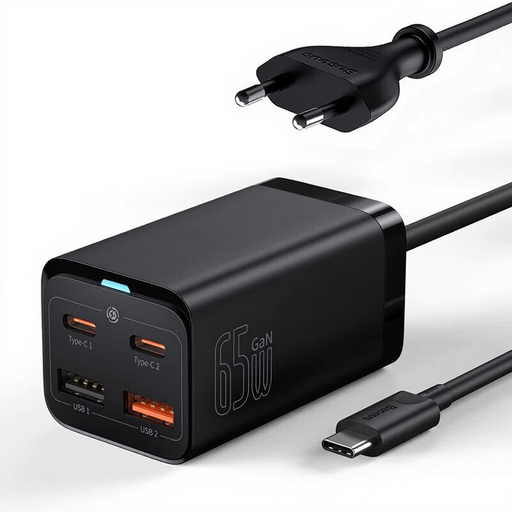
Why we chose it: The perfect solution to declutter your desk. This charging station replaces a power strip and multiple adapters thanks to its 4 ports (2 USB-C, 2 USB-A) and its long 1.5m power cable.
Its desktop station format is designed for heavy use and superior heat dissipation, which eliminates the overheating risk typical of ultra-compact wall chargers when under heavy load.
A powerful, centralized command center for a pristine desk, capable of charging 4 devices at once.
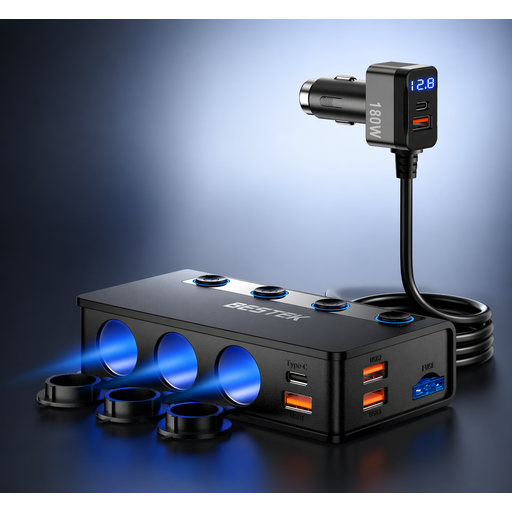
Why we chose it: Essential for those who live on the road or go on family road trips. This hub transforms a single cigarette lighter socket into a power station, capable of powering a laptop at full speed.
It knocks out anemic car chargers. Its 65W PD USB-C port provides enough power to efficiently charge a laptop, whereas conventional adapters struggle just to maintain the battery level.
The power of a desktop charger (65W PD) in your car, with the bonus of 3 cigarette lighter sockets and 5 other USB ports.
We've compiled a complete, up-to-date list of products that meet our strict selection criteria and current safety standards.
No, there is absolutely no risk. Modern chargers equipped with Power Delivery (PD) technology are smart. They communicate with the connected device to provide only the maximum power it can safely accept. Therefore, plugging a 67W charger into a smartphone designed for 20W is completely safe and will not damage its battery.
Yes, and this is a crucial point. To take advantage of power greater than 60W, it is essential to use a USB-C to USB-C cable rated for 100W. These cables include an electronic chip (called an "E-Marker") that authorizes the charger to send a high current. With a standard cable, even the best 67W charger will be throttled.
At the same power output, a GaN charger will be significantly smaller and lighter than a traditional silicon-based charger. It will also run much cooler because its energy efficiency is far better. For mobile use, the savings in size and weight are a considerable advantage.